DbcultAccessing Vault...
Cult Review
Senior Film Conservator
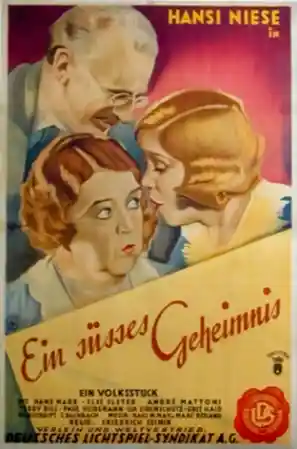
Look, if you hate old black-and-white comedies where people shout for no reason, you should probably skip this one. But if you want to see what passed for a good time in 1932 Berlin, it's actually a pretty decent ride.
I wouldn't call it a masterpiece like The Gold Rush, but it has this manic energy that keeps you from checking your phone. It’s mostly worth watching for Hansi Niese, who is basically a human whirlwind in every scene she’s in.
The plot is about a secret—a 'sweet' one, obviously—and it involves a lot of people getting into arguments in very small rooms. I’m pretty sure the script was just a series of instructions for the actors to look mildly inconvenienced while talking over each other.
The sound quality is a bit crunchy, like someone is eating chips right next to the microphone. You can tell they were still figuring out how to record voices without catching every single footstep on the floorboards.
She is the only reason this movie works. She has this way of looking at the other actors like they are all slightly dim-witted children, and it's honestly hilarious.
There is one scene where she’s trying to explain something, and she just gives up halfway through and waves her hands around. I felt that in my soul.
The rest of the cast, like Teddy Bill and André Mattoni, are fine, I guess. They mostly just stand around and wait for Hansi to stop talking so they can get their lines in.
Compared to something like Rose-Marie, this feels much more grounded and less like a stage play, even though it's still very loud. It has that early 1930s vibe where everyone is dressed in suits but behaves like they're at a frat party.
The sets look like they would fall over if someone sneezed too hard. There’s a door in the main office that looks like it's made of actual cardboard.
I noticed a guy in the background of one shot who just stares at the camera for about five seconds before realizing he's on screen. It’s the kind of mistake you just don't see anymore, and it makes the whole thing feel more human.
The music is also very 1930s. It’s bubbly and happy even when people are supposedly upset, which gives the whole film a surreal, dreamlike quality.
I think the writers, Michael Feuerstein and Jacques Bachrach, were just trying to fit as many jokes as possible into 80 minutes. Not all of them land, but the ones that do are surprisingly sharp for being nearly a century old.
It’s definitely better than some of the drier stuff from that era, like maybe The Pillory, which takes itself way too seriously. This movie knows it's a bit of a mess and just leans into it.
There’s a strange moment near the middle where the camera just stays on a telephone for a long time. I think they forgot to cut the scene, but the silence is actually quite nice after all the yelling.
I wouldn't say this is 'important' cinema. It's more like a snack—light, sweet, and you'll probably forget the details by tomorrow morning. 🥨
If you're into the history of German film, though, you’ll find some interesting bits here. It’s a glimpse into a world that was about to change forever, but for these 80 minutes, everyone is just worried about a silly little secret.
The way Hansi Niese holds her purse like it’s a lethal weapon. It’s terrifying.
There is a lot of smoking. Like, a lot of smoking. I think the air on set must have been grey.
One of the actors keeps adjusting his tie every time he enters a room. It’s a weird tick that becomes distracting after the third time.
The ending comes out of nowhere. It’s like they ran out of film and just decided to stop.
Is it a classic? Probably not. But it’s got personality, and I’d take that over a polished, boring modern comedy any day of the week.
IMDb —
1924
Community
Log in to comment.