DbcultAccessing Vault...
Cult Review
Senior Film Conservator
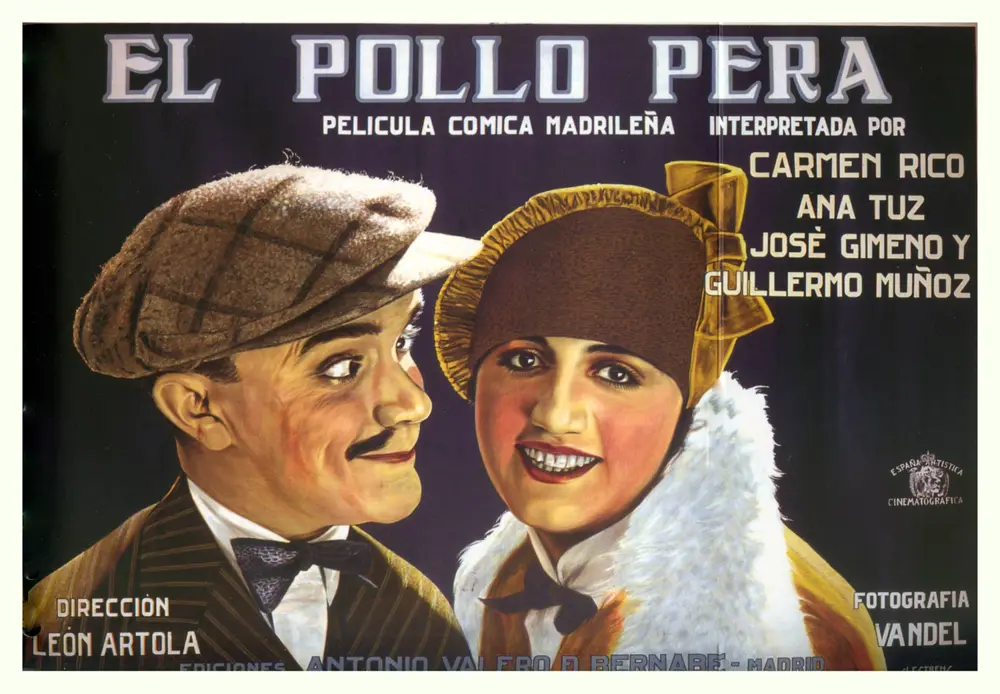
“El pollo pera” is a curious artifact, a short, sharp burst of early cinematic absurdity that, for all its primitive charm, feels distinctly dated. It's not a film I'd recommend for casual viewing unless you possess a genuine, almost academic, interest in the origins of screen comedy and don't mind a good deal of stiff, repetitive physical humor. For those seeking pure entertainment, you’ll likely find its gags thin and its pacing uneven, but for students of silent cinema, it offers a fascinating, if sometimes frustrating, glimpse into a nascent comedic sensibility.
This film works because of its singular, bizarre premise and José María Jimeno’s commitment to the bit, however broad. It fails because its humor is largely one-note, stretched thin across its runtime, and its technical execution is rudimentary, even for its era. You should watch it if you appreciate the historical context of early film, enjoy surrealist slapstick, or want to see a foundational piece of Spanish genre cinema. Avoid it if you prefer sophisticated humor, fast-paced narratives, or anything that doesn't require a generous suspension of modern comedic expectations.
León Artola’s “El pollo pera” hinges entirely on its ludicrous title. A chef, Anselmo (José María Jimeno), is tasked with creating a ‘pear chicken’ for a local dignitary, a misinterpretation that sends him into a spiral of increasingly frantic, nonsensical culinary attempts. Jimeno, with his wide eyes and flailing limbs, embodies the panicked cook with an energy that is undeniably present, if not always refined. His performance is a relentless exercise in broad physical comedy: he trips, he slips, he wrestles with poultry, and his facial contortions telegraph every moment of his escalating despair. It’s the kind of performance that feels less like acting and more like a human cartoon, which, for a film of this vintage, is precisely the point. The film is a one-man show, with the supporting cast—Carmen Rico, Eduardo Prados, Ana Tur—largely serving as bewildered spectators to Jimeno's escalating chaos, their reactions often more understated and therefore more genuinely amusing than the main event.
Artola’s direction is straightforward, almost clinical, in its presentation of the gags. The camera is largely static, observing the unfolding pandemonium from a respectful distance. This framing choice sometimes works against the film, flattening the energy of Jimeno’s performance. There are moments where a closer shot or a more dynamic edit could have amplified the comedic impact, but Artola seems content to let the action play out in medium shots, trusting the inherent absurdity to carry the scene. The kitchen, a set that begins tidy and ends in utter disarray, becomes a character in itself, slowly accumulating a layer of flour, feathers, and fruit. The transformation of this space is perhaps the most satisfying visual arc in the entire film.
The pacing is where “El pollo pera” stumbles most significantly. The initial premise is amusing, but the film commits to it with a stubbornness that borders on masochistic. We see Anselmo try to graft pears onto chickens, try to feed pears to chickens, try to *become* a pear-chicken himself—the variations are few, and the joke quickly loses its fizz. There’s a distinct lack of escalation in the comedic beats; each attempt feels like a repetition rather than a build-up. A silent film relies heavily on visual inventiveness and a tight rhythm, and while the inventiveness is there in concept, the execution often feels like a series of disconnected sketches rather than a cohesive, accelerating narrative. It feels long, despite its short runtime.
The film’s tone is pure, unadulterated farce, but one that occasionally dips into the genuinely surreal. The idea of a ‘pear chicken’ is so inherently bizarre that it lends the proceedings an almost dreamlike quality. There’s a subtle, unsettling undercurrent to Anselmo’s increasingly desperate attempts, as if he’s trapped in a culinary nightmare from which he cannot escape. This slight hint of the uncanny, however, is rarely leaned into. Instead, Artola pulls back, preferring predictable slapstick over the more unsettling possibilities of his premise. This is a missed opportunity, I think. Imagine the psychological toll of such a task, the chef driven to madness by the impossible request. Artola keeps it light, which is fine, but it leaves you wondering what a more daring filmmaker might have done.
The ending, a chaotic presentation that somehow pleases the mayor, feels less like a clever resolution and more like a shrug. It’s a convenient wrap-up, allowing the film to conclude on a note of ironic satisfaction without truly earning it. The humor here relies on the audience’s awareness of the mayor’s arbitrary tastes, but the film doesn't really build up his character enough for this to land with any real punch. He is simply a plot device, a catalyst for Anselmo's suffering. A more robust characterization of the mayor could have elevated the entire enterprise, giving the final gag a much-needed foundation.
There's an argument to be made that to properly appreciate a film like "El pollo pera," one must approach it with a specific historical lens, forgiving its technical limitations and its broad humor. While true to a point, this doesn’t entirely absolve the film of its dramatic weaknesses. The simplicity, which some might laud as charming, often translates to a lack of genuine comedic invention beyond the initial setup. The film is a document of its time, showcasing a particular strain of early Spanish comedy, but it rarely transcends its archival status to become genuinely funny for a contemporary audience. Its appeal is more intellectual than visceral. It's not a bad film, it's just a limited one.
“El pollo pera” is a film best approached as a historical curiosity rather than a laugh-out-loud comedy. Its peculiar premise provides a solid foundation, and José María Jimeno throws himself into the role with admirable gusto. However, the film struggles to develop its initial joke beyond simple repetition, leading to a comedic experience that, while occasionally charming, often feels laborious. It's a valuable piece for understanding the landscape of early cinema, particularly in Spain, but it does not transcend its age to become a universally engaging piece of entertainment. Watch it for its place in history, not for belly laughs.
IMDb —
1936
Community
Log in to comment.