DbcultAccessing Vault...
Cult Review
Senior Film Conservator
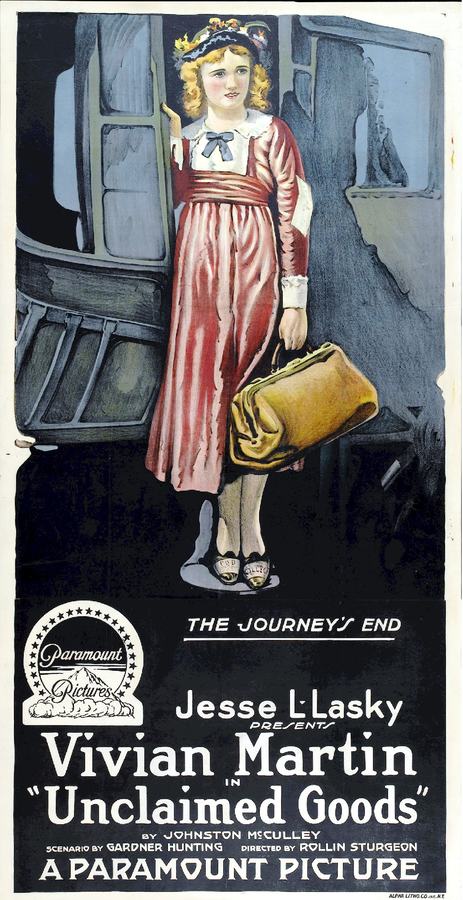
Stepping back into the flickering shadows of 1915, one encounters *Unclaimed Goods*, a silent film that, despite its century-plus vintage, resonates with a profound emotional depth and a startlingly unique premise. This isn't just another Western drama; it's a stark, almost allegorical exploration of human desperation, corporate responsibility, and the unwavering spark of morality in an unforgiving world. The film, penned by the imaginative duo of Johnston McCulley and Gardner Hunting, presents a scenario so audacious it immediately seizes the viewer's imagination: a father, facing an insurmountable financial chasm, resorts to shipping his own daughter via Wells Fargo & Co. Express, treating her as mere cargo in a desperate bid for a better life. This central conceit alone ensures *Unclaimed Goods* carves out a distinct niche in the annals of early cinema, inviting us to ponder the very fabric of human value against the backdrop of burgeoning American capitalism.
The film's audacious core — the packaging and shipping of a living, breathing child — immediately throws the audience into a maelstrom of ethical and emotional questions. It's a testament to the writers' daring vision that they dared to present such a concept, forcing viewers to confront the brutal realities of poverty that could drive a parent to such an extreme. In an era before robust social safety nets, when train tickets were a luxury and migration a necessity, the idea, while shocking, speaks volumes about the lengths to which individuals would go for survival. Wells Fargo, then a dominant force in American logistics, becomes more than just a backdrop; it's an unwitting participant in a deeply human drama, its corporate machinery suddenly imbued with the weight of a young girl's fate. This narrative choice elevates the film beyond a simple melodrama, imbuing it with a raw, almost documentary-like feel, despite its fictionalized plot. It forces us to consider the often-unseen human cost of progress and the sometimes-inhumane efficiency of burgeoning industries.
At the heart of *Unclaimed Goods* lies a quartet of archetypal figures, each embodying distinct facets of human nature under pressure. The desperate father, whose love for his daughter is so profound it compels him to such an unorthodox act, is a figure of immense pathos. His initial choice, born of necessity, sets in motion a chain of events that exposes the vulnerability of innocence and the predatory nature of greed. Vivian Martin, as the young girl, delivers a performance that, even through the lens of silent film conventions, conveys a remarkable sense of innocence and fragility. Her wide-eyed bewilderment and quiet resilience become the emotional anchor of the film, drawing the audience into her terrifying predicament. The villain, portrayed with chilling efficiency by Dick La Reno, is a masterclass in silent film villainy – his sneering countenance and avaricious gaze leave no doubt as to his nefarious intentions. He is the embodiment of opportunistic evil, preying on the weak and exploiting misfortune for personal gain. His attempt to claim the girl, transforming her from a package into a pawn, is a truly sinister turn that ratchets up the tension considerably.
Standing as a bulwark against this encroaching darkness is the Wells Fargo agent, played by the distinguished Harrison Ford (and it is crucial to note, this is the prolific silent film actor Harrison Ford, born in 1884, not the modern-day action star). His portrayal is one of quiet integrity and unwavering resolve. Ford’s agent is not a swashbuckling hero in the traditional sense, but rather a man of keen observation and profound ethical conviction. He represents the nascent ideals of corporate responsibility, a figure who recognizes that his duty extends beyond the mere handling of parcels to the protection of the innocent. His journey from a diligent employee to a compassionate guardian forms the moral backbone of the narrative. The film effectively uses his character to explore themes of duty, empathy, and the individual's power to intervene against injustice. His eventual decision to 'claim' the girl himself, not as property but as a ward, is a powerful moment of redemption and human connection, transforming a commercial transaction into a profound act of guardianship.
While the directorial credit for *Unclaimed Goods* is often attributed to Frank Borzage, the film’s narrative strength undeniably stems from the inventive minds of Johnston McCulley and Gardner Hunting. McCulley, of course, would later gain enduring fame as the creator of Zorro, and one can discern glimmers of his talent for crafting compelling, morally driven narratives even in this earlier work. The screenplay for *Unclaimed Goods* is remarkably tight, building suspense through a series of escalating complications. The visual storytelling, characteristic of the silent era, relies heavily on expressive acting, dramatic staging, and the strategic use of intertitles to convey dialogue and crucial plot points. The cinematography, though rudimentary by today's standards, effectively captures the starkness of the landscape and the claustrophobia of the Wells Fargo office, juxtaposing the vastness of the American West with the intimate, high-stakes drama unfolding within confined spaces. The pacing, while deliberate, never falters, drawing the audience deeper into the plight of the young girl and the unfolding cat-and-mouse game between the villain and the agent. The film's ability to maintain tension and emotional resonance without spoken dialogue is a testament to the skill of its creators and performers.
*Unclaimed Goods* sits comfortably within a broader tradition of early cinema that explored themes of vulnerability, particularly that of women and children, and the dramatic tension of rescue. The idea of an innocent individual being treated as property or facing exploitation was a potent narrative device. One might draw thematic parallels to films like Den kulørte slavehandler (The Colored Slave Dealer), which, while dealing with a far more egregious form of human commodification, shares a core concern for individuals reduced to mere 'goods' within an exploitative system. The sense of a young life hanging in the balance, subject to the whims of cruel individuals, is a common thread that resonates across these early cinematic works. Similarly, the desperate circumstances faced by the father might evoke the struggles depicted in films such as Le roman d'un caissier (The Story of a Cashier), where financial hardship drives the plot, albeit with different outcomes.
The film’s dramatic structure, pitting a clear villain against a morally upright hero in a bid to save an innocent, is also a classic trope of the era, seen in numerous melodramas and action films. The tension of a looming threat and the eventual triumph of justice can be glimpsed in the dramatic arcs of films like Within the Law, which often explored the thin line between legal and moral justice, or even the more action-oriented The Two Sergeants, where heroism is defined by selfless acts in the face of danger. *Unclaimed Goods* distinguishes itself by centering its conflict on such an unusual object of contention—a child as 'unclaimed goods'—thereby imbuing the familiar struggle with a fresh, startling poignancy. It highlights the stark realities of a burgeoning nation, where the lines between human compassion and commercial transaction could become terrifyingly blurred.
More than a century after its release, *Unclaimed Goods* remains a compelling piece of cinematic history, offering a window into the narrative sensibilities and social anxieties of its time. It’s a powerful reminder of an era when stories had to be told with visual flair and raw emotional honesty, without the crutch of dialogue or complex special effects. The film’s exploration of desperate paternal love, the callousness of greed, and the quiet heroism of an ordinary man transcends its silent film origins, speaking to universal themes that continue to resonate. The sheer audacity of its central premise ensures its memorability, positioning it as a fascinating artifact for scholars of early American cinema and a surprising treat for modern viewers willing to engage with its unique charms. It prompts us to consider how far society has come in protecting its most vulnerable, and perhaps, how much remains unchanged in the eternal struggle between good and evil, compassion and avarice. Its ingenuity lies not just in its plot, but in its ability to evoke profound human feeling through the simplest of gestures and the most dramatic of silent expressions, securing its place as a minor but significant classic.

IMDb —
1918
Community
Log in to comment.