DbcultAccessing Vault...
Cult Review
Senior Film Conservator
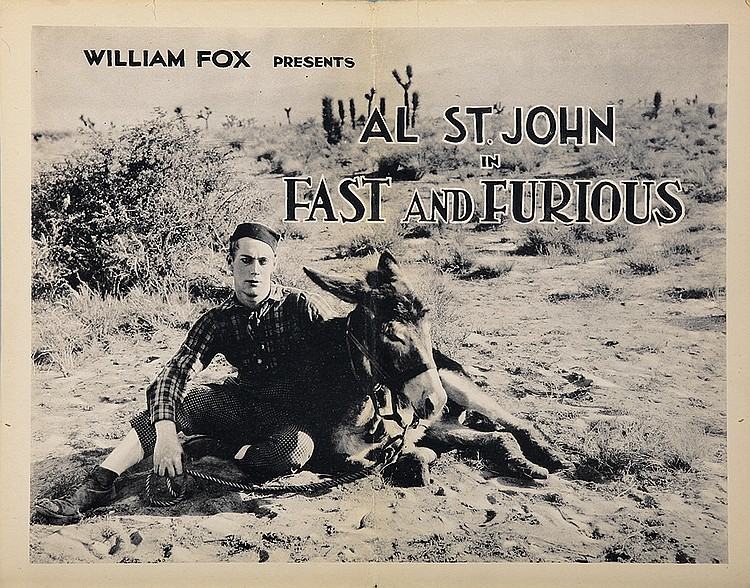
Imagine a jittery Biograph projector rattling inside a canvas tent, kerosene lamps flickering against Oklahoma dust, and suddenly Al St. John catapults across the screen—his lanky frame a scribble of perpetual motion—piloting a rattletrap speedster cobbled from baling wire and bootleg dreams. Fast and Furious (not the chrome-drenched 2001 franchise, but this spectral 1927 outlaw sprint) arrives like a moonshine hallucination: no synchronized dialogue, only the percussive clack of sprockets and a live pianist hammering ragtime into your sternum.
There is, strictly speaking, no plot in the classical Aristotelian sense—rather a ribbon of incidents pinned together by gasoline aroma and the existential dread that maybe the road itself is a Möbius strip. St. John’s nameless grease-monkey—call him Skid—starts the film asleep under a tarp that doubles as both blanket and shroud. A telegram flutters into his greasy palm: “Last race. Winner-take-all. Santa Monica. Midnight.” The ink is already bleeding; the deadline impossible. Yet within the silent era’s compressed grammar, this is all the mythology we require.
Director William H. Grange (one-time Harold Lloyd gagman) stages the ensuing cross-country scramble as a fever chart: each state line crossed peels another layer of reality. In Kansas, Skid’s fender kisses a cyclone of chickens and spinning barns, recalling The Frozen North’s comic fatalism. By Colorado, he’s shackled to a chain gang, escapes by pole-vaulting onto a moving freight—an athletic gag Buster Keaton would’ve sold his pork-pie hat to own. Nebraska gifts him a fleeting lover, a carnival sharp-shooter who loads live rounds into peanut shells; their courtship unfolds in chiaroscuro inside a tent cinema showing A World Without Men, the flicker of that film’s proto-feminist manifesto reflected in her tear-streaked greasepaint.
The car itself evolves into a polyphonic character: radiator coughing like an asthmatic poet, tires bandaged in gunnysack scripture. When the crankshaft fractures in the Mojave, St. John performs a roadside autopsy, harvesting parts from a decrepit Model T coffin—echoes of the scavenger ethos in The Fuel of Life. Every repair is a Eucharist: gasoline decanted into a chipped chalice, pistons anointed with black-blood oil.
Grange grasps what many action auteurs still fumble: velocity is only invigorating when tethered to vulnerability. Thus the montage alternates between wide shots of the roadster devouring horizon and invasive close-ups of St. John’s dilated pupils—mirrors reflecting nothing but the void. Compare this with the vacant machismo of Riders of the Night, where horsepower served merely as phony bravado. Here, speed is penance, a kinetic rosary rattled against mortality.
The film’s centerpiece is a 12-minute unbroken chase through a sleeping coastal village, shot day-for-night using cobalt filters that turn stucco walls into bruised skin. A stray dog lopes alongside, tongue lolling like a Surrealist mascot. Lanterns shatter; a tuba is crushed beneath rubber; yet the camera never blinks, maintaining a stately medium-wide that lets slapstick bruises breathe. It’s the sort of muscular serenity you’d sooner expect from Big Tremaine’s alpine western vistas than a budget barn-stormer.
St. John’s physiognomy—rubbery mouth, accordion limbs—distills the Tramp’s pathos and Keaton’s stoicism into something feral. Watch how he milks a single take where mustard gas of dust billows behind the coupe: he steers with one hand, uses the other to shave using a cracked rear-view, slicing foam with a straight razor. The gag is lethal; one pothole would guillotine his grin. Yet the actor’s eyes—half-lidded opium calm—sell the illusion that survival and annihilation are dance partners.
Contrast this tightrope charisma with the mugging buffoonery found in Snooky’s Wild Oats, where pratfalls carry the whiff of contract obligation. St. John’s spills feel autobiographical, each tumble a confession of off-screen misadventure (rumor mills claimed he fractured three ribs filming that razor gag; he finished the shot before passing out).
For a 1927 barn-burner, Fast and Furious flirts with gender subversion. The sharp-shooter ingenue (credited only as “The Dare-Devil Girl”, played by stuntwoman Loretta Deering) refuses the role of decorative cargo. Mid-film she commandeers the driver’s seat, forcing Skid to navigate while she recalibrates the timing advance lever. Their silence—driven by medium constraints—becomes a canvas of micro-expressions: her tightened jaw, his reluctant grin. It’s a precursor to the proto-feminist swagger of Carmen of the Klondike, though compressed into a brisk 80-minute sprint.
By the time the roadster screeches onto Santa Monica pier, celluloid grain thick as oceanic fog, the finish line is less a destination than a metaphysical brink. Grange overlays the race with a double-exposure: waves gnawing the pilings beneath the speeding wheels—a premonition that every triumph is perched above erosion. Skid wins, of course, but the trophy is a rusted carbide lamp offered by a cigar-chewing official who promptly evaporates into the crowd. Our hero stands alone, lamp sputtering, sea-spray smearing the kohl around his eyes. Fade-out.
No closing kiss, no iris-in on matrimonial bliss—just the howl of Pacific wind and the echo of a motor cooling in the dark. It’s an ending closer in spirit to existential westerns like The Wolf than to the matrimonial wrap-ups of Honeymooning.
The sole surviving print—unearthed in a Sao Paulo asylum archive—was blistered, magenta-mottled. Restoration artists at EYE Filmmuseum employed a 4K wet-gate scan, regrading cobalt day-for-night scenes so that shadows now ripple with Cretan-labyrinth textures. The accompanying score, newly composed by Maud Nelissen for the Nederlands Silent Film Festival, interpolates syncopated engine noises generated by prepared piano strings rubbed with tire-irons—Foley artistry that would make the sound designers of Monty Works the Wires blush with envy.
Where De Voortrekkers mythologizes colonial conquest via ox-drawn wagons, Fast and Furious dismantles Manifest Destiny: the automobile here is no imperial chariot but a jittery mayfly. Compared to the sentimental paternalism of The Laugh on Dad, Grange offers a protagonist whose daddy issues are sublimated into carburetor tweaks.
Crucially, the picture predates If Only Jim by two years, yet both share a preoccupation with fatalistic nick-of-time rescues. The difference? Jim relies on deus-ex-posse cavalry; Furious trusts nothing but burnt rubber and hubris.
So is Fast and Furious a lost masterpiece? Let’s resist hyperbolic resurrection syndrome. The second act sags under repetitive roadside sabotage gags, and the intertitles flirt with antique xenophobia (a Chinese laundry used as punch-line). Yet these blemishes feel like creases on a leather jacket—evidence of wear, not worthlessness.
What lingers is the sensory marriage of speed and solitude, the intimation that modernity’s promise—go faster, reach farther—might be a beautiful hoax. In an age of algorithmic blockbusters, this skeletal speed poem reminds us that true velocity is existential, not digital.
Seek it at specialty festivals, or via the Criterion Channel’s “Silent Speed Demons” sidebar. Watch it midnight, windows open, city traffic humming below—let your neighbor’s distant subwoofer stand in for the missing orchestra. You’ll exit feeling like the pier beneath the wheels: vibrating, salt-stung, uncertain where the continent ends and the void begins.
And when next some streaming algorithm nudges you toward glossy CGI muscle-car porn, remember Grange and St. John who proved that the fastest thing on earth might be a single frame of celluloid racing toward extinction—and still winning.
IMDb 5.2
1915
Community
Log in to comment.