DbcultAccessing Vault...
Cult Review
Senior Film Conservator
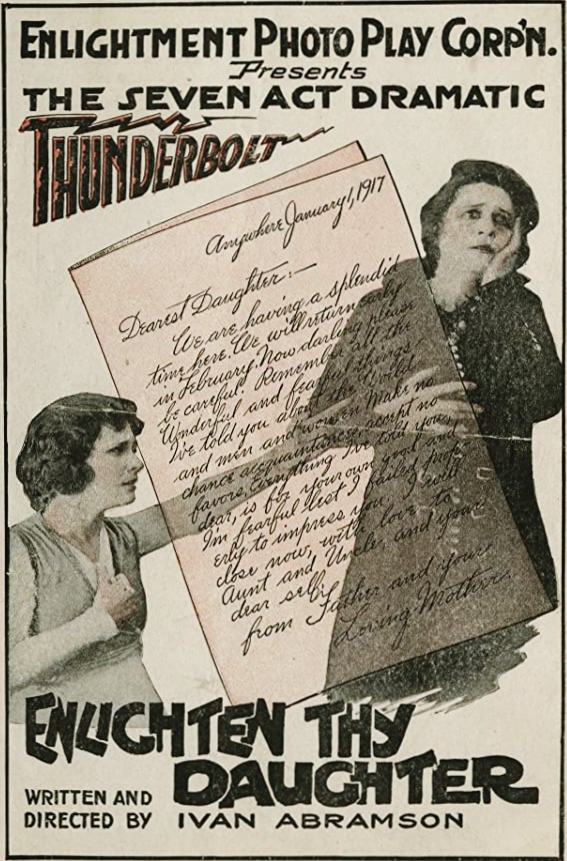
Stepping back into the cinematic landscape of 1917, one encounters a fascinating tapestry of evolving narratives and burgeoning social commentary. Among these, Ivan Abramson’s Enlighten Thy Daughter emerges not merely as a relic of a bygone era, but as a surprisingly potent and prescient exploration of themes that, regrettably, continue to resonate with unsettling relevance today. This isn't just a film; it's a stark, unvarnished mirror held up to societal attitudes regarding female education, parental responsibility, and the perilous journey of innocence in a world often less than benevolent. Abramson, a filmmaker known for his often sensationalist yet morally didactic works, here crafts a narrative that, while perhaps melodramatic by modern standards, possesses an undeniable emotional core and a pointed message.
The premise, at its heart, is deceptively simple: two young girls, their lives diverging dramatically due to the stark contrasts in their upbringing and instruction. Yet, from this foundational dichotomy, Abramson weaves a complex web of cause and effect, illustrating with vivid, almost brutal clarity, what the film itself terms the 'criminal folly' of allowing a young woman to mature into womanhood utterly bereft of essential knowledge concerning her own welfare and happiness. This isn't about mere academic learning; it's about the fundamental truths of life, the realities that equip an individual to navigate the world with agency and self-preservation. It is a profound exploration of the idea that ignorance, far from being bliss, can be a weapon wielded against the innocent, often by those closest to them.
Central to this harrowing narrative is the figure of a mother, portrayed as worse-than-foolish, who, under the misguided guise of protection or perhaps a deeply ingrained societal prudishness, actively keeps her daughter in a state of profound ignorance. This deliberate withholding of vital information creates a vulnerability that is not only tragic but, as the film suggests, morally culpable. The mother’s actions are not born of malice, one might surmise, but rather a catastrophic failure of foresight and a misplaced understanding of what constitutes genuine maternal care. This character’s arc, driven by a desperate desire to shield her daughter from a world she herself likely fears or misunderstands, ultimately becomes the very catalyst for the girl’s undoing. It's a powerful indictment of the kind of 'innocence' that renders one utterly defenseless, a theme echoed in other morally charged narratives of the era, though perhaps rarely with such direct, damning language.
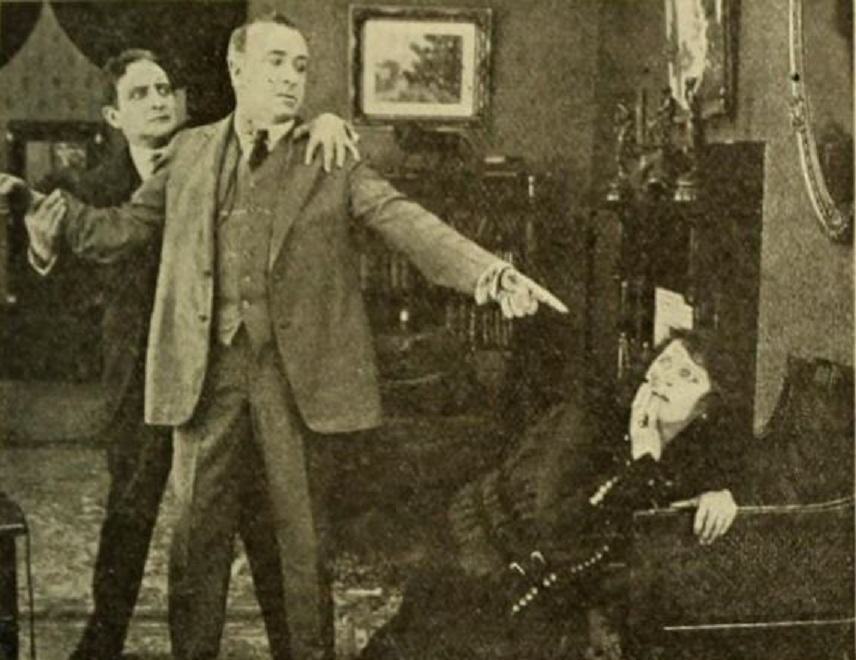
As the inevitable consequences of this willful ignorance begin to manifest, the mother’s panic sets in, leading her down an even darker path. In a desperate, and frankly horrifying, attempt to circumvent the repercussions of her own folly, she places her daughter into the hands of an unscrupulous doctor. This is where the film truly plunges into the abyss of moral compromise. The doctor, far from being a figure of healing and trust, is revealed to be in a chilling partnership with the mother, suggesting a conspiracy of exploitation and manipulation. This unholy alliance between a 'protective' parent and a predatory medical professional elevates the film beyond a simple cautionary tale into a scathing critique of systemic vulnerabilities and the profound betrayal of trust. It highlights how institutions, even those ostensibly dedicated to care, can be corrupted, leaving the most vulnerable utterly exposed. The sheer audacity of this plot point, especially for its time, underscores Abramson’s willingness to tackle uncomfortable truths head-on, even if through the lens of melodrama.
The performances, while often constrained by the acting conventions of the silent era, manage to convey the emotional weight of the narrative. Katharine Kaelred, in particular, as the misguided mother, must navigate a complex emotional landscape, portraying a character who is simultaneously pitiable and reprehensible. Her performance hinges on expressing the inner turmoil of a woman whose good intentions pave a road to hell, a journey from naive overprotection to desperate complicity. Rubye De Remer, likely portraying the daughter kept in ignorance, would have the challenging task of embodying innocence, vulnerability, and ultimately, the crushing weight of betrayal and consequence. Her character's journey is the tragic heart of the film, a testament to the devastating impact of withheld knowledge. The contrast with the other daughter, presumably raised with a more enlightened perspective, would have been crucial, though the plot summary focuses primarily on the tragic trajectory of the ignorant one.
The supporting cast, including Frank Sheridan, Marie Shotwell, James Morrison, Mathilde Brundage, Walter Gould, Violet Horner, Zena Keefe, Arthur Donaldson, and Runa Hodges, would have contributed to the film's dramatic fabric, each playing a role in the unfolding tragedy or its counterpoint. In silent cinema, the power of expression often lay in exaggerated gestures and facial expressions, yet a skilled ensemble could convey nuance even within these stylistic confines. The success of the film's message would have relied heavily on these performances to make the abstract concept of 'ignorance' manifest in human suffering.
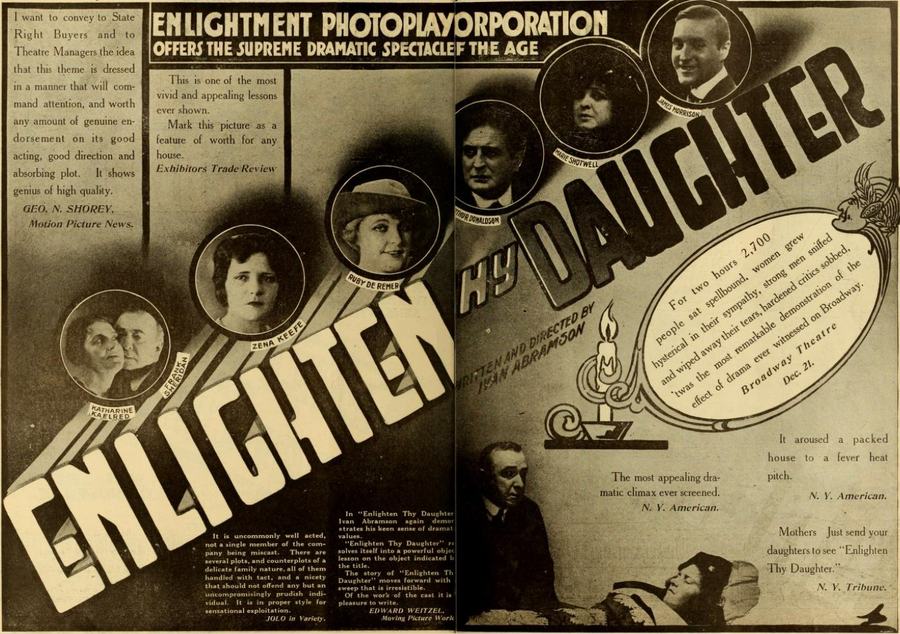
Ivan Abramson’s directorial style, while not always celebrated for its subtlety, was effective in delivering clear moral messages to his audience. He understood the power of visual storytelling to provoke thought and stir emotion, often leveraging sensational elements to draw attention to serious social issues. In Enlighten Thy Daughter, his direction would have been instrumental in crafting the stark contrast between the two girls' lives and emphasizing the 'folly' of the mother's choices. The film's title itself serves as a direct imperative, a call to action for parents and society at large. This didactic approach was common in early cinema, where films often served as moral lessons or public service announcements disguised as entertainment.
The thematic resonance of Enlighten Thy Daughter extends far beyond its specific plot points. It taps into universal anxieties about parental responsibility, the vulnerability of youth, and the societal structures that either protect or endanger individuals. In this regard, it shares a certain kinship with other films of its era that grappled with challenging social norms and the plight of women. One might draw a parallel to the tragic fate depicted in Tess of the D'Urbervilles, where societal strictures and individual innocence clash with devastating results. While Tess's tragedy stems from different sources, the underlying theme of a young woman's destiny being shaped by circumstances beyond her control, and often by the actions or inactions of others, is eerily similar. Similarly, the moralistic tone and focus on female virtue and societal expectations can be seen in films like Should a Wife Forgive?, which also explored the complex moral landscape faced by women in a rapidly changing world.
The film's bold portrayal of an unscrupulous doctor, in league with a mother, is particularly noteworthy. This element introduces a layer of institutional betrayal that elevates the narrative from a personal tragedy to a broader social critique. It suggests that danger isn't always external and obvious, but can lurk within trusted figures and systems. This kind of nuanced, albeit sensationalized, critique of power dynamics and professional ethics was quite progressive for its time. It’s a theme that continues to be explored in cinema, highlighting the timeless struggle against exploitation and the abuse of authority. The notion of a mother actively participating in the placement of her daughter into such a situation is profoundly disturbing, pushing the boundaries of what audiences might have expected from a dramatic feature. It speaks to a certain desperation, a moral panic that overrides even the most fundamental maternal instincts, making the mother a truly complex and tragic figure in her own right.
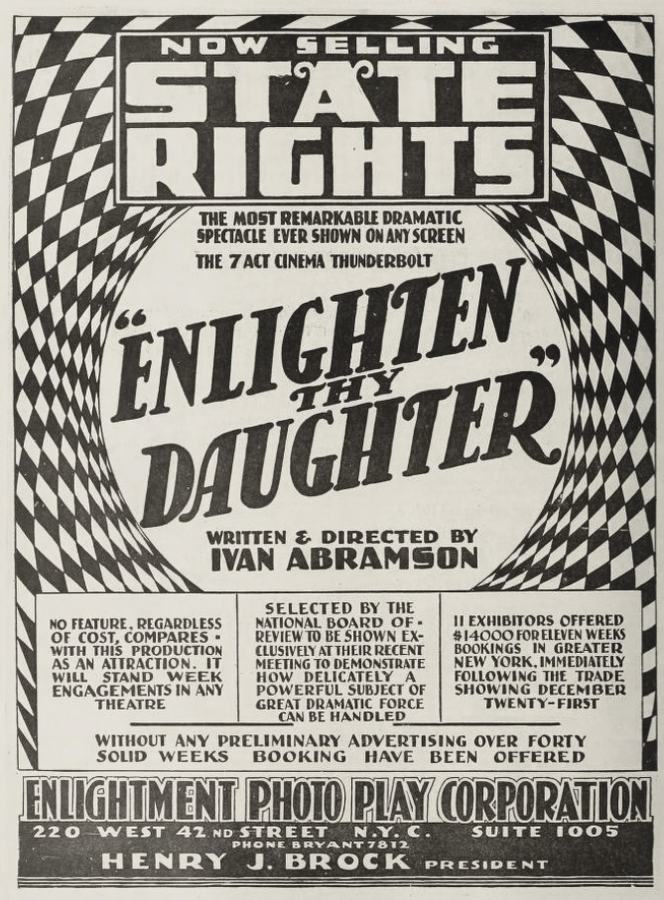
Abramson’s work, while often overlooked in broader cinematic histories, represents an important facet of early American filmmaking. He was a populist filmmaker who understood how to harness the power of melodrama to convey weighty social messages. His films, including Enlighten Thy Daughter, often aimed to provoke discussion and instigate social change by presenting moral dilemmas in vivid, accessible terms. The directness of the film's title itself is a testament to this intention: it’s not just a story, but an admonition, a plea for enlightenment. This didactic approach, while sometimes criticized for lacking subtlety, was undeniably effective in reaching a wide audience and embedding its message within the cultural consciousness of the period. One could argue that this directness is a strength, cutting through the potential for misinterpretation and delivering its message with unequivocal force.
Considering the historical context, Enlighten Thy Daughter was released during a period of significant social upheaval and evolving gender roles. Women were increasingly entering the workforce, advocating for suffrage, and challenging traditional expectations. Films that addressed the education and empowerment of women, even through cautionary tales, were tapping into a very real societal conversation. The film's emphasis on 'knowledge of certain facts essential to her welfare and happiness' can be interpreted broadly, encompassing not just sexual education, but also an understanding of legal rights, financial independence, and personal agency. It’s a powerful argument for equipping young women with the tools they need to navigate a world that was, and often still is, designed with inherent biases and dangers.
While specific cinematic techniques from the silent era, such as intertitles for dialogue and exposition, dramatic lighting, and often symbolic mise-en-scène, would have been employed, the enduring power of Enlighten Thy Daughter lies in its narrative courage. It dared to tackle subjects that were often whispered about, if discussed at all, in polite society. The film’s boldness in portraying the consequences of ignorance and the corruption of trusted figures makes it a significant, if often underappreciated, work in the history of social problem films. It reminds us that cinema, from its earliest days, has been a powerful medium for social critique and a platform for challenging prevailing norms. Even without the sophisticated narrative structures or visual effects of modern cinema, the raw emotional impact and the profound moral questions posed by films like this remain potent.
In conclusion, Enlighten Thy Daughter is more than just a historical curiosity; it is a vital piece of cinematic history that speaks volumes about the anxieties and moral imperatives of its time. It serves as a stark reminder of the enduring importance of knowledge, the profound responsibility of parenthood, and the insidious dangers that can arise from deliberate ignorance. Its unflinching gaze at the 'criminal folly' of keeping young women uninformed, and the subsequent exploitation facilitated by desperation and moral decay, ensures its place as a powerful, albeit often unsettling, work. It compels us to reflect on how far society has truly come in 'enlightening' its daughters, and indeed, all its children, with the essential truths required for a life of welfare and happiness. The film’s message, delivered with the blunt force of early cinematic melodrama, resonates with a timeless urgency, prompting viewers to consider the profound implications of what we choose to teach, and what we choose to withhold, from the next generation. It’s a film that demands to be seen, not just for its historical value, but for its continued relevance in a world still grappling with issues of education, agency, and protection.

IMDb —
1920
Community
Log in to comment.