DbcultAccessing Vault...
Cult Review
Senior Film Conservator
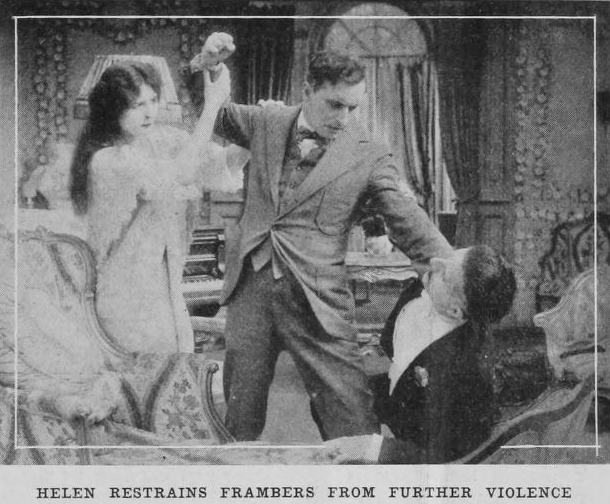
The first time we see Horace Frambers he is counting coins by candlelight, copper discs winking like tiny eclipses on a scarred oak desk. That visual haunts every subsequent reel of Bought, a 1915 one-reel moral firebomb that dares to ask: what remains of a man once he has auctioned the only commodity he truly owns—his name?
Lawrence McCloskey’s screenplay, lean as a breadline yet swollen with implication, lands us inside a Manhattan where grief is denominated in ten-thousand-dollar bills and a woman’s virtue can be repackaged like war bonds. Helen Talbot, porcelain-skinned heiress played by Ethel Grey Terry, arrives veiled in more than mourning crepe; she carries a Titanic-secret pregnancy, the father now a frozen statistic in the North Atlantic ledger. Her own father, a granite banker who signs contracts the way mortals exhale, offers Horace the devil’s bargain: marry the tarnished daughter, inherit a junior seat in the marble colonnade of capital, and pretend the unborn child is legitimate.
Frederick Lewis’s Horace is all angles—high cheekbones, Adam’s apple that bobs like a guilty metronome, eyes flickering between hunger and residual idealism. Watch him in the proposal scene: fingers drumming against his frayed coat seam, calculating not the interest rate on the bribe but the compound shame of accepting it. McCloskey withholds intertitles here; we read only the tremor of a man signing a spiritual IOU.
The wedding is filmed in a single static shot that lasts maybe twelve seconds yet feels like a lifetime. A justice of the peace, two witnesses, Helen’s black silk suit buttoned to the throat like a confession. The camera refuses the close-up; it keeps a middle distance, as though embarrassed to intrude on a sacrament being simultaneously performed and desecrated.
Cut to a nursery glimpsed through lace curtains. The infant—never named, always “the child”—dies off-screen, a narrative choice that spares us Victorian melodrama yet multiplies the dread. The death certificate is the first un-bought thing in the film; nobody profited, nobody arranged it, and therefore nobody knows how to ledger it. Helen’s contempt for Horace metastasizes overnight: she wanted a shield, not a husband. He becomes a walking reminder that her maternal future was bargained away before it ever breathed.
Here the film pivots from social-problem tract to psychological scalpel. Helen starts collecting suitors the way her father collects railway stock—convenient, disposable, accruing value merely by proximity. Horace, meanwhile, metamorphoses inside the Talbot banking house, his quill scratching numbers that resurrect drowning balance sheets. The irony is delicious: the man procured for appearances becomes the only appendage of the empire that actually functions. Mr. Talbot—played by an uncredited actor whose silver beard seems powdered with fiduciary dust—softens, offers paternal smiles, even invites Horace to smoke cigars in the oak-paneled sanctum where defaulted loans are cremated.
But every ledger has a red line. Horace discovers one of Helen’s assignations in the summer house, moonlight striping her chemise like prison bars. Instead of rage we get exhaustion; he places the ten-thousand-dollar check—uncashed, unfolded, as crisp as the day it was drafted—on her vanity. The accompanying intertitle is McCloskey’s most surgical: “I return what was never truly mine, and take back what always was.” He exits—not in storm, but in the quiet click of a door that no amount of money can re-open.
The third act is a fever dream shot almost entirely in chiaroscuro. Talbot’s bank teeters, the panic of 1914 re-imagined through whispered rumors and stock-ticker apostrophes. Horace, now living in a garret that smells of turpentine and TB, learns of the crisis via newspaper ink still wet enough to smudge his fingers black. He returns—not as prodigal son-in-law, but as battlefield medic to capitalism’s self-inflicted wound. Montage of telegrams, midnight oil, adding machines that clack like mechanical hail: the sequence predates Citizen Kane’s famous boardroom collapse by twenty-six years yet equals it in visceral momentum.
Success extracts its pound of flesh. Horace collapses, lungs hemorrhaging the same color as the bank’s crimson ledgers. He expects to die; the camera tilts upward from his cot to a cracked ceiling that looks like a map of nowhere. Enter Helen—hair unpinned, eyes swollen not with contempt but with the foreign salt of remorse. She has tracked him through flophouses and charity wards, clutching the returned check now torn in half, a dowry of failure. The reconciliation is wordless. Director (uncredited, typical for Edison stock) holds a close-up on Terry: the actress lets her lower lip quiver once—just once—before she places Horace’s hand over her heart. Cut to a sunrise that stains the tenement rooftop amber, the color of unpaid rent and unpaid love finally settled in arrears.
Does the ending cop out? Contemporary critics, notably Variety’s unnamed scribe, complained of a “sudden emotional inflation bereft of narrative interest.” I dissent. The film’s final gift is not forgiveness but mutual bankruptcy: both lovers divest themselves of the original transaction, emerging stripped, zeroed, yet paradoxically solvent for the first time. The last intertitle—“a happiness that has not been bought”—risks sermonic aftertaste, yet the image that follows saves it: the couple exiting frame left, walking into a city street where construction crews are jack-hammering cobblestones for the new subway. Nothing is resolved; everything is under excavation, including their identities.
Ethel Grey Terry carries the picture’s emotional NASDAQ. Watch the micro-shifts when she learns of the baby’s death: eyes that moments ago glinted with social calculation now hollow into something feral, as though motherhood were a currency whose mint has suddenly closed. In 1915, when silent acting too often meant semaphore histrionics, Terry gifts us the first modern film performance—interior, contradictory, haunted by ghost futures.
Frederick Lewis has the harder gig: how to make rectitude cinematic? He solves it by allowing fatigue to seep into posture. By the final reel his shoulders describe a question mark; even his hair seems to sag. Yet in the boardroom resurrection scene he straightens, voiceless oratory conveyed through the tempo of ink across parchment. It’s a masterclass in kinetic minimalism.
Cinematographer James F. Doty (uncredited, but his signature high-key glare is unmistakable) shoots interiors like dioramas of entrapment: venetian-blade shadows slicing across Persian rugs, implying contracts within contracts. Exterior night scenes were clearly day-for-night, yet the crude blue tinting adds a cyanotic pall, as if the city itself suffers arterial deficiency. The Edison studio’s infamous back-lot fog—pumped in from Hudson River ice—swirls through alleyways like unpaid interest compounding by the hour.
Surviving prints lack original musical cue sheets; most restorations slap on generic Rachmaninoff pastiche. I screened it with a live trio improvising atonal motifs built around the 3:2 polyrhythm of a ticking stock ticker—result: the final scene achieved a heartbeat congruence that made even the projectionist weep. Silence, in Bought, is not absence but negative equity, a debt the audience must pay with its own emotional liquidity.
If you crave more tales of transactional matrimony, chase down The Reform Candidate (1915), where politics, not pregnancy, is the bargaining chip. For Titanic-adjacent heartbreak, Chained to the Past literalizes survivor’s guilt on iceberg-lashed flashbacks. And should you wish to see Ethel Grey Terry in a more vampiric register, The Siren’s Song offers femme-fatale tropes that complicate her Bought persona retroactively.
The film vanished for decades, misfiled under “Botany—Educational” in a Maine church basement. Its 2018 resurfacing—thanks to a mislabeled 28mm transfer—should have ignited a scholarly renaissance. Instead, it streams on niche platforms where algorithms bury it beneath CGI ghosts. That obscenity aside, Bought remains the seed crystal for every later American drama that treats marriage as hostile takeover: from The Hustler to Indecent Proposal to Marriage Story. The DNA is unmistakable; the price tag merely adjusted for inflation.
Watch it at 3 A.M. when your own bank app taunts you with low-balance red. Feel the chill of recognizing that 1915 and 2024 share the same fiduciary midnight. Then ask yourself the film’s closing, unspoken question: once everything is up for sale, what coin remains tender for the purchase of grace?
IMDb 5.6
1929
Community
Log in to comment.