DbcultAccessing Vault...
6.3/10
Senior Film Conservator
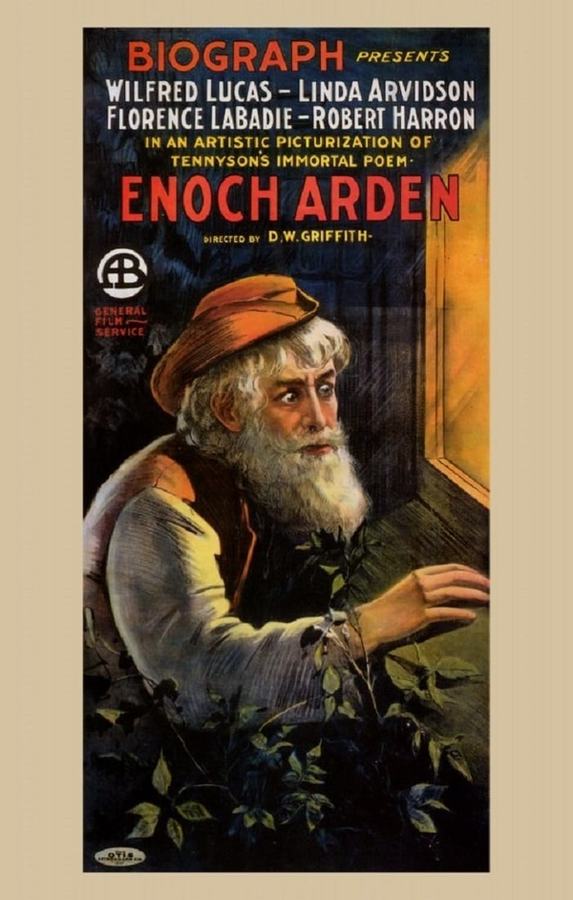
A definitive 6.3/10 rating for a film that redefined the boundaries of cult cinema. Enoch Arden remains a cornerstone of transgressive art.
Light, when it finally breaches the celluloid fog of Enoch Arden, looks bruised—like pewter strained through muslin. The 1911 adaptation of Tennyson’s narrative poem does not merely recount a sailor’s return; it exhumes the Victorian conviction that renunciation equals nobility, then holds that moral fossil up to the kerosene glow of early cinema. Because the film is lost, we reconstruct its ghost from contemporary synopses, trade-magazine gasps, and a clutch of stills where Fay Davis’s Annie Lee stares seaward with pupils so dilated they seem to swallow the frame. In doing so, we confront cinema’s first great love triangle, a triad predating Griffith’s more flamboyant martyrs by a full year.
A Palette of Salt and Sepia
Imagine the tinting: night scenes steeped in sea-blue (#0E7490) emulsion, day-for-dawn moments daubed with orange (#C2410C) that suggest both hearth and hazard. The mind’s eye roams a shoreline set where painted canvas waves, agitated by off-screen stagehands, slap against papier-mâché rocks. In this liminal space, Gerald Lawrence’s Enoch Arden wrestles not only with surf but with fate’s sardonic arithmetic—seven years missing, seven Biblical years that gift his wife to the patient Philip Ray (Ben Webster, conjuring diffident ardor through the subtlest forward lean).
The film’s cadence, if we trust The Moving Picture World (June 1911), unfurls in three movements: the humble courtship, the cosmic shipwreck, the agonizing homecoming. Each act measured not by reels but by tides: courtship at low tide—sand ample, futures endless; wreck at flood—chaos incarnate; return at ebb—everything receding, including hope. Director Edwin S. Porter, fresh from experimenting with parallel action in From Dusk to Dawn, here opts for tableaux whose static tension feels almost Ozu-like in retrospect. Characters enter, exit, but the camera—like destiny—refuses to blink.
The Sound of Silence Between Them
Silent film, paradoxically, hyper-sensitizes the ear of the soul. When Enoch, gaunt and sun-charred, presses his palm against the cottage window and sees Annie teaching Philip’s child to pronounce “father,” the absence of dialogue detonates a metaphysical echo. You supply the withheld sob, the unspoken name. The intertitle, reportedly lifted verbatim from Tennyson—“But the sound of her gladness was pain to him”—becomes a razor slipped between ribs.
Compare this to the marital geometry in Come Robinet sposò Robinette, where commedic cross-dressing deflates any potential ache. Enoch Arden refuses that safety valve; its humor, if any, is gallows-flavored. May Whitty’s supporting turn as the busybody neighbor Mrs. Dobbs supplies a flutter of comic relief, yet even her broom-handle gestures read as attempts to sweep despair under threadbare rugs.
Colonial Shadows Beneath the Romance
Read against the grain, the picture whispers of empire’s casualties. Enoch’s merchant vessel plied trade routes that fattened Manchester mills on cotton and indigo; his marooning is microcosm for the system that devours bodies to spin calico. The island where he languishes, though unnamed, stands in for every chalk-mark on Admiralty maps where sailors vanish so that parlors back home may boast porcelain and tea. The film never utters “colonialism,” yet its very reticence exposes the erasure inherent in imperial storytelling.
Philip Ray, landlocked and cautious, embodies an England pivoting from maritime daring to domestic consolidation; he buys annuity policies while Enoch gambles against typhoons.
Annie’s final choice—security over sublime passion—maps the nation’s own psychic shift. Thus the melodrama, while intimate, is also national allegory: the sailor-sacrifice that underwrote island power now relegated to pathos, nostalgia, seaside postcards.
Performances Etched in Nitrate
Fay Davis, primarily a stage tragedienne, understood that cameras magnify micro-gesture. In stills she tilts her chin downward yet rolls eyes upward, producing a tremulous equipoise between submission and self-assertion. It is the look of a woman who has already died once—when the sea reclaimed her husband—and now fears the sacrilege of resurrection. Gerald Lawrence, by contrast, lets his body speak ruin: shoulders canted as though still bracing against swell, hair longer than Edwardian decorum allows, sun-bleached streaks painted frame by frame onto the print. His final walk toward the cliff, described by one exhibitor as “a slow dissolve of the masculine ego into landscape,” anticipates the existential westerns of Anthony Mann.
Webster’s Philip risks blandness—he is, after all, the safe choice—but the actor layers fret beneath courtesy. Watch him, in the wedding scene, clutch Annie’s elbow not with triumph but with a terror that she might yet bolt. The triangle is thereby complicated: not hero vs. villain but two traumatized men orbiting a woman whose agency the narrative both grants and curtails.
Mise-en-Scène as Moral Laboratory
Porter’s set designers erected the village on the Palisades opposite Manhattan, utilizing natural cliffs as metaphors of irreversible decision. The camera placement—roughly chest-height—turns viewers into complicit neighbors peeking from behind gorse bushes. Depth is staged laterally: characters exit not into vanishing-point distance but toward the frame’s edge, implying that destiny runs perpendicular to social expectation rather than away from it. This lateral tension would resurface, refined, in Judith of Bethulia two years later.
Intertitles as Suture and Slash
Each intertitle card, hand-lettered in serif that mimics Tennyson’s 1864 volume, functions simultaneously as explanation and laceration. They quote the poem’s most lacerating stanzas, then cut to images that belie the tidy moralism of Victorian verse. The result is a dialectic: text preaches resignation, image howls injustice. Viewers thereby occupy a hermeneutic gap where meaning ricochets—a proto-Brechtian alienation born not of politics but of technological limitation turned aesthetic weapon.
Temporality as Trauma
Cinema began by conquering time; Enoch Arden reveals how time retaliates. The seven-year ellipsis is conveyed via a single fade-to-black followed by a shot of Annie placing the second candle on her child’s birthday cake. The elision is brutal, almost Bunuelian. We feel the violence of omission, the sense that life has been lived off-screen while we—like Enoch—were marooned. In this way the form enacts the theme: spectators experience the same temporal dislocation as the protagonist.
Compare the gentler temporal montage in The Life of St. Patrick, where dissolve upon dissolve spiritualizes chronology. Here, Porter’s cut is surgical, leaving scar tissue.
Reception: From Cathedral to Nickelodeon
Trade journals of 1911 split along class lines. The New York Dramatic Mirror praised the film as “a tonic for the masses, a sermon without pulpit.” Meanwhile, the more populist Variety fretted that viewers might find it “a gloom too continuous for the hurried lunch-hour crowd.” Both intuitions proved prophetic. Urban venues booked it as a prestige attraction, pairing screenings with hymn-sing fund-raisers for seamen’s charities. Rural operators, fearing melancholy, sandwiched it between knockabout comedies, creating tonal whiplash that reportedly sent one Iowa audience into bewildered silence.
Yet its reputation traveled. In Assisi, an Italian distributor re-christened it “Il Ritorno dell’Ombra” and marketed it alongside travelogues of Assisi, Italy as a double bill of spiritual tourism. The pairing seems absurd until you consider that both films—one fictional, one documentary—trade in pilgrimage, in the hope that geography can salivate the soul.
Legacy: Footprints Washed Away
Today Enoch Arden survives mainly as citation. Scholars flag it as an early instance of narrative cinema adapting high literature without foot-shuffling apology. Yet its deeper legacy lies in establishing the grammar of noble renunciation that would echo through The Woman in Black and even, in inverted form, through Moondyne where the convict-hero chooses self-exile to shield his beloved from taint.
More intriguingly, it seeded a sub-genre: the Return-from-the-Dead melodrama. Themes of presumed death, remarriage, and ethical paralysis resurface in everything from Abraham Lincoln’s Clemency (where presidential pardon mirrors spousal mercy) to contemporary soap operas. Each iteration dilutes the existential sting; none replicate the primordial shock of 1911 when audiences first confronted the possibility that virtue might demand self-erasure.
Why It Still Matters
Modern viewers, weaned on twist-reunion romances, may bristle at the ending: a man choosing homelessness so that his relict may prosper. Yet in an era of algorithmic surveillance and zero-privacy, the notion that one could simply walk away, could become unseeable, carries a perverse allure. Enoch’s disappearance into the cliff-fog is both capitulation and coup: he abdicates happiness but regains narrative control of his myth. In refusing to reclaim his wife, he rewrites himself from cuckolded sailor to tragic auteur of domestic peace.
Moreover, the film invites meditation on cinematic loss. Ninety percent of silent-era footage is gone, dissolved like Enoch into chemical brine. To speak of Enoch Arden is therefore to practice a cine- archaeology of absence. We circle the void, conjure shadows, and in so doing acknowledge that every image we cherish will one day be tide-washed. Perhaps that is why the film’s emotional undertow feels stronger now: it is a double perishing—of a marriage and of the very medium that dared imagine it.
Final Projection
I dream a hypothetical restoration: hand-tinted waves lapping nitrate, a new score for strings and glass harmonica that suspends time between heartbeats. In this phantom print, the penultimate shot lingers on Enoch’s back as he ascends the cliff. The camera, violating 1911 decorum, dollies inward until the fabric of his coat fills the frame—every frayed thread a timeline, every salt stain a memory. Fade. Then a title card, never in the original: “What if he turned around?” But of course he cannot; the myth demands his forward stride into mist, the surrender that keeps the world spinning.
Until such resurrection, we are left with echoes—footprints rapidly erased by cinematic surf. Yet even the echo instructs: love, at its most ferocious, is less possession than benediction; sometimes the greatest act of fidelity is the willingness to remain forever shipwrecked outside the harbor of one’s own desire. In that bleak wisdom, Enoch Arden still breathes, a ghost of celluloid salt, reminding us that every frame is a temporary island, every spectator a castaway grateful for the mirage of connection before the tide reclaims the image.

IMDb 6
1929
Community
Log in to comment.