DbcultAccessing Vault...
Cult Review
Senior Film Conservator
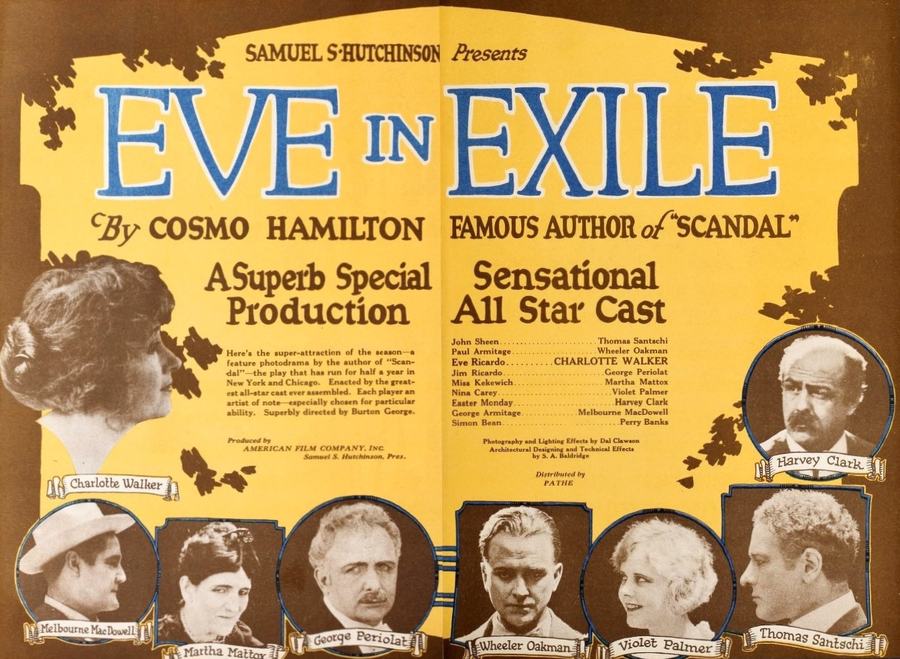
In the annals of early cinema, where narratives often grappled with the seismic shifts of a changing world, Eve in Exile (1919) emerges as a strikingly prescient and emotionally resonant work. This silent drama, penned by the collaborative talents of Cosmo Hamilton and Lois Zellner, delves into the precariousness of social standing, the corrosive nature of unrequited obsession, and the arduous journey toward authentic self-discovery. It’s a film that, despite its vintage, speaks volumes about human nature’s enduring complexities, offering more than just a glimpse into a bygone cinematic era; it provides a mirror to timeless struggles.
At its core, Eve in Exile is a morality play masquerading as a society melodrama. The narrative pivots around Eve Ricardo (Charlotte Walker), a woman accustomed to the shimmering facades of high society, whose world is abruptly upended. Her father, a speculator whose fortunes have spectacularly crashed, effectively banishes her to the seemingly idyllic, yet subtly treacherous, New England countryside. This forced relocation isn’t merely a change of scenery; it’s a crucible, designed to strip away the artifice and reveal the true mettle of her character. Unlike the superficial entanglements of her previous life, this new environment demands a more profound engagement with reality, forcing Eve to confront genuine hardship and the raw, unfiltered emotions of those unburdened by social pretense.
Initially, Eve’s displaced heart finds a fleeting, misguided attraction in John Sheen (Wheeler Oakman). Sheen, portrayed with a compelling blend of rugged allure and simmering menace, represents a dangerous kind of magnetism. His initial charm, perhaps a novelty for a woman accustomed to the polished but often insincere gentlemen of the city, soon gives way to a chilling revelation. As Eve peels back the layers, she discovers a violent thug and a domineering bully lurking beneath the surface. Oakman’s performance here is particularly noteworthy, conveying Sheen’s toxic masculinity through subtle gestures and piercing gazes, a testament to the power of silent acting. This disillusionment serves as Eve's painful but necessary awakening, a stark contrast to the superficial judgments she might have made in her former life. It’s a thematic thread echoed in films like The Whirlpool of Destiny, where characters often find their perceptions of love and loyalty severely tested by unforeseen circumstances and hidden vices.
Her subsequent encounter with Paul Armitage (Tom Santschi), a writer, marks a pivotal shift. Armitage, in stark contrast to Sheen, embodies intellectual depth and genuine sensitivity. Their connection is forged not on fleeting physical attraction, but on shared values and a burgeoning emotional understanding. This romance, blossoming amidst the quiet beauty of the New England village, symbolizes a purer, more authentic love, untainted by the materialistic concerns that once governed Eve’s world. It’s a classic narrative arc: the refined hero saving the heroine from a brutish suitor, yet here it feels less like a cliché and more like a hard-won victory of discernment and character.
“The quiet storm of human ambition and jealousy, often more destructive than any natural disaster, brews menacingly beneath the pastoral tranquility.”
Sheen, however, is not a man to accept rejection gracefully. His wounded pride and possessive nature transform into a virulent desire for vengeance. He finds a willing, indeed eager, accomplice in his sister, Nina Carey (Violet Palmer). Nina is a fascinating, complex antagonist: married to a man serving in India, she harbors a secret, burning love for Paul Armitage. Her unfulfilled desires and festering jealousy make her a dangerous pawn in Sheen’s scheme. Together, they conspire to systematically discredit Paul and shatter his burgeoning romance with Eve through a campaign of insidious rumors and calculated deceit. This intricate plot, reminiscent of the emotional manipulation seen in dramas like Casus or even the intricate power plays in Kampen om hans hjärta, demonstrates the devastating impact of unchecked envy and malice.
The brilliance of the writing by Hamilton and Zellner lies in their ability to weave such a tangled web of personal vendettas and societal pressures. The small-town setting, often perceived as a haven of innocence, becomes a hotbed of intrigue and moral compromise. The film deftly illustrates how quickly reputations can be tarnished and how easily truth can be distorted when fueled by malicious intent. The stakes are profoundly personal, yet the implications feel universal, exploring the fragility of trust and the resilience required to defend one’s integrity against a tide of calumny.
The cast of Eve in Exile delivers performances that transcend the limitations of silent film, communicating profound emotion through expression and physicality. Charlotte Walker’s portrayal of Eve Ricardo is particularly compelling. She navigates Eve’s transformation from a sheltered socialite to a woman of strength and conviction with impressive nuance. Her initial naiveté gives way to a hardened resolve, her eyes reflecting the journey from disillusionment to defiant love. It’s a performance that anchors the film, making Eve’s plight genuinely empathetic.
Wheeler Oakman, as the menacing John Sheen, is equally captivating. He embodies the villain with a palpable sense of danger, his physicality conveying a simmering rage that threatens to erupt at any moment. His ability to project malevolence without uttering a single word is a masterclass in silent film acting. Tom Santschi, as the virtuous Paul Armitage, provides a crucial counterpoint, his earnestness and integrity shining through, making him a truly sympathetic hero. Violet Palmer’s Nina Carey is a study in repressed desire and dangerous manipulation, her subtle facial expressions betraying the depths of her envy and obsession. Even supporting players like Harvey Clark and Melbourne MacDowell contribute to the rich tapestry of characters, each fulfilling their role in the unfolding drama with a quiet efficacy often overlooked in broader analyses.
While specific directorial credits are sometimes obscured by the collaborative nature of early Hollywood, the overall visual language of Eve in Exile is remarkably effective. The cinematography captures the contrast between the opulence of Eve’s former life and the rustic beauty of her New England exile with striking clarity. The use of natural light and carefully composed shots enhances the mood, whether it’s the sun-drenched pastoral scenes that initially lull Eve into a false sense of security or the darker, more claustrophobic interiors where conspiracies are hatched. The editing maintains a steady pace, allowing the dramatic tension to build organically, ensuring that each emotional beat lands with impact.
The film’s visual storytelling relies heavily on symbolism. The transition from city to country is not just a geographical shift but a metaphorical one, representing Eve’s journey from superficiality to substance. The turbulent waters of a nearby river might symbolize the emotional upheaval in her life, or the rugged landscape mirroring the trials she must overcome. These subtle visual cues enrich the narrative, allowing the audience to engage with the story on multiple levels, much like the allegorical journeys depicted in works such as Les travailleurs de la mer, where environment often reflects internal struggle.
“The film’s true power lies in its unflinching examination of character, proving that moral fortitude is tested not in luxury, but in adversity.”
Beyond the captivating romance and thrilling conspiracy, Eve in Exile offers a poignant commentary on the societal structures of its time. The sudden downfall of Eve’s father highlights the precariousness of wealth and the arbitrary nature of social standing. Eve’s exile forces her to confront a world where character, not connections, truly matters. This theme of social re-evaluation and the search for genuine worth is a recurring motif in silent cinema, notably explored in films like Those Who Pay, where financial ruin often precipitates a moral reckoning.
The film also delves into the darker aspects of human morality. John Sheen and Nina Carey represent the destructive forces of envy, possessiveness, and deceit. Their actions serve as a stark reminder that evil can lurk beneath any veneer, whether it be rough-hewn charm or social grace. The narrative ultimately champions the virtues of honesty, loyalty, and perseverance, suggesting that true happiness and redemption are found not in material wealth or social status, but in authentic relationships and moral integrity. This moral compass, guiding characters through treacherous waters, is a hallmark of many silent dramas, echoing the clear-cut good vs. evil narratives often seen in westerns like The Good Bad-Man, but here applied to an intricate social landscape.
The contrast between the urban sophistication Eve leaves behind and the rustic simplicity she encounters also opens a dialogue about authenticity. Is true character forged in the crucible of polite society, or does it emerge more genuinely in the unvarnished reality of rural life? Eve in Exile suggests the latter, portraying the countryside not just as a place of banishment, but as a space for moral clarity and personal growth. This journey of self-discovery through a change of environment can be seen in other narratives of the era, where characters are often forced to adapt or perish, much like the trials faced in The Place Beyond the Winds, where the harsh elements reveal true character.
Despite being over a century old, Eve in Exile retains a surprising contemporary resonance. Its exploration of themes like the downfall of the powerful, the toxic nature of possessive relationships, and the resilience of the human spirit in the face of adversity are as relevant today as they were in 1919. The film serves as a powerful reminder of cinema’s enduring ability to capture the human condition, transcending technological limitations to deliver stories that speak to universal truths. Its narrative structure, balancing romance with thrilling suspense and moral introspection, ensures that it remains an engaging watch for modern audiences willing to delve into the rich heritage of silent film.
The film's quiet strength lies in its ability to build tension and develop character without relying on dialogue. The visual language, the nuanced performances, and the carefully crafted plot work in concert to create a compelling experience. It's a testament to the skill of the filmmakers and actors of the era that they could convey such intricate emotional landscapes through expression and gesture alone. This mastery of non-verbal communication is a hallmark of the silent era, and Eve in Exile stands as a fine example of this artistry, inviting viewers to engage more actively with the story and interpret the subtleties of human interaction.
“The echoes of Eve's struggle against deceit and for genuine affection resound through the ages, confirming the timeless allure of a well-told story.”
In conclusion, Eve in Exile is far more than a historical curiosity; it is a meticulously crafted drama that offers a rich tapestry of human experience. From its compelling plot and strong performances to its insightful thematic explorations, the film holds its own against more widely recognized silent classics. It challenges viewers to look beyond superficial appearances, to question motives, and to champion integrity in the face of adversity. For those with an appreciation for the artistry of early cinema and a desire to unearth narratives that continue to resonate, Eve in Exile is an essential viewing experience. It reminds us that even in the quietest corners of history, powerful stories of human struggle and triumph await rediscovery, offering lessons that remain profoundly relevant in our own complex world. It's a journey not just through a film, but through the enduring heart of human drama.
IMDb —
1929
Community
Log in to comment.