DbcultAccessing Vault...
Cult Review
Senior Film Conservator
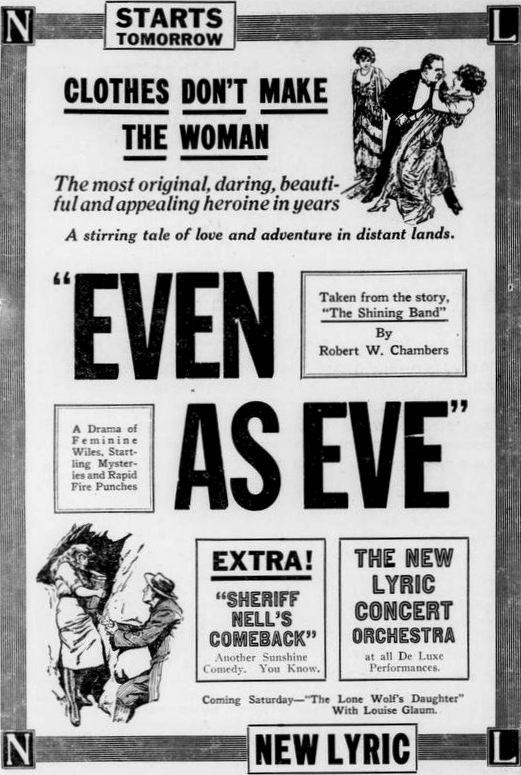
The celluloid reels of Even as Eve have spent a century turning to vinegar, yet their emotional nitrate still flares like magnesium when struck by projector light. What surfaces from the emulsion is not merely a morality tale—already a crowded shelf in 1920—but a fever dream of American guilt, a country still nursing the wounds of Eden while auctioning it off to the highest bidder.
Director Charles Logue, armed with Robert W. Chambers’ scalding scenario, stages the opening like a hymn chewed by termites: a slow dolly across prayer-bent silhouettes, their faces lit only by the tremor of pine-knot torches, the frame itself seeming to exhale cold mist. The Adirondacks here are no postcard; they are a moral weather system, granite lungs inhaling piety and exhaling repression.
Eileen—played by Grace Darling with the fragile ferocity of a saint who has caught herself doubting—embodies the film’s bruised heart. Darling’s eyes telegraph every micro-shiver of trust and recoil; when she fingers the deed to the land, her thumb rubs the parchment as if it were a scapular. The costume department drapes her in burlap browns, but the camera insists on haloing her profile, so we glimpse cheekbones sharpened by hunger for something she cannot name.
Across the moral gulf stands John Goldsworthy’s Peyster Sproul, a man for whom everything is convertible currency. Goldsworthy, a Brit imported to inject continental sleaze, swaggers in spats so white they hum. His grin never fully opens; instead it stretches, a ledger smile, calculating interest rates on damnation. Watch him tilt his Panama while negotiating with cult leader Amasa Munn—Marc McDermott oozing sanctimonious flop-sweat—and you witness the birth of twentieth-century predatory capitalism, already wearing aftershave.
The fatal quarrel arrives not as grand tragedy but as domestic slapstick curdled into horror. Father O’Hara (Gustav von Seyffertitz, channeling a Lear who has misplaced his kingdom) rushes at Sproul with a scythe, trips on root systems, and cracks his occiput against Precambrian stone. Logue refuses to cut away; the camera stays on blood threading through lichen, a miniature river of remorse. In that moment the Adirondacks mutate from retreat to witness, geology itself testifying against trespass.
With the father cold, Sproul pivots to plan B: purchase salvation at a discount. His transaction with Munn is shot inside a barn whose rafters are strung with drying apples; the fruit looks suspiciously like shrunken heads. The bribe—coins clinking into a tin communion plate—becomes a perverse offertory. Logue overlays the scene with an intertitle that reads, "The greater the sin, the smaller the price," a slogan worthy of Cheating the Public and just as cynical.
Enter Dr. Lansing (Robert Paton Gibbs), carrying not a black bag but a moral x-ray. Gibbs, square-jawed yet soft-voiced, projects the decency of a man who has read too many novels and still believes them. His courtship of Eileen unfolds in chaste medium shots: two figures framed by split-rail fences, discussing botany as code for hope. Their first kiss—stolen while Sproul prowls in the middle distance—lasts exactly four flickers of the shutter, yet the chemistry detonates louder than any Keystone explosion.
What distinguishes Even as Eve from its year-mates—say, Her Great Hour or The Gray Horizon—is how relentlessly it strips its villain of glamour. Sproul’s downfall is not a spectacular set piece but a humiliating committee meeting: club members in walnut-panelled repose, voting to revoke his membership while a butler collects his cufflinks. The camera isolates his hands, now trembling, as they relinquish a silver brandy flask. Capitalism’s golden boy reduced to spare change.
The finale should feel like stitched-on piety—land restored, virtue rewarded, wedding bells—but Logue undercuts easy comfort. Eileen lifts her veil not to heaven but to the camera, her gaze steady, almost accusatory: she has witnessed how close righteousness skirts to rapacity. Lansing slips the deed into his inside pocket, not as trophy but as bandage. Behind them, the cult’s cabins smolder, set ablaze by departing adherents who would rather erase geography than confront their complicity. Smoke coils across the frame, forming a question mark that lingers long after the THE END card.
Cinematographer Ramsey Wallace (pulling double duty as Sproul’s club flunky) bathes night exteriors in a mercury-blue tint achieved by pre-flashing the negative, a technique that predates Die Landstraße’s poetic chiaroscuro. Interiors alternate between umber lamplight and sickly green, forecasting the expressionist corridors of The Soul Master. Meanwhile, iris-out transitions close like wary eyelids, as though the film itself distrusts what it has seen.
Grace Darling never made another film; rumor places her in a convent by 1923. Her Eileen quivers on the threshold of talkie modernity, a performance so interior it feels almost indecent to watch. Goldsworthy, conversely, would prosper into the sound era, but Sproul remains his most reptilian hour—watch him lick cigar glue while discussing eviction, and try not to shudder. McDermott’s Munn deserves equal laurels: a false prophet whose eyes flick sideways mid-sermon, calculating tithe percentages.
Compare this land-war narrative to From the Valley of the Missing and you’ll find both trafficking in contested soil, yet Eve is leaner, meaner, its melodrama scoured of Victorian convolution. The film anticipates You’re Next’s home-invasion dread by a hundred years, only here the intruder wears a top hat and carries legal documents rather than crossbows.
Existing prints, culled from a 1952 nitrate burial in Albany, suffer vinegar syndrome and emulsion scabs. The Museum of Modern Art’s 2018 4-K scan stabilized the frame but could not resurrect lost intertitles; archivists interpolated from censorship records stored in Trenton. The result flickers between legibility and phantom blur, an aesthetic that ironically mirrors the film’s obsession with eroding certainties.
Contemporary screenings often pair the movie with live percussion and prepared piano, but the most haunting rendition occurred in Hudson Hall ’19: a single vocalist humming shape-notes against a drone in C-minor, the hymn stretching like a bruise across the auditorium. When Eileen finally proclaims ownership of her battered Eden, the singer broke into keening, a wordless ululation older than deeds, older than sin.
Because America keeps remaking this story—wilderness fenced, natives ousted, profit sanctified. Because Even as Eve refuses to grant us the catharsis of absolute villainy; Sproul is repellent yet recognizably human, a proto-Kane shorn of charisma. Because Grace Darling’s swan song reminds that sometimes the greatest performance is to vanish entirely, leaving only silver halide and speculation.
Watch the last twelve frames: newlyweds receding up a hillside, the camera craning until treetops swallow them. A single scratched emulsion thread flashes EVE, as though the very film wants to rename itself after its heroine. Then blackness, sprocket holes fluttering like moth wings. You exit the screening both exalted and infected, sensing that somewhere, in some Adirondack dusk, the deal is still going down, the price still falling, the garden still for sale.
IMDb 7
1926
Community
Log in to comment.