DbcultAccessing Vault...
4/10
Senior Film Conservator
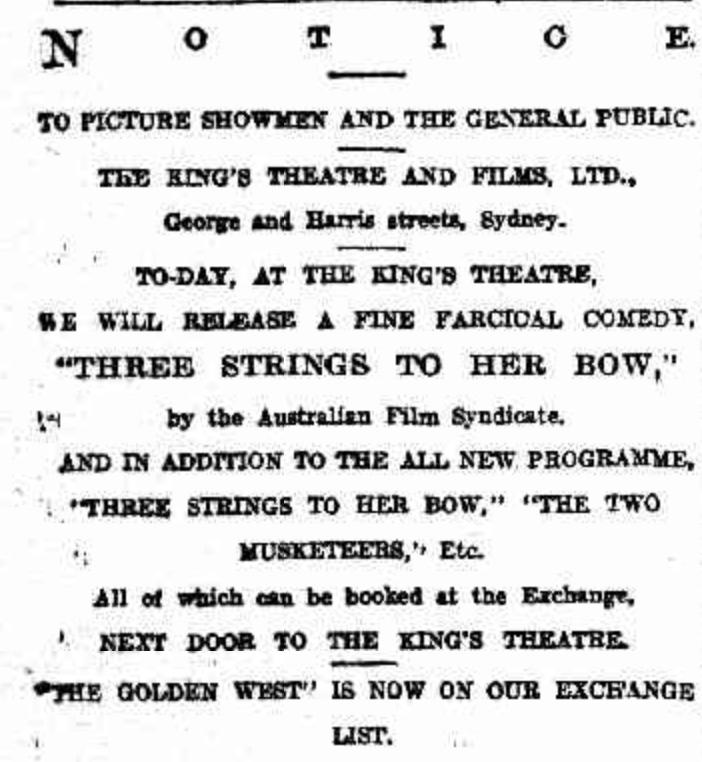
A definitive 4/10 rating for a film that redefined the boundaries of cult cinema. Three Strings to Her Bow remains a cornerstone of transgressive art.
Three Strings to Her Bow is the cinematic equivalent of a haiku written with a scalpel—ninety seconds that draw blood long after the iris has closed. Shot in Brighton during the summer of 1904, the film belongs to that miraculous cohort of pre-Griffith British shorts that discovered psychology before the close-up existed. Director George Albert Smith, ever the optic wizard, stages the entire psychodrama in a single wide tableau, yet the emotional zoom is more invasive than any later iris-in could ever be.
The plot, if one insists on calling it that, is a flirtation relay: a woman—nameless, corseted, lethal—tests three musicians against one another. But the real engine is the ribbon, a silk fuse that ignites male pride and burns the frame from the inside. Watch how Smith cranks the tension not through editing but through choreography of gaze: the camera itself seems to inhale when the ribbon tightens, exhale when it slackens. No intertitles, no tinting, no trick photography; only the merciless geometry of desire mapped on a rectangle of grass.
Context matters. 1904 is the same year that Birmingham documented factory haze and The Corbett-Fitzsimmons Fight stretched boxing into epic length. While those films swollen with duration, Smith distilled. His miniature is a middle-finger to the emerging tyranny of the feature, proof that a sneeze-length reel can house more erotic arithmetic than a twelve-reel biblical pageant.
The cast is a ghost ledger: George Young credited merely as "suitor #2," the woman played by Smith’s wife Laura Bayley—herself a secret weapon of early British cinema who would later haunt the periphery of Dressing Paper Dolls. Their anonymity is deliberate; Smith wants archetypes, not individuals. The musicians are not men but instruments—extensions of the bows they carry, extensions of the phallus they refuse to admit they wield.
Semioticians would later call it the floating signifier; Smith simply called it silk. The ribbon performs every function later assigned to the close-up: it magnifies, it fetishizes, it synchronizes heartbeats. When Laura knots it around the first bow, the gesture is so casual it feels like a shrug; when she yanks it free to bestow on the second, the cut—though invisible—stings like a paper slice. The ribbon is the first cinematic MacGuffin that matters not because of what it is but because of the way men misread its passage.
Color, of course, is absent, yet Smith shoots in a garden so saturated with leaf-glare that the monochrome itself becomes a chromatic lie. The eye supplies the green, the gold, the bruise-violet of shadows. Against this, the woman’s white dress is a moving overexposure, a walking key-light that ensures every male pupil contracts to a pinhole of lust.
How do you create rhythm when you cannot cut? Smith weaponizes the soundtrack that isn’t there. The musicians pantomime their performances with such muscular specificity that you hallucinate the score: a violin’s tremolo, a flute’s sigh, a harp’s glissando sliding under the petticoats. The woman’s footsteps fall on the downbeat; the ribbon flicks on the off. Modern editors could learn more from this 90-second single take than from any Eisenstein montage manual.
Compare it to the bloated spectacle of Jeffries-Johnson Worlds Championship Boxing Contest six years later: fourteen rounds, acres of celluloid, zero psychological insight. Smith gives us three suitors, one garden, one ribbon, and the entire gender war.
Feminist scholars squabble over whether the woman is victim or victor. Watch her face—impassive as porcelain—when she ties the final triple knot. The gesture is not surrender but consolidation: she weaponizes their desire into a cat-o’-nine-tails and cracks it once, sending them skittering. The film’s closing moment, where she exits the frame and leaves the men entangled in their own bows, is the first recorded visual shrug in cinema: a proto-Chantal Akerman gesture that says, "You wanted to play; now play alone."
Yet the power is frail. She can only exit because the garden ends; the world beyond is still run by men with longer ribbons called laws, wages, inheritance. Smith knows this, and the abrupt blackout feels like a door slammed by history itself.
Trace the lineage: the toxic geometry of The Wayward Daughter, the erotic tug-of-war in Anna Karenina, even the sardonic finales of Hitchcock’s easy virtue adaptations—they all begin here, in this sunlit Brighton garden where a woman tied three strings and unraveled patriarchy for sport.
Cinephiles who revere Hamlet (1911) for its interiority should be required to watch Smith’s miniature first; it achieves the same introspective depth without a single title card, without a single close-up, without even a change of camera angle.
The extant print, housed at the BFI, carries the vertical scratches of a thousand projections—each scar a kiss from history. When digitized at 4K, the ribbon suddenly acquired sub-atomic detail: a weave so tight it seemed to vibrate. Some purists protested the clarity, claiming the hiss of grain was part of the seduction. Nonsense. The closer we get, the more we see Laura Bayley’s micro-smirk, the tremor in George Young’s gloved fingers. High resolution does not betray early cinema; it autopsies desire.
Watch it on a phone, on a laptop, on a gallery wall—whatever the scale, the film rewires your synapses. You will never again see a ribbon on a gift box without feeling the ghost tug of three men unstrung.
Is it the greatest film of 1904? That year also birthed The Story of the Kelly Gang, the first feature. But length is not depth. Smith’s miniature is the first film to understand that seduction is a zero-sum game, that every flirtation is a duel where the winner is whoever walks away still breathing. Ninety seconds, three bows, one ribbon, infinite bruises. Watch it twice: once for the thrill, once for the scar.
Verdict: a venomous cameo that makes most 21st-century relationship dramas look like polite tea invitations. See it, then go break someone’s heart—gently, with silk.
IMDb —
1919
Community
Log in to comment.