DbcultAccessing Vault...
Cult Review
Senior Film Conservator
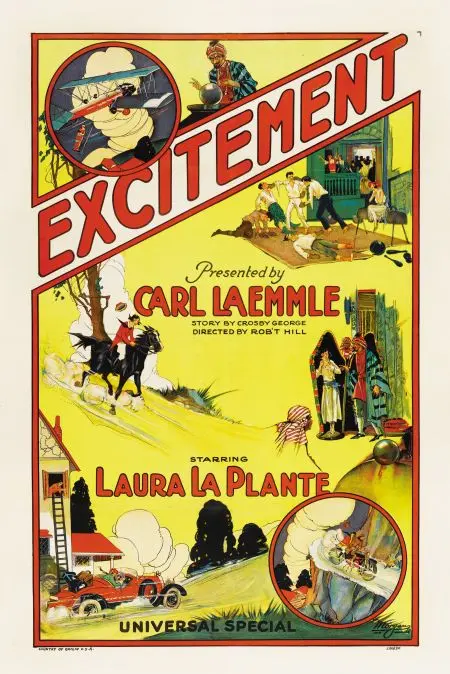
There's a curious allure to silent films that transcends mere nostalgia, a unique language of gesture and expression that often speaks more profoundly than spoken dialogue. Among these cinematic relics, 1926's Excitement stands as a particularly intriguing specimen, a narrative that blurs the lines between marital drama, adventure thriller, and psychological experiment. Directed with a keen eye for suspense and featuring the luminous Laura La Plante, this film offers a fascinating glimpse into the anxieties and entertainment sensibilities of the Jazz Age. It's a story that asks profound questions about the nature of desire, the boundaries of love, and the sometimes-extreme measures taken to 'cure' a spirited personality.
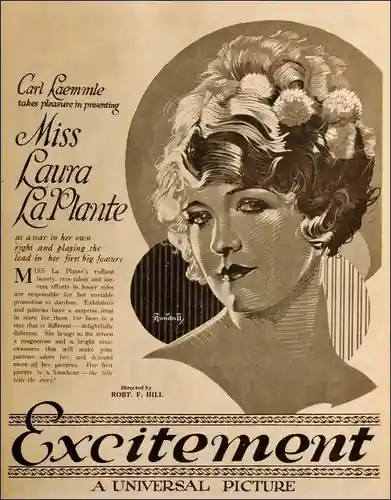
At the heart of Excitement lies Nila Drew, portrayed with vivacious intensity by Laura La Plante. Nila is not your typical demure silent film heroine; she is a woman afflicted by an insatiable wanderlust, a yearning for the extraordinary that chafes against the comfortable, yet suffocating, confines of her newlywed life. Her husband, Arthur, played by Edward Hearn, is a man of stability and practicality, utterly bewildered by his wife's relentless pursuit of novelty. This fundamental clash of temperaments forms the bedrock of the film, setting the stage for the audacious events that follow. La Plante, a star whose versatility often saw her navigate comedies, dramas, and even horror, embodies Nila's restlessness with a compelling blend of charm and desperation. Her facial expressions, so vital in the silent era, convey a woman teetering on the edge of boredom, dreaming of adventures far grander than afternoon teas and social calls. This portrayal of a woman actively seeking thrills, rather than passively awaiting them, was perhaps somewhat progressive for its time, even if the film ultimately seeks to 'correct' her.
The narrative truly ignites when Nila’s desire for excitement is answered in the most terrifying manner imaginable. She is kidnapped, an act that plunges her into a nightmarish scenario. The sheer audacity of the plot is what makes Excitement so memorable: Nila isn't merely taken; she is ensconced within a mummy case, a grotesque sarcophagus that transforms her into an unwitting ancient artifact. This macabre imprisonment is then followed by a clandestine shipment to a mysterious Egyptian figure, who, upon her 'unveiling,' pronounces her the 'Queen of Pharaoh' and threatens her with a literal return to the tomb. The sequence of her abduction and subsequent journey is handled with a commendable degree of suspense, utilizing the limitations of silent film to heighten the sense of claustrophobia and impending doom. The visual of La Plante struggling within the confines of the mummy case is genuinely unsettling, tapping into primal fears of burial and confinement. The exotic Egyptian setting, while perhaps leaning into orientalist tropes common in the era, serves to amplify Nila's terror and the otherworldliness of her predicament. The film leverages these dramatic elements to build an almost unbearable tension, leaving the audience to wonder how Nila could possibly escape such an elaborate trap.
Just as Nila's fate seems sealed, her husband Arthur dramatically arrives to rescue her. It is in this climactic moment that the film delivers its most shocking twist: the entire harrowing ordeal, from the kidnapping to the Egyptian pharaoh's threats, was an elaborate, meticulously orchestrated trick by Arthur himself. His motivation? To 'cure' Nila of her relentless pursuit of excitement by giving her an overdose of terror. This revelation instantly transforms the film from a straightforward adventure into a complex psychological drama, raising a multitude of ethical questions. Can love justify such extreme manipulation? Is curing someone of their inherent personality traits a noble endeavor or an act of control? Arthur's plan, however well-intentioned from his perspective, is profoundly unsettling. It speaks to a patriarchal desire to domesticate and contain a woman's adventurous spirit, framing her 'excitement' as a flaw to be remedied rather than a characteristic to be embraced. The film, by its very title, suggests a celebration of thrill, yet its resolution implies a cautionary tale against it. This moral ambiguity is arguably its most compelling feature, inviting contemporary viewers to critically examine the assumptions underlying Arthur's actions and Nila's supposed 'cure'.
Laura La Plante's performance is undoubtedly the linchpin of Excitement. Her ability to convey Nila's initial boredom, escalating terror, and eventual relief (and perhaps lingering resentment) without a single spoken word is a testament to her mastery of silent acting. She employs a range of gestures, from subtle eye movements to more dramatic physical reactions, to communicate Nila's internal state. Her expressions of fear are particularly convincing, making the audience genuinely root for her escape, even before the twist is revealed. Other cast members, including Rolfe Sedan, Fred DeSilva, and Margaret Cullington, contribute effectively to the film's atmosphere, but it is La Plante who truly carries the emotional weight of the narrative. Her presence alone elevates the film beyond a simple potboiler, grounding the fantastical plot in a relatable human experience of fear and desire. Her career, spanning from the early 1920s into the sound era, showcases an actress of considerable range, and Excitement provides a strong example of her dramatic capabilities.
The directorial choices for Excitement effectively build tension and guide the audience through its convoluted plot. The use of intertitles is judicious, providing necessary exposition without bogging down the visual storytelling. Cinematography plays a crucial role in establishing the mood, whether it's the mundane comfort of Nila's home or the shadowy confines of her abduction. The pacing, while typical of silent films, manages to maintain a sense of urgency during the kidnapping sequences. Writers Hugh Hoffman and Crosby George deserve credit for crafting such an audacious and memorable premise. While the 'cure' itself might be ethically dubious by modern standards, its sheer originality and the dramatic potential it unlocks are undeniable. The narrative structure, which hinges on a significant twist, demonstrates a sophistication in screenwriting that often goes unappreciated in early cinema. The film's ability to pivot from a seemingly straightforward adventure to a psychological examination of a marriage is a testament to their storytelling prowess.

Placing Excitement within the broader landscape of silent cinema reveals its unique position. Its blend of adventure, mystery, and marital drama echoes elements found in various films of the period. The 'mummy' motif, for instance, immediately brings to mind films like Das Geheimnis der Mumie, though Excitement subverts the supernatural horror for a more human-centric deception. The theme of elaborate tricks and deceptions can be seen in films like A Self-Made Widow, where appearances are constantly misleading. Nila's yearning for a life beyond the ordinary, her dissatisfaction with domesticity, resonates with character arcs in films such as The Easiest Way, which explores societal pressures on women and their limited choices. While not as overtly political as Gira política de Madero y Pino Suárez, Excitement still reflects societal attitudes towards gender roles and the control exerted within relationships. The thrilling aspects of Nila's ordeal, though manufactured, align with the pulse-pounding adventures found in serials and features like Plunder or even the more exotic narratives hinted at in The Sultan of Djazz. The film's commitment to delivering a unique premise, even if somewhat outlandish, distinguishes it from more conventional romantic comedies or melodramas of the era. It shares a spirit of playful deception with films like Nancy from Nowhere where mistaken identities and elaborate plots drive the narrative. The sheer audacity of Arthur's plan, and the subsequent portrayal of Nila's reaction, makes it a fascinating companion piece to films that explore the intricacies of human psychology and the lengths to which individuals will go to achieve their desires, or to impose their will upon others.
Despite its age and its somewhat dated premise by contemporary standards, Excitement still holds a peculiar resonance. It serves as a potent, if extreme, metaphor for the marital struggles that persist across generations: the clash between partners with differing desires, the attempts to change one another, and the often-unforeseen consequences of such endeavors. The film implicitly critiques the idea that one can simply 'cure' a fundamental aspect of a person's character, especially through deceit. Nila’s experience, while fabricated, is genuinely traumatizing, leaving the viewer to ponder the long-term implications for her marriage. Will she truly be 'cured' of her desire for excitement, or merely traumatized by its horrifying manifestation? The film's ending, while seemingly conclusive, leaves a lingering sense of unease, a testament to its more complex undercurrents. It’s a compelling reminder that sometimes the greatest excitement lies not in grand adventures, but in the nuanced, often challenging, landscape of human relationships. For those interested in the evolution of cinematic storytelling, the range of themes explored in silent films, and the enduring power of a strong central performance, Excitement remains a compelling, albeit ethically challenging, watch. It stands as a testament to the creativity and sometimes audacious storytelling of early Hollywood, a period where filmmakers were still defining the language of the silver screen, often with surprising results.
Ultimately, Excitement is more than just a silent film curiosity; it's a fascinating artifact that encapsulates a particular moment in cinematic and cultural history. It’s a film that dares to explore the darker side of well-intentioned manipulation, wrapped in the guise of an exotic adventure. Laura La Plante’s electrifying performance ensures that Nila’s predicament, however contrived, feels real and impactful. It challenges viewers to consider the true meaning of 'excitement' and the price one might pay for seeking it, or for attempting to control it in others. While the narrative's resolution might feel simplistic to a modern audience, the journey it takes us on, filled with suspense, psychological intrigue, and a truly unforgettable twist, makes Excitement a film well worth rediscovering for its peculiar charm and its provocative themes.

IMDb 7.1
1923
Community
Log in to comment.