DbcultAccessing Vault...
Cult Review
Senior Film Conservator
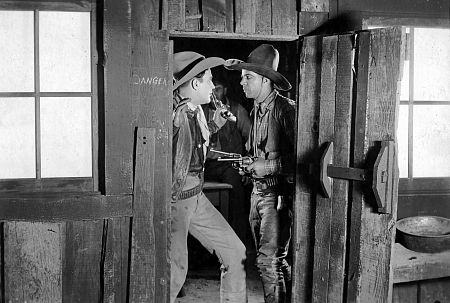
The year 1919 stood as a pivotal junction in the evolution of American cinema, a temporal bridge between the experimental infancy of the nickelodeon era and the sophisticated visual language of the 1920s. Within this transformative landscape, The Jack of Hearts emerges as a compelling artifact of the Western genre, a film that captures the rugged essence of the frontier while grappling with the burgeoning complexities of narrative structure. To watch this film in the modern era is to engage in a form of cinematic archaeology, brushing away the dust of a century to reveal a work of surprising emotional resonance and technical ambition.
At the heart of this production lies the screen presence of Jack Perrin and Hoot Gibson. While Perrin provides the film's moral compass, Gibson’s involvement hints at the burgeoning stardom that would eventually make him a household name. Their interaction on screen is less about the grandiosity of the Hollywood 'hero' and more about the grit of the working-class cowboy. This isn't the sanitized West of later decades; it is a world of dirt, sweat, and genuine peril. When compared to the more theatrical performances found in Christus (1919), the acting in The Jack of Hearts feels remarkably grounded, eschewing the exaggerated pantomime of early silent drama for a more restrained, naturalistic approach.
Josephine Hill, as the female lead, transcends the typical 'damsel in distress' trope that plagued many films of this vintage, such as the more formulaic Viviette. Hill possesses a gaze that communicates volumes in the absence of dialogue, her presence serving as the emotional anchor for Perrin's Jack. The chemistry between them is palpable, even through the flicker of aged celluloid, suggesting a depth of character that the intertitles only begin to scratch. It is through their relationship that the film explores the concept of the 'Jack of Hearts'—a card that is neither the highest in the deck nor the lowest, but one that carries a weight of romantic and tragic potential.
The screenplay, a collaborative effort by Dorothy Rockfort and Anthony Coldeway, displays a sophisticated understanding of pacing and suspense. Unlike the somewhat disjointed narrative flow of The Lost Express, The Jack of Hearts maintains a tight, propulsive energy. Rockfort and Coldeway understand that the Western is not merely about gunfights and horse chases; it is about the intersection of personal desire and social responsibility. They weave a tale where every action has a consequence, echoing the somber moral weight found in A Roadside Impresario.
The writers utilize the 'Jack' motif to great effect, using the gambling table as a metaphor for the unpredictability of life on the edge of civilization. This thematic depth elevates the film above contemporary works like Some Job, which, while entertaining, lacks the philosophical underpinnings present here. The dialogue—rendered through carefully crafted intertitles—is sparse but evocative, allowing the visual storytelling to take center stage. There is a sense of inevitability in the plot, a tragic momentum that reminds one of the darker undertones in A Victim of the Mormons, though The Jack of Hearts ultimately leans toward a more hopeful, if battle-scarred, resolution.
Visually, the film is a masterclass in using the natural environment to reflect internal psychology. The wide shots of the desert are not merely for spectacle; they emphasize the isolation of the characters. The cinematography captures the play of light and shadow on the rugged terrain with a precision that rivals the urban aesthetics of The Madonna of the Slums. There is a specific scene involving a sunset ride that feels almost transcendental, the silhouettes of the horses cutting a sharp profile against the fading light, symbolizing the end of an era and the onset of an uncertain future.
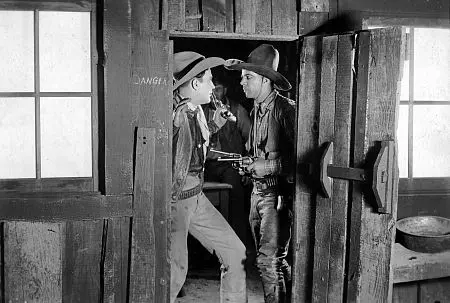
The use of close-ups is also noteworthy. In 1919, the close-up was still a relatively new tool in the filmmaker's kit, often used sparingly. However, in The Jack of Hearts, the camera lingers on the faces of Perrin and Hill, capturing the micro-expressions of doubt, fear, and love. This intimacy creates a bond between the audience and the characters that is often missing in more action-oriented silent Westerns like The Man from Painted Post. The film understands that the most significant battles are not fought with revolvers, but within the human heart.
To fully appreciate The Jack of Hearts, one must consider it alongside its contemporaries. While The Amazing Wife explored the domestic spheres of the early 20th century, and Garden of Lies delved into the intricacies of high-society deception, The Jack of Hearts remained steadfast in its commitment to the frontier mythos. Yet, it shares a certain DNA with the European sensibilities of Doktor úr or the Hungarian intrigue of Makkhetes (which also utilizes card-based imagery). There is a universal quality to the 'gambler' archetype that transcends borders, a recognition of the inherent risk involved in the pursuit of a better life.
The film also avoids the comedic frivolity found in Jazz Monkey, maintaining a somber tone that respects the hardships of the period it depicts. Even the mystery elements, which could easily have devolved into the melodrama of The Ivory Snuff Box, are handled with a sense of realism. The stakes feel genuine because the world feels lived-in. The costumes are appropriately weathered, the sets are utilitarian and sparse, and the overall aesthetic is one of beautiful, unvarnished truth.
In the grand tapestry of silent cinema, The Jack of Hearts may not have the monumental status of a Griffith or a Murnau epic, but its importance lies in its craftsmanship and its soul. It is a reminder that even in the early days of the industry, filmmakers were striving for more than just simple entertainment. They were attempting to capture the human condition in all its messy, glorious complexity. The film echoes the poignant observations found in Old Brandis' Eyes, focusing on the clarity that comes from suffering and the wisdom gained through loss.
The Jack of Hearts is a testament to the power of silent storytelling. It proves that you don't need synchronized sound to hear the beating of a heart or the whistle of a desert wind. You only need a camera, a vision, and actors who understand the gravity of their roles. Jack Perrin, Hoot Gibson, and Josephine Hill delivered exactly that, creating a work that remains as evocative today as it was over a century ago. It stands as a beacon of the silent Western, a genre that did not just provide thrills, but provided a mirror to the American soul during a time of immense national change.
Ultimately, the film functions as a meditation on the concept of 'home.' For the Jack of Hearts, home is not a place, but a state of grace achieved through sacrifice. As the final frames fade to black, the audience is left not with the ringing of gunshots, but with the quiet resonance of a man who has finally found his place in the world. It is a masterstroke of understated cinema, a hidden gem that deserves its place in the pantheon of early 20th-century art. In an era of loud, over-saturated blockbusters, returning to the silent, sepia-toned world of The Jack of Hearts is a refreshing, deeply moving experience that reminds us of the true power of the moving image.
The archival preservation of such films is vital, for they are the blueprints of our modern cinematic language. Every cut, every lighting choice, and every narrative beat in The Jack of Hearts paved the way for the Westerns of Ford and Leone. To overlook this film is to overlook a critical chapter in the history of art. It is a vibrant, breathing piece of history that continues to speak to us across the decades, whispering tales of honor, love, and the eternal gamble of the human heart.
IMDb —
1924
Community
Log in to comment.