DbcultAccessing Vault...
Cult Review
Senior Film Conservator

In the pantheon of early silent cinema, few narratives capture the jagged intersection of feminine agency and moral decay as viscerally as False Ambition (1918). This is not merely a cautionary tale of a woman gone astray; it is a sophisticated autopsy of the American Dream curdling into a nightmare of sociopathic social climbing. Directed with a keen eye for the chiaroscuro of the human soul, the film serves as a vehicle for a performance that defies the era's penchant for melodramatic pantomime, offering instead a nuanced portrait of a woman who views the world as a chessboard and her own integrity as a pawn to be sacrificed.
The film opens in a domestic space that feels less like a home and more like a cage. Judith, portrayed with a simmering, restless energy by the luminous Alma Rubens (though often credited to Peggy Pearce in various archival contexts, Rubens' presence is the gravitational center), is introduced not as a victim of circumstance, but as an architect of her own malice. Her sister, Felicity, represents the virginal, static ideal of the period—a trope we see explored with varying degrees of success in films like Honor Thy Name. However, Judith is the antithesis of this docility. Her manipulation of David Strong is a masterclass in psychological warfare; she doesn't just want his money; she wants to strip him of the affection he holds for her sister, a petty cruelty that foreshadows her later, more grandiose crimes.
When David provides her with the funds for a supposed 'trousseau,' the audience witnesses the first of many shedding of skins. Judith’s departure for New York City is framed not as a journey of hope, but as a predatory migration. The city, in the eyes of director and writer E. Magnus Ingleton, is a sprawling masquerade where identity is fluid and the past can be buried under the weight of skyscrapers and neon. It is here that Judith undergoes her first major metamorphosis, adopting the moniker 'Zariska.'
The transition into the persona of Zariska allows the film to pivot into a fascinating critique of the 1910s obsession with spiritualism and the occult. By establishing herself as a society fortune-teller, Judith exploits the existential anxieties of the wealthy. This segment of the film mirrors the thematic concerns found in The Spider, where the line between mysticism and criminality is dangerously thin. Judith-as-Zariska is a creature of pure artifice, draped in exoticism to mask her provincial origins. She navigates the drawing rooms of Peter Van Dixon and Paul Vincent with a predatory grace, proving that in the high-stakes game of social maneuvering, the perception of power is more potent than power itself.
The cinematography during these sequences utilizes the limitations of the era to create an atmosphere of claustrophobic luxury. The lighting is deliberate, often casting Judith in a half-shadow that emphasizes her dual nature. We see her not just as a con artist, but as a woman who has realized that the only way to survive in a patriarchal structure is to become a mirror that reflects the desires and fears of the men around her. This is a recurring motif in silent dramas of the time, such as The Flirt, though False Ambition pushes the moral stakes much higher.
The narrative fulcrum of the film is the shipwreck sequence. In a pre-CGI era, the depiction of such a disaster relied on practical effects and a visceral sense of dread. For Judith, the shipwreck is not a tragedy but a providential opportunity. Witnessing the death of Mrs. Dorian is the catalyst for her most audacious crime: identity theft. This sequence is jarring in its coldness. As Judith pilfers the jewels and papers of the deceased, she effectively murders her own past. The symbolism is heavy-handed yet effective; she is reborn from the freezing waters, not as a penitent, but as a ghost inhabiting a corpse’s life.
This shift into the persona of Mrs. Dorian elevates the film from a simple 'fallen woman' narrative into a proto-noir thriller. The tension shifts from 'will she succeed?' to 'when will she be caught?' The psychological weight of this deception is palpable. Unlike the protagonist in The Legacy of Happiness, who finds joy in simple truths, Judith finds a perverse satisfaction in the complexity of her lies. She is now moving in circles where the stakes are matrimonial and financial ruin, a theme echoed in the high-stakes drama of High Play.
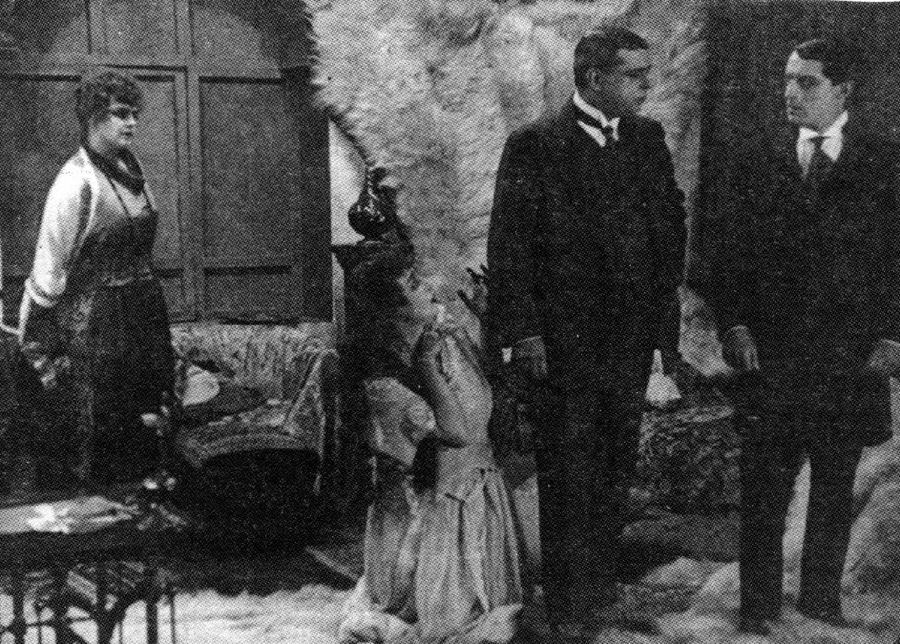
The final act of False Ambition is a masterclass in escalating tension. Judith is on the precipice of securing her future through a marriage to the wealthy Peter Van Dixon. The irony is thick; she has achieved everything she set out to do, yet she is more isolated than ever. The sudden appearance of David Strong functions as the 'return of the repressed.' He is the physical manifestation of the conscience she tried to drown in the Atlantic. His exposure of her fraud is not just a social execution; it is a spiritual one.
The film’s resolution, involving Judith’s return home and her eventual acceptance by Paul Vincent, might feel like a concession to the moralistic demands of 1918 audiences. However, viewed through a modern lens, it suggests a more complex psychological reality. Judith’s 'repentance' is perhaps less about a sudden discovery of morality and more about the total exhaustion of the ego. Having played so many roles—the sister, the lover, the fortune-teller, the aristocrat—she has finally run out of scripts. Paul Vincent’s offer of marriage is not a reward for her crimes, but a recognition of the 'better nature' that was buried under layers of defensive ambition. This redemptive arc is a staple of the genre, reminiscent of the emotional journeys in God of Little Children and God's Law and Man's.
Technically, False Ambition stands as a testament to the sophistication of the Triangle Film Corporation’s output. The editing, though primitive by today’s standards, manages to maintain a brisk pace that underscores Judith’s frantic social climbing. The contrast between the rural simplicity of the opening scenes and the opulent, often threatening interiors of New York provides a visual shorthand for Judith’s internal conflict. While it may not have the rugged outdoor scale of The Heart of Texas Ryan or Arizona, it excels in the 'chamber drama' format, focusing on the micro-expressions of its lead actress to tell the story.
Comparing it to other contemporary works like The Lash of Destiny or Paid in Full, one can see a burgeoning interest in the 'career woman' or the 'independent woman,' even if that independence was often framed as villainous. Judith is a precursor to the femme fatale of the 1940s, a woman who uses her intellect and beauty to navigate a world that would otherwise ignore her. The film also touches on the class anxieties of the era, much like The Martinache Marriage, highlighting the fragility of the social ladder.
Ultimately, False Ambition is a haunting reminder of the ephemeral nature of identity. It asks uncomfortable questions about the cost of reinvention: How much of ourselves must we kill to become the person we think we want to be? While the film ends on a note of domestic stability, the shadow of Judith’s past exploits lingers. The viewer is left wondering if the fire that fueled 'Zariska' is truly extinguished or merely smoldering beneath the surface of a quiet life.
For enthusiasts of silent cinema, this film is an essential artifact. It lacks the simplistic moralizing of Doctor Neighbor and avoids the bleakness of The Great White Trail, finding instead a middle ground of psychological realism. It is a story of a woman who flew too close to the sun, not on wings of wax, but on wings stolen from the dead. In the end, Judith’s greatest ambition wasn't wealth or marriage, but the terrifyingly modern desire to be someone else entirely. In achieving that, even briefly, she became one of the most compelling figures of early 20th-century film.
— A cinematic journey through the ruins of a soul, False Ambition remains a poignant study of the masks we wear and the truths we cannot outrun. —

IMDb —
1920
Community
Log in to comment.