DbcultAccessing Vault...
Cult Review
Senior Film Conservator
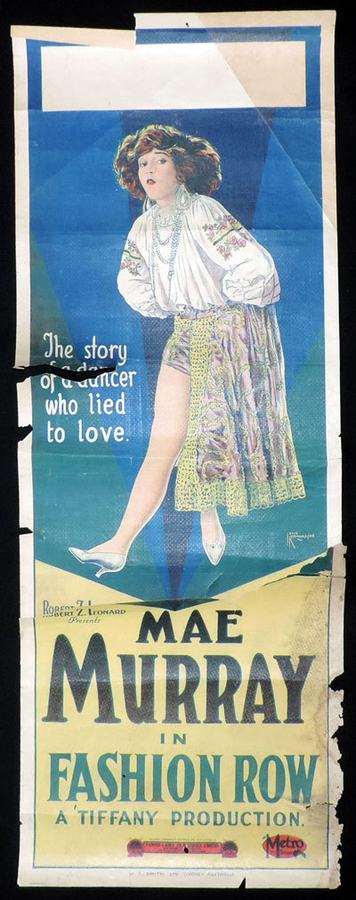
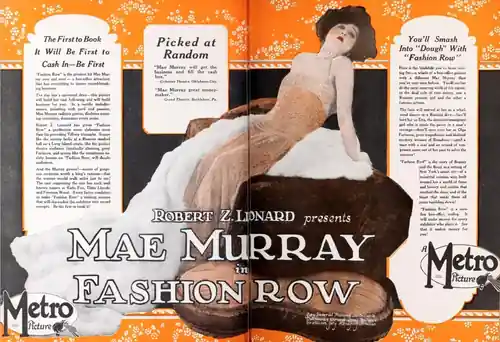
Fashion Row
, a 1924 silent film directed byAlfred A. Cohn
, is a chiaroscuro of human ambition and moral decay. The story, penned bySada Cowan
, unfolds with the precision of a gilded clockwork, its gears grinding against the jagged edges of class warfare and familial disintegration. At its core, the film is a duet between two sisters,Olga Farinova
, both portrayed with uncanny duality byMae Murray
, a performer whose physical expressivity transcends the limitations of silent cinema.Fashion Row
is not merely a melodrama of Russian émigrés; it is a searing indictment of the American Dream’s transactional soul.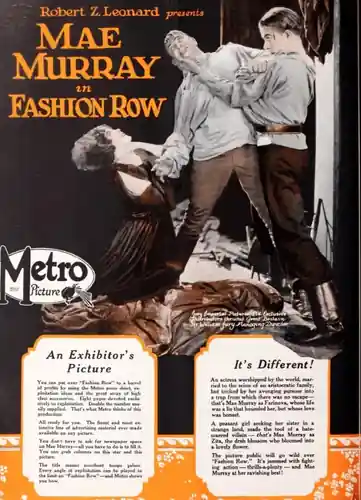
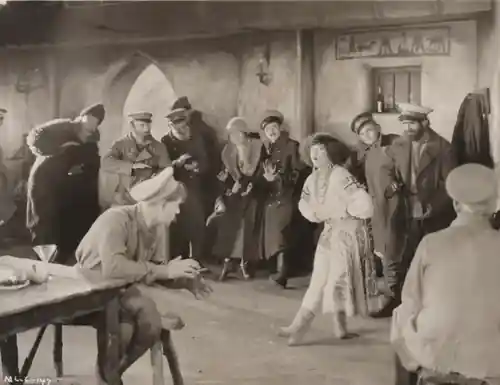
The film’s opening act is a masterclass in visual storytelling. The revolution’s chaos is rendered in stark, expressionistic shadows—peasant huts reduced to ash, snow-strewn fields swallowing fleeing figures. Olga and Zita’s escape is less an act of love than a calculus of survival. While Zita clings to her rural simplicity, Olga sheds her past like a snake’s skin, donning a false crown and a new lexicon of aristocratic pretense. Her transformation from peasant to
"Princess Anastasia"
is as seamless as it is sinister, a performance within a performance that blurs the line between reinvention and erasure. The film’s most provocative line, delivered via intertitle, reads:"A name is a mask; wear it, or be worn by it."
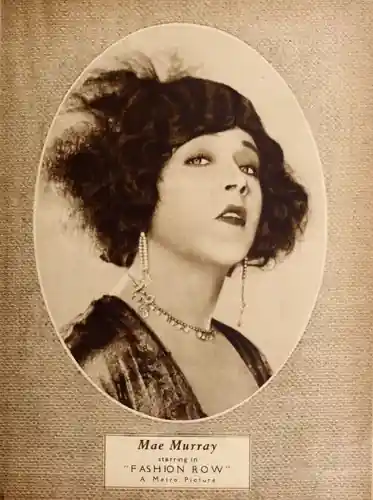
Mae Murray’s portrayal of Olga is a study in contrasts. Her physicality—aristocratic poise juxtaposed with the feline menace of a woman perpetually on the hunt—is both mesmerizing and unsettling. When Olga waltzes into the drawing rooms of her nouveaux riches patrons, her gestures are a choreography of deception, each step a calculated overture to power. Yet, in stolen moments alone, Murray’s eyes betray the flicker of her true self, a peasant girl haunted by the ghosts of her siblings’ poverty. Zita, by contrast, is a figure of quiet resilience. Her scenes—often bathed in the muted hues of a servant’s quarters—serve as the film’s moral compass, a stark counterpoint to Olga’s gilded excess.
The narrative’s pivot occurs when Kaminoff, a brooding
Elmo Lincoln
, becomes the tragic foil to Olga’s ascent. His obsession with her is not born of love but of a warped admiration for her ability to transcend her origins. His eventual act of violence—a gunshot fired in a fit of thwarted pride—serves as the catalyst for the film’s unraveling. The shooting is staged with Hitchcockian suspense, the camera lingering on Olga’s shattered mask before cutting to Zita’s tear-streaked face. It is here thatFashion Row
transcends its melodramatic roots, questioning the cost of upward mobility in a society that demands the commodification of identity.The film’s second act is a labyrinth of social satire. Olga’s marriage to the industrialist’s son is less a union of equals than a merger of capital and cunning. Their interactions are choreographed like a boardroom negotiation, each line of dialogue a stock trade in social capital. The husband, played with weary charm by
Freeman Wood
Visually,
Fashion Row
is a feast of interwar aesthetics. The sets—gleaming Art Deco parlors and crumbling Russian estates—contrast like opposing philosophies. The film’s color palette (in its surviving tinted reels) leans into crimson and gold, hues that evoke both opulence and blood. In one striking sequence, Olga’s reflection is split on screen: half a peasant in a squalid tenement, half a starlet in a gilded dressing room. It is a visual metaphor for the duality that defines her existence.The film’s third act is a reckoning. Zita, now a reluctant heir to her sister’s empire of lies, must navigate a world where truth is a currency no one wants to hold. Her arc is not one of redemption but of quiet endurance—a testament to the idea that survival sometimes requires complicity. The final scene, which mirrors the opening’s snowy exodus, sees Zita walking away from the family mansion, her back turned to the viewer. Whether this is liberation or resignation is left ambiguously in the frame.
In the pantheon of
1920s silent cinema
occupies a unique niche. It shares thematic DNA with in its exploration of duality, though its tone is far more cynical. The film’s preoccupation with performance also echoes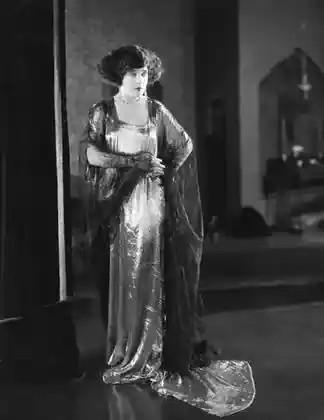
Fashion Row
is a threnody. Its critique of class mobility anticipates the themes of , though with a sharper edge. For modern audiences, the film’s greatest resonance lies in its interrogation of identity politics—how we wear our histories like costumes, and what happens when those costumes begin to unravel.The casting of
Mae Murray
in dual roles is a masterstroke. Her ability to inhabit both Olga’s glittering artifice and Zita’s earthy authenticity is a feat of silent-era acting that would makeLillian Gish
envious.Elmo Lincoln
, though often typecast as a brooding villain, brings a tragic gravitas to Kaminoff, elevating the character beyond mere melodramatic fodder. The supporting cast, includingMathilde Brundage
Freeman Wood
as the oblivious industrialist, provide the necessary texture to the film’s social critique.The screenplay, credited to
Sada Cowan
, is a labyrinth of intertitles that marry wit to existential dread. Lines such as"We are all actors in a play we did not write"
and"Poverty is a mask only the rich can see through"
are delivered with the punch of a well-timed farce, yet linger with the weight of tragedy. The film’s dialogue is less a vehicle for plot than a mirror held up to the audience’s complicity in the very systems it deconstructs.In the broader context of early American cinema,
Fashion Row
pre-Code Hollywood
and the more restrained narratives of the coming Code era. Its exploration of class, gender, and identity would have been deemed too incendiary in the late 1930s, yet here, in the unregulated spaces of the 1920s, it thrives. The film’s influence can be traced in the work ofDouglas Sirk
, whose melodramas similarly weaponized color and excess to critique postwar America.For contemporary audiences,
Fashion Row
is a revelation. It is a film that understands the performative nature of identity long before the advent of social media. Olga’s journey from peasant to princess is a precursor to the modern influencer’s rise, where authenticity is a brand and vulnerability a liability. Zita, meanwhile, represents the quiet rebellion of those who refuse to perform, who live in the margins but anchor the center of the narrative.The film’s technical achievements are also worth noting. The use of
double exposure
in the mirror scene is a marvel of 1920s special effects, a visual conceit that anticipates the layered narratives of . The editing, though brisk by today’s standards, is taut and purposeful, with cross-cutting between Olga’s lavish world and Zita’s squalor amplifying the film’s social commentary.In conclusion,
Fashion Row
is a film that rewards multiple viewings. Its layers of metaphor, its nuanced performances, and its unflinching critique of class and identity make it a cornerstone of silent cinema. It is a film that asks uncomfortable questions about the cost of ambition and the masks we wear to survive. For cinephiles and historians alike, it is a window into a world where reinvention was both a lifeline and a noose.
IMDb 5.4
1928
Community
Log in to comment.