DbcultAccessing Vault...
Cult Review
Senior Film Conservator
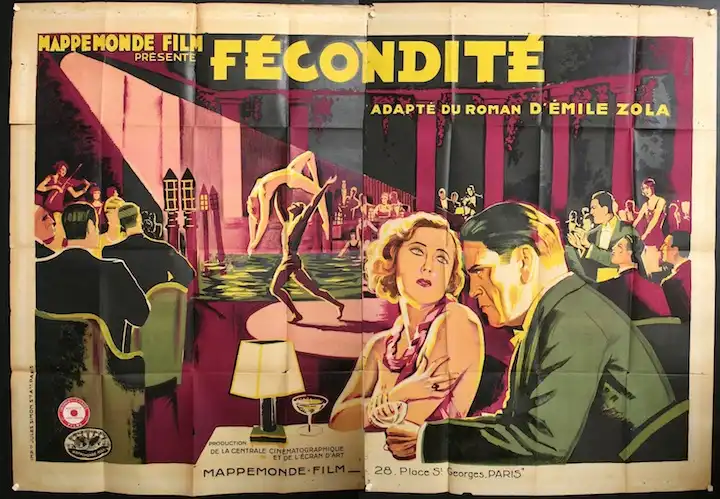
Alright, so if you're dipping your toes into early French cinema and happen upon Fécondité, you're in for a specific kind of ride. This isn't a blockbuster, obviously. Folks who appreciate a really slow burn, the kind that lets you just *sit* with the story and its ideas, might find something quite compelling here. Especially if you're into Émile Zola's stuff, or just old films that really try to tackle big social questions. But for anyone expecting a fast pace, or even just some clear, crisp picture quality, this one will probably test your patience. And it's okay if it does! Not every film is for every mood.
The whole thing is based on Zola's novel, and it’s about a couple, Mathieu and Marianne, who decide to just keep having kids. Like, *lots* of kids. It’s their answer to what they see as a dwindling French birthrate, and the film really leans into this idea of life, growth, and family. You feel the weight of this almost immediately.
One of the first things you notice is the pacing. It’s glacial, honestly. Not in a bad way, necessarily, but it moves at its own speed. You get long, lingering shots on faces, on scenes that just… exist for a while. It gives you a lot of time to think, maybe too much sometimes, but it’s definitely not rushed.
There's a scene early on where Mathieu, played by Albert Préjean, is just looking out a window. It goes on for what feels like a full minute. You really feel his thoughts, or what the director wants you to feel he's thinking. It’s **really effective** at making you consider his character, but also, you start to wonder if the projectionist fell asleep. 😂
The film just lets moments breathe. It's not worried about moving the plot along. It's more about showing you a *state* of being, a way of life. The conversations, when they happen, feel deliberate, almost like declarations.
Flore Deschamps as Marianne is just wonderful. Her face holds so much. You see the joy, sure, but also the sheer exhaustion of having so many children. It’s not romanticized motherhood at all. It feels gritty, real in a quiet way. There’s a shot where she’s surrounded by about five or six little ones, all clamoring, and her smile is there, but her eyes… they tell a whole other story. It stuck with me.
Préjean’s Mathieu is a bit more of a dreamer, maybe even a zealot for his cause. He’s often shown with a sort of intense, faraway look. He's not always easy to like, but you understand his conviction. His interactions with other characters, especially those who doubt his large family ideal, are often quite sharp. You see the social commentary really surface there.
The supporting cast, like Alex Allin and Andrée Lafayette, they just *fit* into this world. They're not flashy. They're just people. Andrée Lafayette, especially, had this almost tragic air about her character. It makes you wonder about her whole life story, even though the film doesn't really go there. It just hints at it. Like the way she holds herself, a bit stiff, a bit guarded.
Visually, it's exactly what you'd expect from the era. Black and white, sometimes a bit grainy, but there are some **really beautiful** shots. The outdoor scenes, especially, have a raw, natural light to them. You see the fields, the simple homes. It feels lived-in, not staged. It’s less about grand sets and more about capturing the everyday.
There’s a part where they show the kids growing up, a series of quick cuts. It's almost montage-like, but very early cinema style. It’s pretty neat how they convey the passage of years with just a few moments. It's efficient, which is a word I wouldn't use for much else in the film, but it works there.
One thing that kept catching my eye was the clothing. It's so specific to the time, and you see the progression from simple farm wear to slightly more 'modern' (for the 20s) city clothes. It’s a subtle way to show the family's journey, even if it feels like a side note.
And the sound design, or lack thereof, is just part of the experience. The quiet makes you focus on the visuals, on the facial expressions. Sometimes you wish for a bit of score, but then you realize the silence is part of its charm. It just *is*.
You can tell this is Zola. The emphasis on social issues, the almost scientific observation of human behavior, the way it presents an idea and then explores it through characters. It’s not subtle about its message, about the importance of family and children. But it’s not preachy either, not in a way that feels forced. It just lays it all out.
The film does a good job of showing the *consequences* of Mathieu and Marianne's choices. Not just the happy ones, but the struggles, the sheer amount of work, the way it sets them apart from others who choose different paths. There’s a strong sense of a choice being made, and lived with.
It's interesting to compare this to other adaptations of social novels from the era, like maybe The Message of Emile Coué, which also had a clear, almost didactic message. Both films use their medium to directly address contemporary concerns, though Fécondité feels a bit more narrative-driven than purely instructional.
There's a scene near the end, a big family gathering, children and grandchildren everywhere. It’s supposed to be this triumphant moment. And it is, sort of. But you also see the sheer *volume* of people, the chaos, the noise. It feels like a real family, messy and overwhelming, rather than some perfect, idyllic picture. That small detail really makes the film feel grounded.
Is Fécondité a masterpiece? Probably not in the conventional sense. But it's a **fascinating artifact**. It's a window into a specific time, a specific mindset, and a specific style of filmmaking. It doesn't try to entertain you with thrills. It just *is*. And sometimes, that's enough.
It’s the kind of film you put on when you want to truly disconnect from everything else. You let it wash over you. It’s not something you passively watch; it demands a bit of your attention, even with its slow pace. And for that, it earns some respect. It's just a raw, unvarnished look at a big family trying to make its way in the world, trying to prove a point.
The ending leaves you with a lot to ponder. It doesn't wrap everything up neatly, which is nice. It just shows you the ongoing life, the legacy. And that’s what Zola was going for, wasn’t it? A slice of life, with all its mess and meaning.
IMDb —
1920
Community
Log in to comment.