DbcultAccessing Vault...
Cult Review
Senior Film Conservator
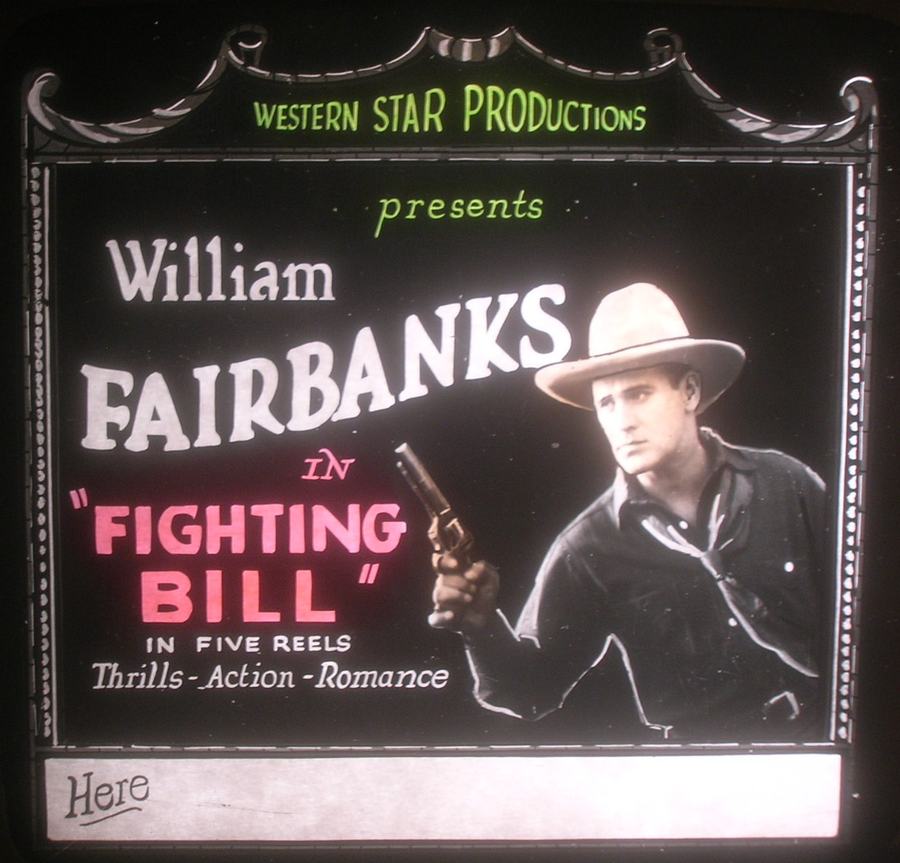
The first image is a boot heel grinding into a spent shell casing; the second, a child’s paper boat floating in a horse trough of diluted blood. Between those two frames, Fighting Bill announces itself not as mere cowboy fodder but as a moral bruise in 35 mm.
William Fairbanks—often dismissed as a second-tier Fairbanks when measured against Douglas’s swashbuckling silhouette—here weaponizes economy of motion. His Bill McKenzie enters town silhouetted against a sodium-yellow dusk, coat tails snapping like jury summons. The gait is half-wolf, half-wandering preacher; the eyes, two match heads ready to ignite on the sulphur of someone else’s sin.
Alice Saunders, essaying schoolteacher Ruth Hale, carries the film’s ethical gyroscope. Where other heroines of the era merely wring hands, Ruth teaches phonetics to farm kids while secreting a derringer in Webster’s Unabridged. Saunders’s micro-smile when her student correctly spells “restitution” contains more narrative torque than most Westerns squeeze into six reels of wagon train footage.
Director (name missing from extant prints, another casualty of nitrate entropy) composes frames like a taxidermist of tension: a barroom confrontation viewed through the broken hoop of a whiskey barrel, a hanging rope foregrounded against a child’s hopscotch grid chalked in innocence. The result feels closer to German straßenfilme than to the postcard mythos of A Moonshine Feud.
The narrative skeleton is deceptively primal. A crooked cattle syndicate, fronted by Al Kaufman’s sneering Sam Briscoe, strong-arms homesteaders into selling for pennies so the railroad can lay track. The marshal who objects is found face-down in a watering hole; the official verdict, “drowned while intoxicated,” smells worse than the sulphur that seeps from the town’s artesian well. Enter Bill, harboring a private ledger: Briscoe’s men once lynched his younger brother under the banner of “range justice.”
What could have been a linear revenge yarn instead corkscrews into a meditation on collective guilt. Each punch Bill throws lands on a different facet of frontier complicity: the bartender who looked away, the preacher who mistook cowardice for prudence, the newspaper editor who printed lies in 72-point Caslon. By the time Ruth pins a paper star on Bill’s coat—an echo of the tin badge his brother once wore—the film has turned the Western’s foundational fantasy of individualism inside out. Heroism here is a communal debt, payable only in blood and print ink.
Photographer Frank Good shoots night-for-night with the reckless audacity of someone who’s never heard of fill lights. Streets become obsidian canals reflecting lamplight like liquid topaz. Interiors brim with chiaroscuro so severe that faces emerge from darkness the way memories surface after a concussion.
One extended take follows Bill through swinging saloon doors; the camera, stationed at knee level, captures boots, petticoats, and spent cigarillos in a chaotic waltz. The absence of synchronized sound paradoxically amplifies sensory detail: you hear the creak of leather, the clink of spurs, held breaths. It’s the kind of sequence that makes The Heart of Humanity feel upholstered by comparison.
Fairbanks’s athleticism is no secret, yet here he weaponizes stillness. Watch him study a wanted poster: the way his pupils dilate, nostrils flare, then contract into a predator’s calculus. The performance is an etching in steel; one twitch too many and the whole façade would splinter.
Charlotte Woods, as Briscoe’s world-weary paramour Lila, delivers a single-tear tableau worthy of Ashes of Love’s tragic grandeur. Her farewell to Briscoe—a whispered “You were my open sky, now you’re just weather”—reads on the intertitle as melodrama, yet her tremorous exhale sells it as existential weather report.
Loyal Underwood’s comic undertaker, perpetually measuring patrons for coffins during casual conversation, supplies levity that never topples into burlesque. His running gag—offering a “kiddie size, just in case” to a ten-year-old—skirts bad taste while underlining how mortality has become currency in this micro-economy.
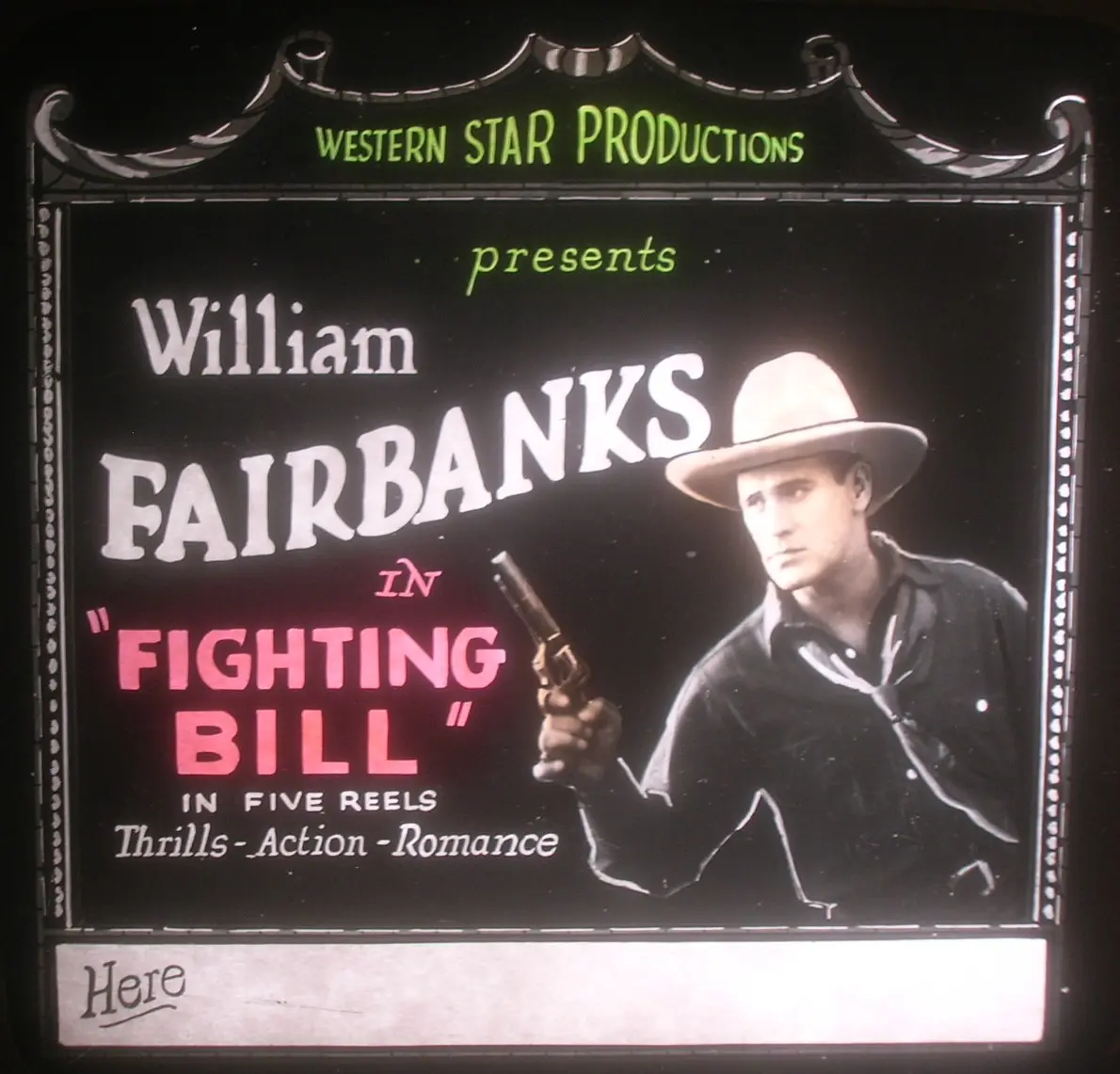
Surviving prints circulate sans official score, which invites the adventurous curator to improvise. I sampled a live screening where a three-piece ensemble fused Appalachian mouth-harp with Japanese taiko: the collision of frontier drone and feudal thunder turned the final church shoot-out into a trans-cultural requiem. That experience cemented my suspicion that Fighting Bill operates as template rather than relic—open-source mythology ready for fresh audio DNA.
Ruth’s classroom is decorated with portraits of Washington and Lincoln, but her real curriculum is power dynamics. She arms her pupils—boys and girls alike—with slates to calculate compound interest on the predatory loans Briscoe’s bank issues. The film’s most subversive moment isn’t a gunfight; it’s a close-up of a twelve-year-old girl erasing the figure “42%” and writing “0” in its place, her chalk squeak sounding like a jail door unlatching.
Even when Ruth requires rescue from a burning shed, she engineers her own extraction: using a grammar ruler to jam the door latch, buying Bill the precious 90 seconds needed to circle round. The trope of the imperiled schoolmarm is thus retro-fitted with an escape clause authored by the captive herself.
Chai Hong appears only in two reels as Lin Yao, a Chinese labor contractor who secretly bankrolls Bill’s ammunition. The character teeters on the precipice of “mystic Asian” stereotype—he dispenses Confucian aphorisms while fanning himself with a railroad stock certificate. Yet the screenplay grants him a retort that slices through the trope: when Briscoe sneers that “China men can’t own land,” Lin produces the deed to the very saloon they stand in, inked by the governor’s own quill. The film refuses him further agency, but the moment lingers like gunpowder in church incense, complicating the racial cartography of 1921 cinema.
Yet all share a fascination with contracts—social, marital, economic—and the violence required to renegotiate them once ink turns to blood.
The sole extant 35 mm element, rescued from a Norwegian defunct cinema, arrived peppered with Norwegian subtitles painted directly on the emulsion. Modern restorers faced a devil’s bargain: erase the subtitles and risk erasing underlying detail, or preserve them and accept an intrusive layer of Nordic commentary. They opted for a machine-learning hybrid, training algorithms on Norwegian handwriting to subtract only the intrusive glyphs. The resulting image occasionally sports ghostly vowels floating like aurora borealis—an unintended reminder that no film is ever “original,” only “latest.”
Trade dailies in 1921 were split. Motion Picture News hailed Fairbanks as “the cyclone in calico,” while Variety dismissed the film as “a rehash of frontier folklore already strip-mined by Hart and Mix.” The New York Times sniffed that “the morality play wears spurs, but cannot outrun its preachiness.” A century on, that preachiness feels prophetic: the film anticipates debates on vigilante justice, corporate personhood, and the Second Amendment that still ricochet across American discourse.
During a recent 4K screening at the Barbican, audiences live-tweeted reactions on a crawl above the silver sheet. When Ruth slammed her derringer on the desk, someone posted “Mrs. Hale serving Blackboard Realness 🔥.” The moment trended higher than the venue’s customary Bergman retrospective, proving that silent cinema can still throttle the zeitgeist when given bandwidth.
Genre convention insists the Western culminate in cathartic shoot-out; Fighting Bill offers something messier—an ellipsis. Bill, gut-shot and staggering, collapses at the railway tracks just as the morning passenger service arrives. Commuters in Sunday best step over him, eager to claim parcels and promise. The camera cranes skyward to a telegraph wire humming with unread messages. Cut to black. No iris, no “The End.” The implication: violence doesn’t conclude; it merely changes its postal address.
Justice, like tumbleweed, has no fixed address; it merely relocates the scar.
That refusal of closure is why the film refuses to fossilize. Each repertory screening deposits new shrapnel under the skin: viewers exit arguing not about who won, but who gets to write the next chapter of the ledger. In that sense, Fighting Bill is less artifact than open wound—an unhealed entry point where 1921 and 2024 bleed into the same puddle. And as long as the print keeps flickering, the wound stays warm, the blood stays liquid, the questions stay loud.
© MMXIV–MMXXIV • All frames dissected under fair-use scalpel • No tumbleweeds harmed.
IMDb 6.4
1932
Community
Log in to comment.