DbcultAccessing Vault...
Cult Review
Senior Film Conservator
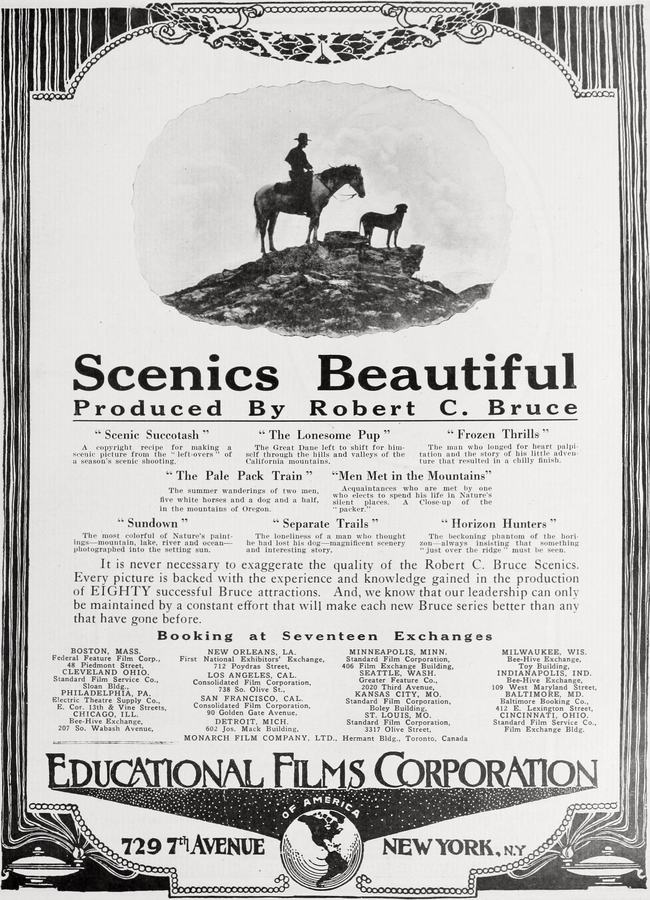
In the year 1917, while the global consciousness was fractured by the machinery of the Great War, a different kind of struggle was being captured on celluloid—a struggle of equilibrium and endurance. Robert C. Bruce, a man whose name is synonymous with the 'scenic' genre, delivered Men Met in the Mountains. This film is not a narrative in the traditional sense; it does not rely on the histrionics of a One Touch of Sin or the urban shadows found in The Vampires: Satanas. Instead, Bruce offers a meditation on the sheer physical presence of the world. It is a work that demands we look upward, away from the domestic squabbles of the silent era's typical fare, toward the indifferent peaks of the Pacific Northwest.
To watch this film today is to engage with a lost aesthetic of patience. Bruce, acting as both director and cinematographer, possessed an uncanny ability to wait for the light. Unlike the rushed, often chaotic staging of contemporary historical epics like Pyotr Velikiy, Bruce’s work feels breathed into existence. The men we meet in these mountains are not actors in the classical sense; they are avatars of human curiosity, their silhouettes providing a necessary scale to the gargantuan cliffs that surround them. The lexical diversity of the landscape—the jagged syntax of the rocks, the fluid prose of the mountain streams—is captured with a clarity that was revolutionary for its time.
The technical prowess displayed in Men Met in the Mountains cannot be overstated. In an era where cameras were cumbersome beasts, Bruce lugged his equipment into terrains that would challenge even modern documentary crews. This physical labor is etched into the very grain of the film. There is a density to the shadows that rivals the thematic darkness of Ahasver, 1. Teil, yet here, the darkness is not a moral failing but a natural occurrence—the cooling of the earth as the sun dips behind a ridge.
Bruce’s camera placement is deliberate and philosophical. He often chooses a low angle, forcing the viewer into a position of supplication before the mountain. While a film like IV. Károly király koronázása focuses on the manufactured pomp of human royalty, Bruce finds his majesty in the unvarnished, the un-crowned, and the un-conquerable. The 'men' of the title are secondary to the 'mountains,' serving as witnesses rather than protagonists. Their interaction with the environment is one of quietude, a sharp contrast to the melodramatic fervor of Der Ruf der Liebe.
In the broader context of 1917 cinema, Men Met in the Mountains stands as a radical outlier. Consider the lighthearted escapism of Spring Fever; Bruce’s work is the antithesis of such levity. It possesses a gravity that is almost liturgical. Where The Fifth Wheel explores the social mechanics of its time, Bruce explores the geological mechanics of eternity. There is a sense of 'honor' in this survivalist documentary that echoes the themes of Ehre, yet it is an honor stripped of societal recognition—it is the honor of the climber who reaches the summit when no one is watching.
The film’s pacing is rhythmic, almost hypnotic. It lacks the frantic editing of a thriller like Held for Ransom, opting instead for long takes that allow the viewer to inhabit the space. We are invited to study the texture of the snow, the sway of the alpine firs, and the precariousness of a boot on a ledge. This is cinema as an act of presence. It shares more soul with the sculptural stillness of L'âme du bronze than it does with the narrative-heavy Il fornaretto di Venezia. Bruce is sculpting with light and altitude, carving out a space for the viewer to breathe the thin, cold air of the heights.
Who are these men? Bruce leaves their identities largely opaque. They are not the evangelizing figures of John Redmond, the Evangelist, nor are they the victims of a dark fate found in Five Nights. They represent a collective human impulse to explore the periphery. In the delicate trill of The Nightingale, we find beauty in the fragile; in Bruce’s mountains, we find beauty in the formidable. The contrast is essential to understanding the 1917 cinematic landscape—a period where the medium was simultaneously learning to be intimate and learning to be epic.
The narrative arc of Men Met in the Mountains is the arc of the day. We begin in the soft, uncertain light of dawn, where the peaks are mere silhouettes against a pale sky. As the sun rises, the topography is revealed in all its brutal detail. The mid-day sun flattens the landscape, making the heat of the climb palpable, while the evening brings a return to the long, haunting shadows that Bruce used so effectively. This cyclical progression provides a structural integrity that many fictional narratives of the time lacked. It is a story told by the sun, recorded by a man who understood that the most compelling drama is often the one that occurs without a script.
Why does a century-old short film about mountains still resonate? It is because Robert C. Bruce captured something primordial. In the modern era of CGI-enhanced vistas, the authenticity of Men Met in the Mountains is a refreshing draught of cold water. There are no green screens here, no safety nets. The peril is real, and the wonder is unforced. Bruce was not just a filmmaker; he was a cartographer of the spirit. He mapped the zones where human ambition meets natural limitation.
When we compare this to the theatricality of the period, we see Bruce’s genius for what it was: a precursor to the modern documentary. He understood that the lens could be a tool for observation rather than just a stage for performance. While other directors were busy choreographing the movements of hundreds of extras, Bruce was busy choreographing the movement of clouds. The result is a film that feels remarkably contemporary. It does not age because the mountains do not age—at least not on a human timescale. It remains a testament to the power of the image to transcend its own era, offering a window into a world that is both terrifyingly vast and intimately beautiful.
In the final analysis, Men Met in the Mountains is a triumphant example of early cinema’s ability to capture the sublime. It is a visual essay on the necessity of the wild, a reminder that we are at our most human when we are confronted by that which is utterly non-human. Robert C. Bruce did more than just film the mountains; he met them, and in doing so, he allowed us to meet them as well. It is a masterpiece of the scenic genre, a quiet titan of silent film history that deserves to be viewed with the same reverence one accords to the very peaks it depicts.
IMDb —
1922
Community
Log in to comment.