DbcultAccessing Vault...
Cult Review
Senior Film Conservator
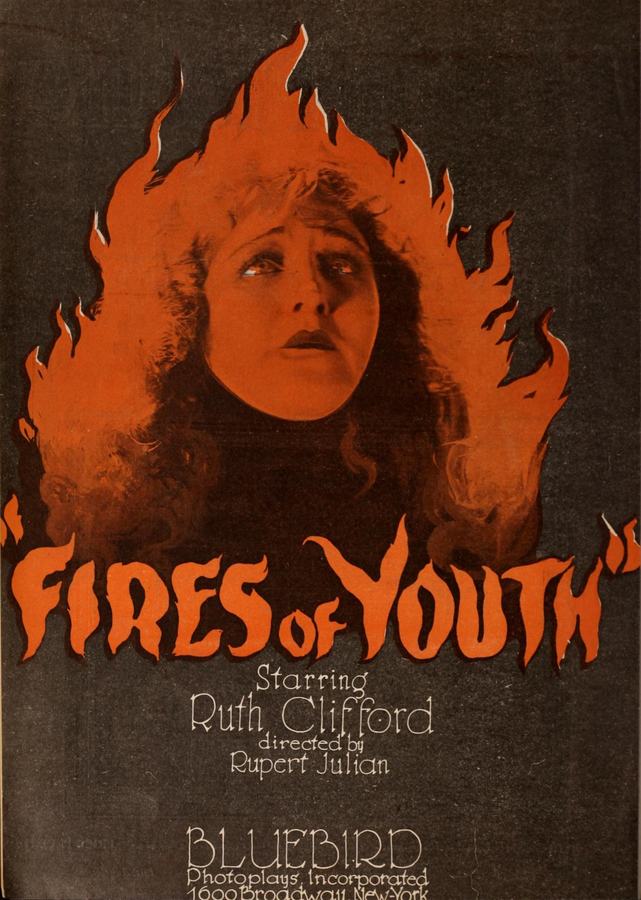
Where embers of longing lick the varnish of respectability, Rupert Julian’s Fires of Youth flickers—an intoxicating bonfire of silk, guilt, and self-immolating grace.
There is a moment, roughly two-thirds through this 1924 Paramount silent, when the camera forgets to blink: Lucille glides across a parquet floor strewn with torn love letters, her satin train dragging the fragments like a comet tail of regret. The iris-in halts, the frame burns white-hot, and for an instant the medium itself seems to inhale her anguish. Few films of the era dared such synesthetic subjectivity; fewer still survived the nitrate purgatories that followed. Yet here we are, a century later, squinting at a 2K scan that crackles like a hearth newly stoked, realizing that Julian’s melodrama is less a relic than a revelation.
Act I—Ice. The Linforth mansion, a mausoleum of mahogany, swallows Lucille’s footsteps whole. Cinematographer James Van Trees lenses her introductory close-up through a prism of crystal beads, fragmenting Ruth Clifford’s face into kaleidoscopic desire: here a mouth, there a widow’s peak, everywhere the ache of unused youth. John’s proposal arrives not on bended knee but via fountain pen: a contract masquerading as courtship. The wedding scene is staged in a conservatory where orchids droop like exhausted courtesans, their perfume almost audible on the intertitles, which flicker with Clawson’s signature haiku brevity: “A ring of gold—yet colder than the gap between stars.”
Act II—Fire. Ronald’s re-entrance is heralded by a match-cut: a polo mallet striking a ball smash-cuts to Lucille’s hand slapping a croquet hoop, the sonic void bridged by pure kinetic eroticism. Their clandestine tutorials in laissez-faire morality unfold in the solarium where panes of glass become moral barometers—fogged by breath, cleared by shame, re-fogged by compulsion. Julian’s blocking is ballet: the lovers orbit a pedestal table like planets caught in each other’s gravity, while a single caged canary provides avian Greek chorus, trilling whenever dialogue would be redundant.
Act III—Ash. The blackmail subplot arrives with Germanic inevitability, owing perhaps to Julian’s stint at UFA. The burglar, face obscured by a harlequin mask half-lit, resembles a negative-image Pierrot—tragedy inverted into farce. His demand is not cash but ownership: he wants Ronald to buy back the evidence of his own humanity. The moral ledger balances only when Lucille kneels before her husband’s massive desk—an altar to capitalism—and offers up her transgression like a communion wafer. John’s forgiveness is visualized as a slow dolly-in on Ralph Lewis’s granite profile, a tear traversing one cheek like a rivulet splitting stone. The final jump-cut to a year-later wedding is both miracle and curse: we never see the divorce papers signed, only autumn leaves superimposed over Lucille’s remarried smile, suggesting time itself has been montaged out of existence.
Ruth Clifford operates at the rare frequency where technical precision and reckless abandon cohabitate. Watch her pupils in the medium two-shot when Ronald first utters the word “free”—they dilate like ink drops in water, an involuntary confession the camera seizes like a pickpocket. Her hands, always half a second ahead of her intentions, flutter, clasp, wring, finally fold into a cathedral of resignation. It is a masterclass in micro-gesture, predating Maria Falconetti’s Joan by four years yet every bit as seismic.
George Fisher’s Ronald carries the contradictory weight of boyish pluck and moral fatigue. His cheekbones seem perpetually back-lit, as though conscience were a lantern held inside the skull. When he refuses elopement, the decision lands not as cowardice but as a tragic recognition that freedom purchased with forgery is merely another gilt cage. The intertitle reads: “We would always taste iron on our wedding cake.” Fisher lets the line hang, then swallows it like broken glass.
Ralph Lewis, saddled with the thankless role of “antiquated husband,” refuses caricature. He endows John with the weary dignity of a man who once loved deeply but misplaced the instruction manual. His final gesture—placing Lucille’s hand into Ronald’s while staring at the minister’s feet—carries the stoic ache of King Lear divesting himself of the storm.
Julian and Van Trees conspire to make shadow a character. When Ronald scales the garden trellis to Lucille’s balcony, his silhouette merges with a wrought-iron vine, transforming him into a hybrid of flesh and flora—desire literally taking root. Interior scenes favor low-key lighting that carves caverns under cheekbones, while exteriors bloom with over-exposed whites, as though the world beyond the manor were a perpetual overcast noon. The burglar’s mask, half-black, half-white, is not symbolic; it is diagnostic: morality here is a lighting decision.
Note the motif of mirrors. Lucille’s boudoir contains an oval looking-glass cracked in a spiderweb pattern. Each time she consults it, the fracture multiplies, implying identity itself is subject to compound interest. In the penultimate scene, as she prepares for her second wedding, the mirror is whole again—yet Ronald’s reflection appears slightly out of register, a ghosted double-exposure suggesting that memory, like silver nitrate, can never fully self-repair.
Surviving prints are accompanied by a 2019 Donald Sosin score that favors minor-key piano and glass harmonica, yet I urge you to watch it once with the volume zeroed. In that vacuum, the film becomes a Rorschach of personal noise: the imagined rustle of Lucille’s taffeta, the phantom clink of John’s brandy snifter, the remembered hush of your own heartbreak. The absence of music exposes the rhythmic twitch of the film itself—every fourth frame seems to skip a beat, as though the celluloid too suffers arrhythmia.
Set it beside The Bar Sinister (1922) and you’ll notice both films weaponize the intertitle as whispered gossip; yet where Bar winks, Fires weeps. Pair it with Locura de amor and you find continental cousins in hysterical brides and senescent grooms, though the Spanish melodrama opts for convent bells where Julian chooses wedding bells. The closest spiritual sibling may be Out of the Night (1925), which likewise trades in blackmail and moral restitution, yet lacks Clifford’s luminous translucence—its heroine is a femme fatale, whereas Lucille is merely femme, full stop.
Contemporary trade sheets praised Clifford’s “opaline luminosity” while dismissing the plot as “a pudding of penny-postcard predicaments.” Modern viewers, inoculated against irony, will instead detect a pre-code prophet: a film that sanctions divorce without demonizing desire, that labels blackmail a capitalist adjunct long before noir codified the trope. When the burglar snarls, “Everything has a price, even your conscience,” he could be quoting 2023 ransomware.
Because we are all, in some ledger, debtors to choices we did not invoice. Because Ruth Clifford’s eyes hold the same liquid question we avoid in our own bathroom mirrors. Because Rupert Julian, dismissed as a journeyman, sneaks transcendence into what could have been mere assignment. And because the final image—a slow fade on Lucille and Ronald exiting the chapel, confetti falling like discharged securities—reminds us that happiness is sometimes a merger, sometimes a buy-out, but always a risk.
Stream the 4K restoration on Silent Tuesdays or haunt your local cinematheque; just don’t let the fire die out before you’ve felt its heat on your own conscience.
IMDb 7.5
1935
Community
Log in to comment.