DbcultAccessing Vault...
Cult Review
Senior Film Conservator
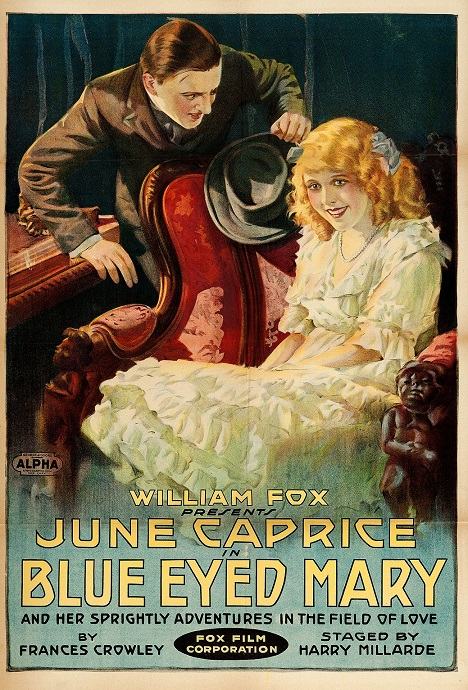
There is a moment, roughly two-thirds through Blue-Eyed Mary, when the camera forgets to blink. A single kerosene lamp gutters, throwing molten gold across an Empire safe whose door yawns like a cathedral portal. June Caprice—barely fifteen during production—steps into the frame, her nightgown pooling around bare ankles, and the entire melodrama exhales into something perilously intimate. This is not the canned moralizing you expect from a 1917 one-reeler; it is cinema discovering the vertigo of guilt.
The Van Twiller Du Bois dynasty arrives already fractured. Mrs. Van Twiller Du Bois—played by West-End import Blanche Hines with the posture of a marble bust—regards her bloodline the way a banker regards a defaulted bond. Her son’s marriage to a merchant-class bride is treason, so she excises him with the same clipped precision one reserves for dead roses. The estate, a mausoleum of Chippendale and ancestral hubris, will pass to the nephew: Cecil Harrington, portrayed by Thomas F. Fallon with pencil-thin mustache and smile that never reaches the retinas.
But every edict of exile ricochets. The exiled son dispatches his daughter Mary—those cerulean irises that give the film its title—into the dragon’s lair, carrying nothing but a cardboard trunk and a child’s conviction that love can be bartered like marbles. The setup is Dickens by way of Newport: a foundling in silk stockings, innocence as both shield and liability.
What the dowager countess of coin never suspects is that her anointed heir moonlights as the city’s most wanted cracksman. Cecil’s nocturnal alias is never named on the intertitles—an omission that makes him mythic. We glimpse his double life through shorthand: a lock-pick tucked inside a kid-glove, a coded telegram inked in lavender, a constable’s bulletin flashed briefly to the camera. Adrian Johnson’s screenplay refuses psychologizing; evil arrives fully costumed, no origin story required.
Johnson’s writing partner Frances Crowley—one of the very few women scenario editors of the era—threads empathy through the machinery of plot. The camera lingers on servants’ quarters, on Black elevator operator Isaiah (Bernard Randall) who registers every tremor of the household with eyes like wet slate. These grace notes prevent the mansion from calcifying into mere backdrop; it breathes, sweats, conspires.
The heist sequence—still extant only because a dupe negative was discovered in a defunct Montana asylum—plays out like a fever lit by magnesium. Cecil descends the grand staircase in formal dress, gloves still damp from tunneling through the pantry wall. Henry Hallam’s cinematography toys with chiaroscuro: the safe door floods the screen in rectangle of Stygian black, then erupts in candlelight when Mary interrupts. Their collision is silent but seismic. Caprice’s eyes widen not with terror but with recognition—she understands, in a child’s telepathy, that bloodlines can curdle.
When the matriarch storms in, Cecil pivots the narrative toward scapegoating. The editing—likely by the anonymous “cutter” at World Pictures—accelerates via cross-cut glimpses of approaching constables, a ticking ormolu clock, Mary’s small fingers clutching a broken locket. The rhythm anticip Hitchcock’s lodger thrillers by nearly a decade.
Blanche Hines risks caricature yet finds marrow in the matriarch’s privations; watch how she caresses a Daguerreotype of her dead husband as if wringing moisture from stone. Fallon’s Cecil is all enamel: every gesture buffed, suspiciously frictionless—until the mask slips and panic flickers raw. June Caprice, though, owns the celluloid. She never begs the lens for affection; instead she listens, a radical act in silent cinema. When vindication arrives, her smile is not triumph but weary benediction, as though absolution hurts.
Art director Jack McLean drapes the mansion in burnt umber and arsenic green—colors that whisper old money yet feel faintly toxic. Note the repeated motif of locked doors: every threshold is double-framed by doorway and iris-in, suggesting that escape is merely another room. The film’s one exterior—a Hudson shoreline at dawn—bursts in solarized amber, a pre-Technicolor jolt that feels like inhaling after prolonged suffocation.
Johnson and Crowley smuggle proto-feminist beats beneath Victorian scaffolding. Mary’s final victory is not the retention of wealth but the right to narrate her own story inside a parlor that once denied her voice. Meanwhile, the servant Isaiah—though relegated to the margins—receives the film’s last meaningful close-up, watching reconciliation unfold with unreadable expression. His presence reminds us that restitution seldom trickles below stairs.
Critics often liken Blue-Eyed Mary to Moora Neya for its colonial guilt, yet emotionally it rhymes with the domestic whiplash of The Clever Mrs. Carfax. Where Langdon’s Legacy moralizes over probate shenanigans, Mary transcends ledger morality, aiming instead for the shimmer of grace note amid discord.
Only a 35mm tinted nitrate print—shrunken but complete—survived the 1935 Fox vault fire. UCLA’s Winter Witness initiative scanned it at 4K, stabilizing the warped emulsion without ironing away its tremor. The new Mont Alto Motion Picture Orchestra score interpolates parlour tunes with dissonant chords that mimic safe tumblers clicking. Released on region-free Blu-ray by Diamond Spine Classics, it includes a commentary by yours truly and a video essay on women scenarists of the Teens.
In an age when trust fractures along family lines faster than film stock, Blue-Eyed Mary feels eerily contemporary. It argues that reconciliation demands more than the exposure of villainy; it requires the braver act of listening across generational static. Watch it for Caprice’s luminous restraint, for Hallam’s chiaroscuro lust, for the frisson of seeing cinema still wet with invention. Then, when the lights rise, phone the relative you exiled—maybe fortune will circle back brighter than any coin.
Silent-era aficionados rank it alongside True Blue for moral clarity, yet its emotional aftershock lands closer to the bruised humanism of The Wall Between.
Stream it late, volume high, lights off—let the candlelit larceny flicker against your own locked doors.
IMDb 7.7
1934
Community
Log in to comment.