DbcultAccessing Vault...
Cult Review
Senior Film Conservator
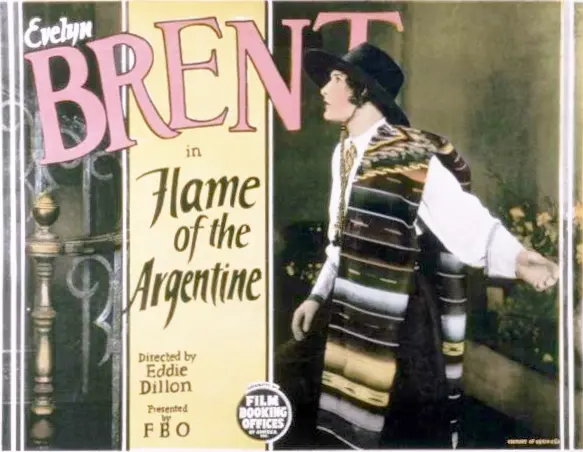
Is Flame of the Argentine worth your time today? Short answer: yes, but primarily as a masterclass in silent-era screen presence and the 'bad girl' redemption arc. This film is for those who find beauty in the expressive shadows of 1920s melodrama; it is decidedly not for viewers who demand complex, non-linear narratives or modern pacing.
This film works because it leverages the incredible facial acting of Evelyn Brent to bridge the gap between a cynical con artist and a repentant daughter. This film fails because the third-act reveal of Dan Prescott’s true identity feels like a narrative shortcut that undermines the tension built in the first hour. You should watch it if you want to see how early Hollywood interpreted the 'heist gone wrong' trope through a lens of high-stakes domestic drama.
The film opens not in the titular Argentina, but in the gritty, atmospheric cabarets of New Orleans. This choice is vital. It establishes Inez Remírez (Evelyn Brent) not as a villain, but as a survivor of the urban grind. When Emilio Tovar (Frank Leigh) approaches her, the camera captures the weary resignation in her eyes. It is a moment reminiscent of the character depth seen in films like The Song of the Soul, where the environment dictates the morality of the protagonist.
The cinematography in these early scenes is intentionally claustrophobic. The smoke-filled rooms and the tight framing of the piano keys create a sense of entrapment. This makes the subsequent journey to the wide-open spaces of the Argentine ranch feel like a liberation, even if that liberation is built on a foundation of lies. The contrast is sharp. It is effective. It tells us everything we need to know about Inez’s internal state without a single intertitle needed.
Evelyn Brent was often cast as the 'tough broad' with a hidden heart, and here she perfects the archetype. Her transformation from the cynical pianist to the 'returned' Conchita is handled with a subtlety that was rare for 1926. Watch the scene where she first meets Doña Aguila. There is a micro-expression of guilt that flickers across her face when the older woman embraces her. It is a small moment, but it carries the weight of the entire film.
Unlike the more theatrical performances in The Third Degree, Brent plays the internal conflict. She doesn't just act; she exists within the frame. Her chemistry with Rosita Marstini, who plays Doña Aguila, is the emotional anchor of the movie. When Aguila shows Inez the emerald necklace, the conflict isn't just about the jewelry; it's about the unearned love Inez is receiving. It’s a brutal realization of her own moral bankruptcy.
Frank Leigh as Emilio Tovar provides a necessary foil to Brent’s nuance. He is a villain in the classic sense—greedy, manipulative, and entirely devoid of a conscience. His performance is more aligned with the traditional silent film style, characterized by sharp movements and predatory glares. While some might find it dated, it serves the narrative by making the stakes of Inez’s choice crystal clear. There is no middle ground with Tovar; you are either his accomplice or his victim.
His descent from a calculating manager to a violent attacker in the final act is a predictable but satisfying arc. The film doesn't try to humanize him, which is a wise choice. In a story about the fluidity of identity and redemption, you need one character who remains a fixed point of malice. Tovar is that anchor.
The direction by Edward Dillon (who, though uncredited in some records, brought a distinct flair to this production) manages to keep the middle act from sagging. Melodramas of this era often suffer from a 'long middle' where characters simply sit in rooms and feel things. Flame of the Argentine avoids this by introducing Dan Prescott (Orville Caldwell) early on. His presence creates a constant undercurrent of suspicion.
Prescott is an enigma for most of the film. He forces his way into the group, and his motives are opaque. Is he a blackmailer? A rival thief? A romantic interest? The film plays with these possibilities skillfully. This reminds me of the narrative tension found in The Snarl, where the audience is kept off-balance regarding a character's true intentions until the final reel.
If you are looking for a historical artifact that still possesses emotional resonance, then yes. Flame of the Argentine is a compelling look at the themes of found family and the weight of deception. It manages to transcend its simple plot through strong performances and a clear visual language. However, if you struggle with the slower rhythm of silent cinema, the middle sections might feel repetitive. It works. But it's flawed.
The film excels at building atmosphere. The Argentine ranch feels like a fortress of tradition being besieged by modern greed. The emerald mine, though only seen in glimpses, acts as a powerful symbol of the cold, hard wealth that Tovar craves, contrasted against the warm, living connection that Doña Aguila offers. This thematic depth elevates the film above standard genre fare like Plain Jane.
Pros:
The acting is surprisingly modern in its restraint, particularly from the female leads. The film successfully navigates a complex emotional arc for Inez, making her redemption feel earned rather than forced. The location shooting (or the convincing sets) gives the film a grander scale than many of its contemporaries.
Cons:
The male characters are significantly less developed than the women. Dan Prescott, in particular, feels like a plot device rather than a person. The final action sequence, while exciting, relies on several convenient coincidences that strain the logic of the story.
The film’s use of light is its secret weapon. In the New Orleans scenes, the lighting is low-key, emphasizing the shadows and the moral ambiguity of the characters. As the story moves to Argentina, the lighting becomes high-key and bright, reflecting the 'purity' of the ranch life and the maternal love of Doña Aguila. This isn't just a stylistic choice; it's narrative shorthand.
The pacing is brisk during the transition and the climax, though it slows down considerably during the domestic scenes at the ranch. This creates a rhythm that mimics the heartbeat of the story—moments of high anxiety followed by periods of deceptive calm. It’s a technique also seen in Blue Jeans, where the environment dictates the speed of the action.
"The emeralds are cold, Inez. But a mother's heart... that is where the true flame of the Argentine burns." - A paraphrased sentiment that defines the film's moral core.
Flame of the Argentine is a fascinating example of silent cinema’s ability to tell a universal story of guilt and grace. While the 'secret agent' twist is a bit of a groan-inducing cliché, the journey getting there is filled with genuine tension and excellent character work. Evelyn Brent proves why she was one of the most compelling stars of the era, delivering a performance that feels grounded even when the plot becomes heightened.
It is a film that rewards those who look past the surface-level adventure to see the psychological drama underneath. It stands taller than similar efforts like Slaves of Pride or Castles for Two because it refuses to let its protagonist off the hook too easily. Inez has to choose her redemption, and that choice is what makes the film resonate nearly a century later. Final verdict: A solid, if slightly formulaic, piece of cinematic history that is well worth the 60-minute investment.
IMDb 6.6
1917
Community
Log in to comment.