DbcultAccessing Vault...
Cult Review
Senior Film Conservator
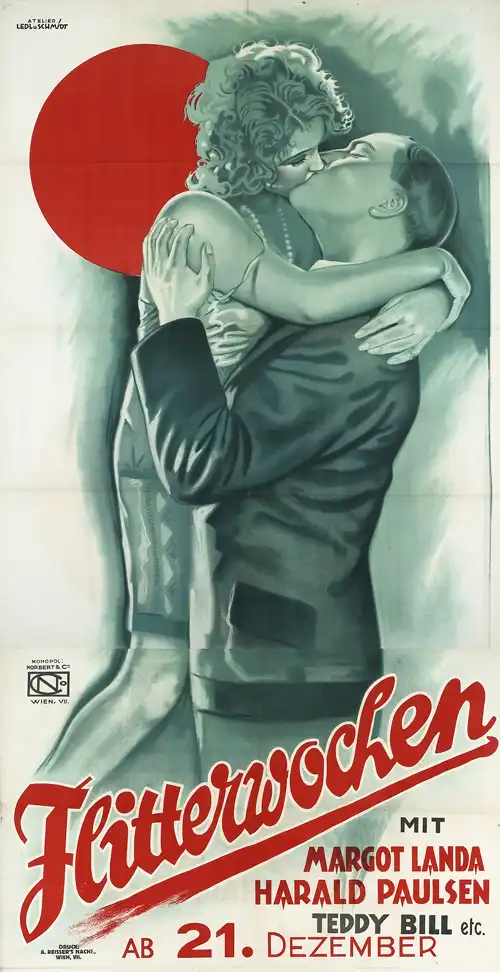
So, Flitterwochen (that's Honeymoon, for those of us not fluent in German) from 1928. Is it worth tracking down today? Well, if you're deep into silent-era comedies, or just really curious about what passed for laughs almost a century ago, then yeah, maybe. For everyone else? Probably not. You’ll likely find the pacing a bit much, and the humor might not quite land like it used to. But it's got a certain charm if you're willing to lean in. 🎞️
The film kicks off with Harald Paulsen and Margot Landa as our fresh-faced couple. Paulsen, bless his heart, does a lot of eyebrow acting. Seriously, his brows are doing more emoting than some entire casts I've seen lately. You can tell they're aiming for 'exasperated but still sweet,' but it often just hits 'confused man blinking a lot.'
Landa, meanwhile, has this fantastic way of making even mundane actions feel like high drama. There’s a scene where she's just trying to pour coffee, and it's like she's wrestling an octopus. It's not subtle, not by a long shot, but it's pretty endearing.
The plot? Oh, it's a classic mix-up. Someone thinks someone else is having an affair, there's a mistaken identity involving a hat, and a surprisingly long sequence about a misplaced dog. The dog bit felt a little tacked on, honestly, but the little terrier was quite good on camera. 🐶
Max Ehrlich pops up as the meddling uncle, and he's just delightful. Every time he's on screen, there’s this immediate shift in energy. He doesn't just walk into a room; he bustles.
There’s one particular moment where Ehrlich is trying to whisper a secret, and he’s so loud and gesticulating so wildly that everyone in the room can clearly hear him. It’s a classic comedic beat, played broad, but it works.
The sets are pretty minimal. You get a few rooms, a park bench, and a very obvious studio backdrop for what's supposed to be a fancy restaurant. It makes you focus more on the performances, I guess, or maybe just how well they could fake it back then.
One shot, late in the film, just lingers on a teacup for what feels like forever. No one’s doing anything with it, it's just... there. It’s one of those things that makes you wonder what the director was thinking. Was it symbolic? Or did someone just forget to yell 'cut'? 🤔
The physical comedy is where this really shines, if you're into that sort of thing. There’s a sequence involving a runaway carriage that's clearly sped up, and it’s gloriously over-the-top. No digital effects here, just pure, unadulterated silent film chaos. You can almost feel the movie trying to convince you this moment matters. And for a second, it really does!
Dialogue, of course, comes via intertitles. Some of them are genuinely funny, little zingers that still land. Others are just descriptions of what's happening, which felt a bit redundant when the actors are showing you. It’s a balance they hadn't quite perfected yet.
Trude Hesterberg as the 'other woman' (or at least, the one suspected of being the other woman) is very good at looking suspicious. Her sidelong glances are a masterclass in silent-era villainy, even if her character isn't really a villain.
There's this moment where Harald Paulsen's character, bless him, tries to look suave while lighting a cigarette. He fumbles it a bit. You can see the slight hesitation. It’s a tiny detail, probably unintentional, but it makes him feel more real, less like a character and more like a guy just trying to make a good impression. ✨
The score, or what's left of it with the print I watched, is mostly piano. It really leans into the comedic moments, sometimes a little too hard. Like, you know exactly when to laugh because the music tells you to. It's charmingly unsubtle.
Teddy Bill, in a smaller role as a bewildered hotel clerk, manages to steal a few scenes just by looking utterly overwhelmed. His eyes dart around like he's constantly searching for an escape route. It’s a whole mood. 😬
You get this sense that everyone is just having a grand time making this film, even when the plot gets a bit silly. There's an energy, a kind of joyous abandon, particularly in the chase scenes. It’s not polished, but it’s alive.
One quick shot of a street vendor selling pretzels... just a flash. No real reason for it. But it sticks with you. Like, someone thought, 'Hey, a pretzel vendor!' and they just filmed it. It’s these small, almost random bits that give the film a peculiar texture.
The lighting is pretty flat for most of it. Everything's bright, no real shadows, unless it’s a night scene, and then it’s just *dark*. It's very much 'point the lamp at the actors' kind of filmmaking. But then again, it was 1928, so maybe I'm asking too much.
It's interesting how much space the actors are given to just perform. There aren’t many close-ups. You mostly see them full-body, reacting with their whole selves. It's a different way of watching a story unfold, less intimate, more like observing a play.
The whole thing wraps up pretty neatly, as you'd expect. All misunderstandings cleared up, everyone happy. It’s less about a surprising twist and more about enjoying the journey to the obvious conclusion. There are no grand revelations here, just a gentle resolution.
Watching it, you pick up on little things. Like how the men's suits are always perfectly pressed, even after a chase scene. Or the way everyone seems to *stare directly at the camera* for a beat too long sometimes, like they're acknowledging the audience. It pulls you out of it, but also feels very human.
It's a curious little film, a snapshot of early German cinema. Not a masterpiece, certainly. But it's got its moments. It’s one of those films that makes you appreciate how far cinema has come, and also how some things, like slapstick and marital woes, never really change.
IMDb —
1928
Community
Log in to comment.