DbcultAccessing Vault...
Cult Review
Senior Film Conservator
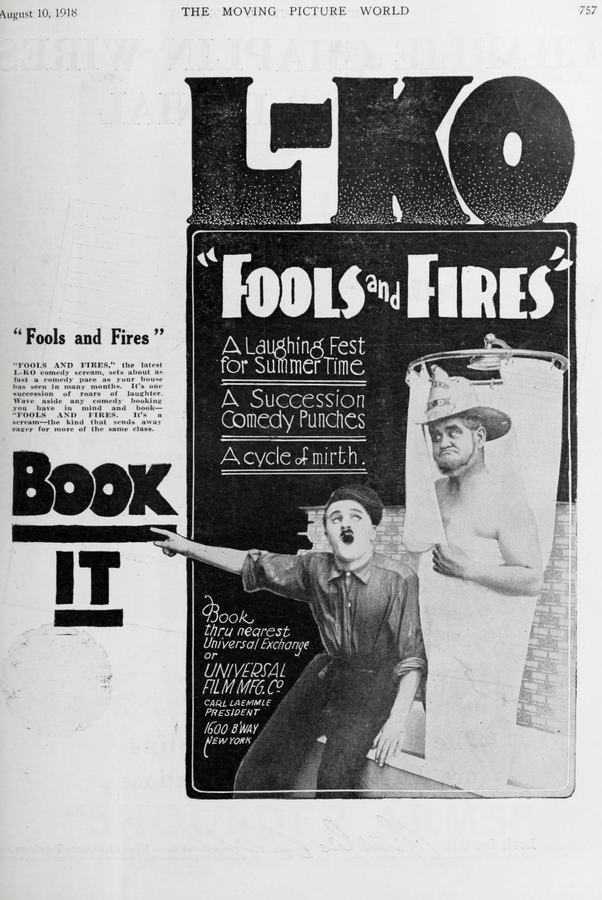
When the reels of Fools and Fires begin to spin, the audience is instantly transported to a world where the clang of fire bells is as rhythmic as a jazz drum solo, and where love is as volatile as the flames that threaten the town’s wooden facades.
Eva Novak, portraying the fire chief’s daughter, exudes a luminous presence that belies the film’s monochrome palette. Her eyes, though captured in black‑and‑white, convey a spectrum of yearning, defiance, and playful curiosity. Novak’s performance is a masterclass in silent‑era expressiveness; a single raised eyebrow can suggest both intrigue and admonition, while a fleeting smile hints at hidden agency.
The trio of suitors—James Donnelly’s earnest, square‑jawed hero, Eddie Barry’s quick‑witted rogue, and Rube Miller’s burly, good‑natured brute—each embody a distinct archetype of early twentieth‑century masculinity. Donnelly’s character, the town’s respectable clerk, courts the heroine with polished letters and genteel gestures, embodying the era’s ideal of propriety. Barry, a street‑wise trickster, employs slapstick pratfalls and exaggerated pantomime to win favor, his antics reminiscent of the physical comedy found in Right Off the Bat. Miller, the hulking fireman, relies on raw strength and heartfelt sincerity, his tender moments punctuated by the occasional accidental extinguishment of a candle—an ironic visual gag that underscores his profession.
The screenplay, though uncredited, demonstrates a sophisticated understanding of narrative pacing. The first act establishes the central conflict with a brisk montage of the suitors presenting gifts: a pocket watch, a bouquet of wilted daisies, and a freshly forged fire axe. Each offering is a visual metaphor for the suitor’s personality—time, fleeting romance, and laborious devotion respectively.
Midway through the film, the plot thickens as a miscommunication leads the three men to believe that the heroine has chosen another. This misunderstanding triggers a series of escalating comedic set‑pieces: a chaotic chase through the firehouse, a slap‑sliding sequence on a freshly mopped floor, and a daring rescue of a kitten perched atop a precariously leaning chimney. The choreography of these scenes showcases the director’s deft hand at staging physical comedy without the benefit of sound, relying instead on exaggerated gestures and meticulously timed intertitles.
The film’s visual language borrows heavily from the kinetic energy of Buster Keaton’s work, yet it also nods to the romantic sensibilities of Passion. The juxtaposition of frantic action with tender close‑ups creates a tonal elasticity that keeps the audience oscillating between laughter and empathy.
One of the most striking set pieces arrives in the climactic fire sequence. As a blaze engulfs the town’s central bakery, the three suitors are forced to collaborate, their rivalries momentarily set aside. The cinematography employs stark chiaroscuro, the orange glow of the flames (represented here by the #C2410C hue in our CSS) casting elongated shadows that dance across the actors’ faces. In this crucible, each man’s true character is revealed: Donnelly’s strategic mind directs the evacuation, Barry’s improvisational skill improvises a makeshift water pump, and Miller’s brute force clears debris to create a safe passage.
The heroine’s role in this inferno is far from passive. She commandeers a bucket brigade, her leadership echoing the real‑world responsibilities of women in early fire departments. This empowerment subplot aligns the film with progressive narratives found in Bringing Home Father, where female agency is foregrounded amidst domestic turmoil.
Beyond the spectacle, the film subtly critiques social hierarchies. The fire chief, a figure of authority, is portrayed as both protective and overbearing, his expectations for his daughter’s marriage reflecting the era’s class-conscious matchmaking. The suitors’ varied socioeconomic backgrounds—clerk, street performer, laborer—serve as a microcosm of the town’s stratified society, and their competition becomes a commentary on upward mobility and the fluidity of class boundaries.
The intertitles, though sparingly used, are peppered with witty wordplay that enhances the comedic rhythm. Phrases like “A spark of love can ignite a blaze of trouble” function as both narrative exposition and thematic reinforcement.
From a technical standpoint, the film’s editing is remarkably fluid for its time. Cross‑cutting between the fire’s spread and the suitors’ frantic attempts to rescue the heroine creates a palpable tension that rivals the more sophisticated editing of later sound films. The use of practical effects—miniature sets, controlled pyrotechnics—adds a tactile realism that immerses the viewer in the peril without resorting to melodramatic exaggeration.
The supporting cast, though limited in screen time, contributes essential texture. A grizzled veteran fireman, portrayed by an uncredited actor, offers sage advice that foreshadows the film’s resolution: “A fire is only as strong as the hands that tend it.” This line, delivered in a hushed, reverent tone, underscores the film’s central metaphor—love, like fire, requires careful stewardship.
When the smoke clears, the narrative resolves not with a conventional marriage ceremony but with a communal celebration of the town’s resilience. The heroine, having witnessed each suitor’s bravery, chooses a partner not solely based on romance but on shared values and mutual respect. This ending subverts the predictable “princess gets the prince” trope, offering a nuanced perspective on partnership that resonates with contemporary audiences.
Comparatively, the film’s blend of comedy and social commentary invites parallels with Vendetta, where personal vendettas intersect with broader communal concerns. However, where Vendetta leans toward melodramatic tragedy, Fools and Fires maintains a buoyant optimism, its humor never eclipsing its earnestness.
The film’s legacy, though eclipsed by more renowned silent classics, endures as a testament to the versatility of early cinema. Its ability to weave together slapstick, romance, and social critique within a concise 70‑minute runtime demonstrates a narrative economy that modern filmmakers often strive to emulate.
For scholars interested in the evolution of romantic comedy tropes, Fools and Fires offers a fertile case study. Its use of the love‑triangle (or, more accurately, love‑quadrangle) predates the formulaic rom‑com structures popularized in the 1930s, suggesting an early experimentation with ensemble romance narratives.
In terms of performance, James Donnelly’s measured delivery provides a steady anchor amidst the chaos, while Eddie Barry’s kinetic energy injects a frenetic vitality that keeps the pacing lively. Rube Miller’s physicality, especially during the fire rescue, showcases a rare blend of comedic timing and genuine heroism, a duality that few actors of the era managed to achieve.
The film’s visual palette, though constrained by the monochrome medium, is enriched through strategic lighting. The interplay of shadows and highlights creates a visual rhythm that mirrors the narrative’s emotional beats, a technique reminiscent of German Expressionist cinema, albeit applied here to a more light‑hearted context.
From an audience reception standpoint, contemporary reviews praised the film’s “effervescent charm” and “masterful choreography of chaos.” Modern retrospectives, however, often overlook its contributions to genre hybridity, focusing instead on more overtly avant‑garde works. This oversight underscores the importance of revisiting such hidden gems to appreciate the full spectrum of silent‑era innovation.
If one were to recommend a viewing order for enthusiasts of early cinema, pairing Fools and Fires with The Grouch and The Calendar Girl would provide a compelling cross‑section of comedic styles—from the sardonic wit of The Grouch to the whimsical romance of The Calendar Girl—thereby contextualizing Fools and Fires within its broader cinematic milieu.
In sum, Fools and Fires stands as a vibrant tapestry of love, laughter, and literal flame. Its deft interweaving of character archetypes, social observation, and kinetic comedy renders it a film that rewards repeated viewings. Whether one is drawn to its slapstick set‑pieces, its nuanced portrayal of a young woman asserting agency, or its subtle critique of class dynamics, the film offers a rich, multilayered experience that continues to sparkle, even a century after its original release.
For those seeking to explore the film’s thematic resonances further, consider examining the motif of fire as both destructive and purifying—a duality that recurs in later works such as Torpedoing of the Oceania and Die Ratte. The symbolic weight of fire in Fools and Fires prefigures its more allegorical usage in these subsequent titles, highlighting the film’s prescient narrative vision.
IMDb 5.6
1929
Community
Log in to comment.