DbcultAccessing Vault...
Cult Review
Senior Film Conservator
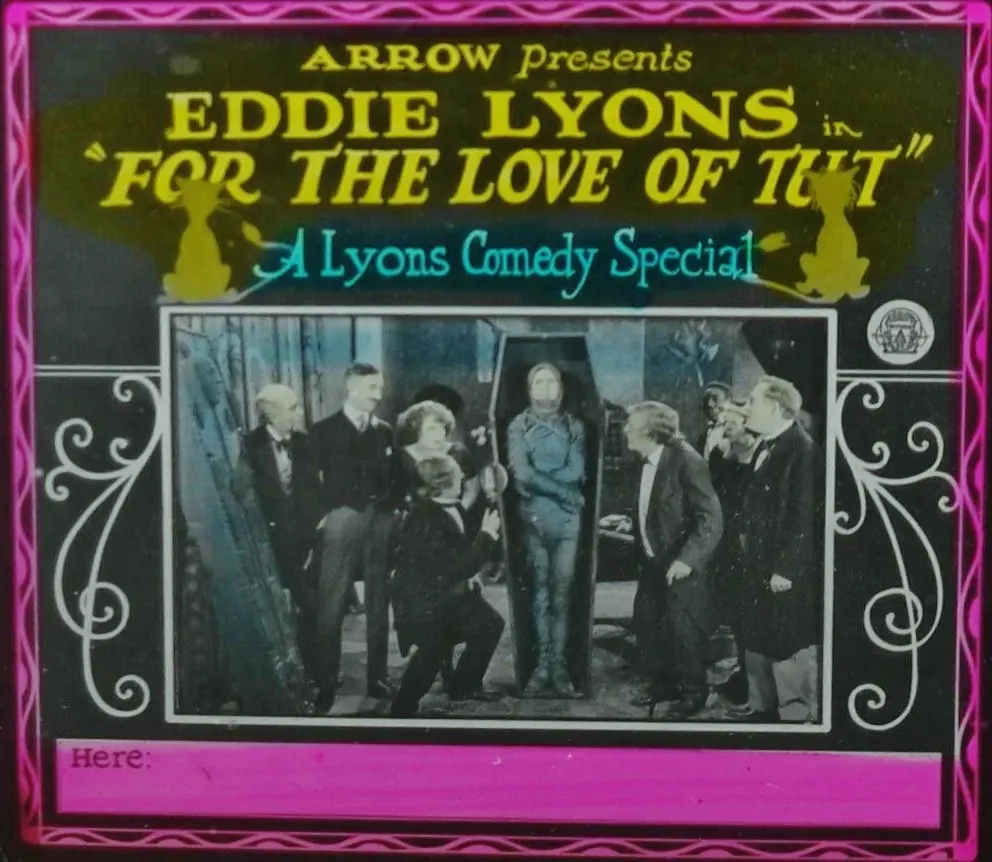
The year 1918 stood as a pivotal junction in the evolution of the moving picture, a period where the primitive flickers of the nickelodeon era were rapidly coalescing into sophisticated narrative structures. Within this fertile landscape, For the Love of Tut emerges not merely as a relic of early slapstick, but as a fascinating intersection of cultural zeitgeist and comedic innovation. Directed by and starring the effervescent Eddie Lyons, the film leverages the global fascination with 'Egyptomania'—a fever that would only intensify in the coming years—to construct a domestic comedy that is as much about social mobility as it is about romantic conquest.
Eddie Lyons, a performer whose physicality often rivaled the greats of his era, brings a frantic yet controlled energy to the role of Eddie. Unlike the swashbuckling, almost mythological presence found in Robin Hood, Lyons operates within the realm of the everyman pushed to extraordinary lengths. His transition from a dapper suitor to a rigid, bandaged artifact is a masterclass in physical transformation. One cannot help but observe the subtle twitching of his eyes beneath the gauze, a visual shorthand for the internal panic of a man literally trapped by his own romantic ambitions.
The brilliance of Lyons' performance lies in the dichotomy of his movement. When he is 'in character' as the mummy, his stillness is a comedic weapon, creating a tension that the audience feels in their gut. When he is forced to move—perhaps to steal a kiss or avoid a curious servant—his movements are sharp, staccato, and inherently rhythmic. It is a performance that anticipates the great silent comedians who would follow, yet it retains a unique, almost desperate charm that is specific to Lyons' screen persona.
The screenplay by Charles Diltz is a marvel of economy and escalating stakes. While contemporary audiences might find the premise of a man shipping himself in a crate to be a well-worn trope, in 1918, this was a fresh exploration of the 'trojan horse' motif. Diltz avoids the heavy-handed moralizing found in films like Israël, opting instead for a narrative that prioritizes situational irony and the subversion of authority. The collector, the girl's father, is portrayed not as a villain, but as a man so blinded by his obsession with the past that he is unable to see the living, breathing reality right in front of him.
"The film serves as a satirical mirror to the upper-class obsession with provenance, where a dead king is more welcome in the parlor than a living suitor of modest means."
When examining For the Love of Tut alongside its contemporaries, its tonal lightness becomes even more apparent. For instance, while The Whispering Chorus delved into the dark, psychological recesses of the human soul through innovative double exposures and grim moral quandaries, Lyons' work remains resolutely focused on the joy of the gag. It shares more DNA with the urban fish-out-of-water themes of Hick Manhattan, though it swaps the rural-urban divide for a temporal one—the ancient world versus the modern heart.
Furthermore, the film's approach to masculinity is worth noting. In All Man, the protagonist must prove his worth through traditional displays of strength and grit. Eddie, conversely, proves his worth through vulnerability and the willingness to be humiliated. He becomes an object—literally—to achieve his goal, a subversion of the 'man of action' archetype that feels surprisingly modern. This vulnerability is also explored, albeit in a more dramatic fashion, in The Lure of Youth, where the pressures of societal expectation drive the narrative forward.
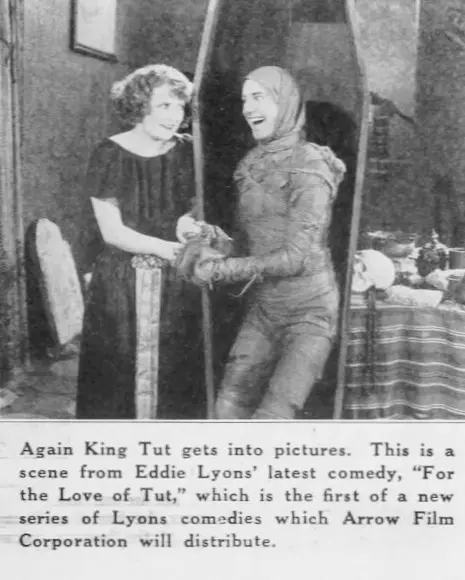
The cinematography, though constrained by the technical limitations of the era, utilizes the interior space of the collector's home with remarkable efficiency. The shadows cast by the various 'artifacts' in the house create a labyrinthine atmosphere that heightens the stakes of Eddie's concealment. There is a specific sequence where the lighting catches the texture of the mummy bandages, creating a ghostly, almost surreal visual that briefly pivots the film from comedy into the realm of the phantasmagoric, reminiscent of the atmospheric tension in The Midnight Man.
The use of props in For the Love of Tut is not merely decorative; they are active participants in the comedy. The sarcophagus becomes a hiding spot, a bed, and a prison all at once. This tactile relationship with the set design is a hallmark of the era's best comedies, where every object on screen holds the potential for a punchline. It lacks the gritty realism of A Child of the Paris Streets, but it replaces that grit with a polished, theatrical flair that is deeply satisfying to behold.
As we look back at For the Love of Tut, we see a film that successfully navigated the transition from the short-form 'gag' reel to a more structured narrative feature. It doesn't possess the sprawling ambition of In the Days of Daniel Boone, nor does it attempt the complex mystery of The Carter Case. Instead, it finds its strength in its specificity. It is a film about the lengths one will go for love, and the hilarious consequences of choosing the most absurd path possible.
In the broader context of 1918 cinema, which included the rugged landscapes of The Forbidden Trail and the intense moral dramas like Die Stimme des Gewissens, For the Love of Tut provided a necessary levity. It reminded audiences that even in a world reeling from the Great War, there was still room for the ridiculous. The film's enduring appeal lies in this universal truth: that love makes mummies of us all—stiff, silent, and entirely at the mercy of those we adore.
Whether compared to the high-stakes action of To a Finish or the intricate social maneuvering in Shuffle the Queens, Lyons' work stands out for its sheer commitment to its central conceit. The film doesn't blink; it embraces the mummy disguise with a sincerity that makes the comedy work. It is a testament to the power of the silent screen to communicate complex emotions and hilarious situations without the need for a single spoken word. Even the title itself, a play on 'King Tut,' suggests a film that is self-aware of its place in the pop-culture landscape, much like the vibrant energy found in Sunlight's Last Raid.
To watch For the Love of Tut today is to witness the birth of the modern romantic comedy. The DNA of this film can be traced through the decades, from the screwball comedies of the 1930s to the high-concept rom-coms of the present day. Eddie Lyons may not be a household name in the 21st century, but his contribution to the grammar of visual humor is undeniable. This film remains a sparkling example of how a simple premise, executed with panache and physical brilliance, can transcend its era and continue to delight those who seek out the hidden treasures of the silent archive.
The interplay of light, shadow, and linen bandages creates a visual tapestry that is uniquely early-century. In the silent era, the face was the primary instrument of storytelling, and Lyons uses his to extraordinary effect. Every widened eye, every furrowed brow, and every suppressed grin tells a story of a man who is terrified of being caught but even more terrified of losing the woman he loves. It is this emotional core that prevents the film from becoming a mere series of vignettes. It is a cohesive, heartfelt, and genuinely funny exploration of the human condition—wrapped in several yards of ancient Egyptian linen.
IMDb 6.2
1932
Community
Log in to comment.