DbcultAccessing Vault...
Cult Review
Senior Film Conservator
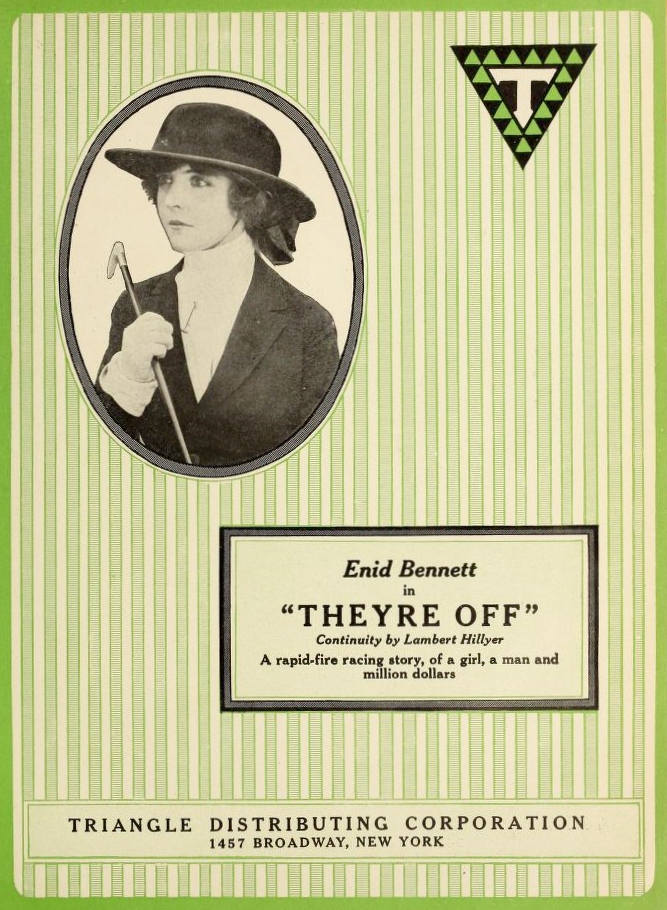
The year 1917 represents a pivotal juncture in the evolution of the moving image, a period where the primitive techniques of the early decade began to coalesce into a sophisticated visual grammar. Within this fertile environment, Lambert Hillyer—a name often synonymous with the rugged aesthetics of the early Western—delivered a work of surprising nuance and structural complexity: They're Off. While the title suggests a mere preoccupation with the adrenaline of the racetrack, the film is, in reality, a profound meditation on the erosion of Southern gentility and the emergence of a more ruthless, industrial morality. It is a cinematic tapestry that weaves together the threads of honor, deceit, and the radical reclamation of agency through performance.
At the heart of They're Off lies the Manners estate, a structure that functions less as a setting and more as a silent protagonist. The eviction of Randolph Manners (Walt Whitman) by the unscrupulous Hackett (Melbourne MacDowell) is not merely a legal transaction; it is a ritualistic wounding of the landscape itself. Hillyer utilizes the physical geography of the estate to delineate the shifting power dynamics. When Randolph is forced into the training quarters, the camera captures the spatial claustrophobia of his new reality, contrasting it sharply with the cavernous, cold opulence now occupied by the Hacketts. This transition mirrors the thematic gravity found in The Old Curiosity Shop, where the loss of physical property signals a deeper existential crisis.
The mansion becomes a site of moral conflict for Rita Hackett. Enid Bennett, an actress of remarkable expressive range, portrays Rita not as a spoiled heiress, but as a woman awakened to the rot beneath her father's newfound prestige. Her discovery of her father’s deeds is handled with a restraint that was rare for the era’s melodramas. Instead of histrionic gestures, Hillyer relies on the interplay of light and shadow—a precursor to the chiaroscuro techniques that would later define the noir aesthetic. Rita’s gaze, often framed through the ornate windows of the mansion, suggests a prisoner looking out, rather than a mistress looking down.
The narrative pivot—Rita’s decision to disguise herself as a jockey—is where They're Off transcends the boundaries of typical 1910s drama. In an age where gender roles were rigidly codified, Rita’s adoption of masculine attire and a professional identity is a revolutionary act. This is not the whimsical cross-dressing found in Shakespearean comedy, but a calculated, dangerous subversion of the social order. Bennett’s physicality changes; her posture stiffens, her movements become more purposeful. She inhabits the role of the jockey with a conviction that challenges the spectator’s perception of the "weaker sex."
This theme of disguise and the hidden self resonates with other contemporary works such as The Dummy, though Hillyer imbues the trope with significantly higher stakes. Rita is not merely solving a crime; she is attempting to restore the moral equilibrium of her world. The race itself is a masterclass in early action cinematography. The editing, supervised by the legendary Thomas H. Ince’s studio standards, creates a rhythmic intensity that mirrors the galloping hooves. The dust, the sweat, and the sheer velocity captured on celluloid provide a visceral counterpoint to the earlier, more static scenes of domestic tension.
Melbourne MacDowell’s portrayal of Hackett is a chilling study in the banality of greed. Unlike the mustache-twirling villains of lesser silents, MacDowell’s Hackett believes in the righteousness of his acquisition. He represents the burgeoning capitalist spirit that viewed the traditionalism of the South as an inefficiency to be corrected. This conflict between the old guard and the new money is a recurring motif in the cinema of 1917, often explored with varying degrees of cynicism. While The Millionaire Baby deals with the corruption inherent in wealth, They're Off focuses specifically on the displacement of heritage.
The relationship between Rita and Randolph Manners (Rowland V. Lee) is handled with a delicate touch. It is a romance born out of shared loss and mutual respect rather than mere proximity. Lee plays Manners with a quiet dignity, a man who has lost his home but refuses to lose his soul. His presence in the training quarters, surrounded by the horses that represent his last connection to his former life, provides some of the film's most poignant imagery. The horses themselves are treated as noble creatures, symbols of a purity that the human characters struggle to maintain.
One cannot discuss They're Off without acknowledging the profound influence of the Ince-Hillyer collaboration. The film exhibits a "factory-like" precision in its storytelling—a hallmark of Ince’s production methods—yet it never feels mechanical. The pacing is deliberate, allowing the emotional weight of the eviction to settle before escalating into the high-octane finale. The cinematography captures the expansive beauty of the Southern landscape, utilizing deep focus shots that allow the viewer to perceive the distance between the mansion and the stables, a visual metaphor for the social chasm that has opened between the characters.
When compared to the allegorical grandeur of Civilization, They're Off might seem like a smaller, more intimate affair. However, its exploration of personal integrity and the courage required to defy one's own kin gives it a universal resonance. It shares a certain thematic DNA with Where Are My Children? in its willingness to tackle difficult social questions, albeit through the lens of a sporting drama rather than a social problem film.
The final act of the film is a tour de force of silent era editing. As Rita, in her jockey silks, mounts her horse, the tension is palpable. Hillyer cuts between the thundering hooves, the anxious faces of the spectators, and the looming figure of Hackett in the stands. This sequence is far more sophisticated than the simple race in The Great Ruby. Here, every frame is imbued with the weight of the Hackett-Manners legacy. The victory is not just a sporting triumph; it is a legal and moral victory that forces a reckoning.
The resolution of the film avoids the easy sentimentality that plagued many of its contemporaries. While the mansion is reclaimed, the scars of the conflict remain. Rita’s relationship with her father is irrevocably altered, suggesting that true justice often comes at a significant personal cost. This nuanced ending elevates the film above the standard "hero wins the day" narrative, placing it in the company of more complex works like The Wasted Years.
In the broader context of 1917 cinema, They're Off stands as a testament to the power of character-driven storytelling. It lacks the overt propaganda of War Brides or the fantastical elements of The Frozen Warning, but its groundedness is its greatest strength. It is a film about the tangible—earth, horses, wood, and stone—and the intangible—honor, courage, and love.
For the modern viewer, the film offers a fascinating window into a vanished world. The meticulously recreated Southern atmosphere, the authentic equestrian details, and Enid Bennett’s luminous performance make it a mandatory viewing for anyone interested in the foundations of American narrative cinema. It is a work that rewards close attention, revealing layers of social commentary that remain surprisingly relevant. Whether viewed as a sporting drama, a feminist proto-text, or a study of class warfare, They're Off remains a vibrant, pulsing piece of celluloid history.
A definitive triumph of the silent era, blending high-stakes action with a sophisticated exploration of the human condition.
IMDb —
1920
Community
Log in to comment.