DbcultAccessing Vault...
5.9/10
Senior Film Conservator
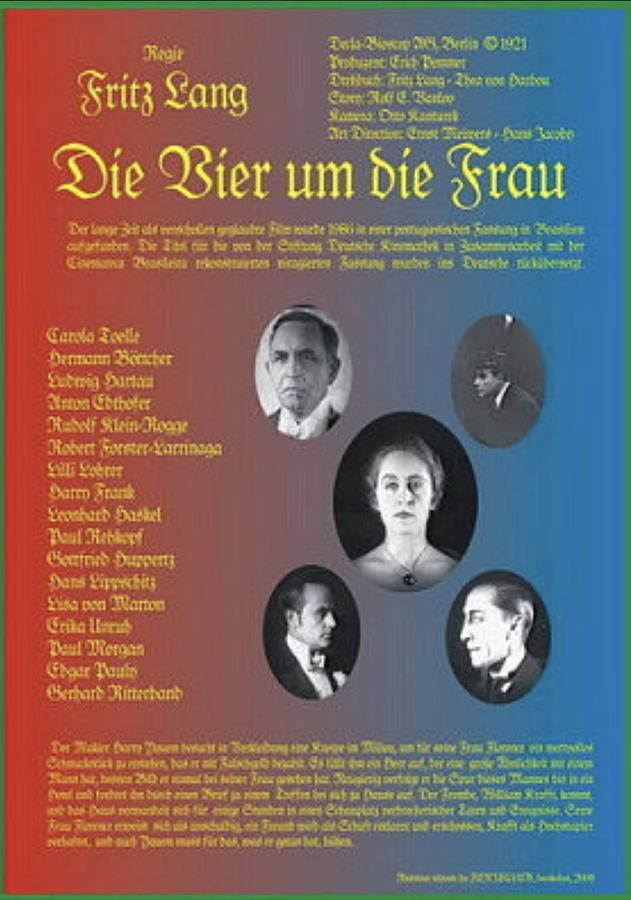
A definitive 5.9/10 rating for a film that redefined the boundaries of cult cinema. Four Around the Woman remains a cornerstone of transgressive art.
Fritz Lang, a name synonymous with the architectural grandeur of Metropolis and the psychological terror of M, was already refining his surgical precision in 1921 with Four Around the Woman (originally titled Kämpfende Herzen). This early silent work serves as a fascinating crucible, melting down the tropes of the contemporary melodrama into something far more sinister and structurally complex. Unlike the more linear narratives found in Not My Sister, Lang’s vision here is a subterranean exploration of the human psyche, specifically the male ego's capacity for self-destruction through unverified suspicion.
The film marks a pivotal collaboration with Thea von Harbou, whose writing often grappled with the tension between destiny and individual willpower. In Four Around the Woman, the 'destiny' is not an external force but the internal rot of Harry Yquem, played with a simmering, stiff-necked intensity by Ludwig Hartau. While films like The Divorcee handled marital dissolution with a certain post-war frankness, Lang elevates the concept to a level of existential dread. He transforms the domestic space into a panopticon where every glance is scrutinized and every silence is an indictment.
Harry Yquem is not merely a jealous husband; he is a man of the market, a broker who believes everything—including truth—can be brokered or uncovered through strategic investment. When he begins to doubt his wife, Florence, his reaction is not one of emotional vulnerability but of tactical surveillance. He descends into the 'Catacombs,' a brilliantly realized set piece that prefigures the expressionistic underworlds Lang would later master. Here, we see the first glimpses of the director’s obsession with the 'double' or the disguised man. By adopting a pseudonym to track his wife’s supposed lover, Yquem essentially bifurcates his own identity, becoming a voyeur in his own tragedy.
This thematic preoccupation with identity and the masks we wear is a staple of early German cinema, yet Lang imbues it with a unique kinetic energy. While Out of the Storm focuses on the external pressures of fate, Lang focuses on the internal pressure of the secret. The four men mentioned in the title—Yquem himself, the blackmailer, the former lover, and the brother—act as a quadrilateral of male anxiety, each pulling at the threads of Florence’s reputation until the fabric of her life begins to unravel. It is a stark contrast to the more singular focus of Anny - en gatepiges roman, which follows a more traditional path of social fall and redemption.
Visually, Four Around the Woman is a masterclass in the use of space and light to convey psychological states. Lang uses the verticality of the sets to suggest the social hierarchies of Berlin. The gleaming, expansive offices of the brokerage firm contrast sharply with the cramped, shadow-drenched corners of the criminal dens. This use of contrast is far more sophisticated than the visual palettes of contemporary shorts like Nutt Stuff or the utilitarian cinematography of 500 Pounds Reward. Lang is not just recording a story; he is composing a visual symphony of entrapment.
The performance of Carola Toelle as Florence is particularly noteworthy. In an era where female characters were often relegated to the roles of the 'saint' or the 'seductress,' Toelle navigates a middle ground of dignified suffering. She is the calm center around which the male characters spin in their frantic orbits. Her performance lacks the slapstick levity of Life Savers, opting instead for a grounded, almost modern realism that makes Yquem’s delusions feel all the more tragic. She represents the 'American Gentleman' ideal of virtue (perhaps a nod to the themes in An American Gentleman) being systematically dismantled by European cynicism.
The narrative structure of the film is notoriously dense. Lang and von Harbou weave multiple subplots involving counterfeit money, mistaken identity, and long-buried secrets. This complexity serves a purpose: it mirrors the cluttered and confused mind of Harry Yquem. As he follows the 'Risky Road' (a thematic parallel to The Risky Road), the audience is invited to feel his disorientation. The film functions almost like a procedural, pre-dating the courtroom drama of The Murdoch Trial, but the 'crime' being investigated is one of the heart rather than the law.
One cannot discuss a Lang film without mentioning Rudolf Klein-Rogge. Although his role here is not as iconic as his later turn as Rotwang, his presence adds a layer of gravitas and menace that anchors the film’s more melodramatic impulses. The ensemble cast works with a rhythmic precision that was rare for the time, avoiding the exaggerated gesticulation that plagued many silent productions. This restraint makes the moments of high tension, such as the confrontation in the Catacombs, feel genuinely dangerous, unlike the more stagey conflicts in The World Against Him.
Released in the early years of the Weimar Republic, Four Around the Woman reflects a society in flux. The figure of the wealthy broker, Yquem, is a symbol of the new economic power that arose from the ashes of the empire, yet his internal instability mirrors the fragility of the republic itself. The film captures a sense of 'Sporting Blood' (as seen in Sporting Blood) but applied to the high-stakes game of social standing and marital fidelity. It is a world where everyone is watching everyone else, a precursor to the surveillance state themes Lang would explore decades later.
The film’s exploration of the 'paths of life'—echoing the sentiment of I sentieri della vita—suggests that our pasts are never truly buried. Florence’s past returns not as a ghost, but as a series of living men who demand her attention, forcing Yquem to confront the fact that he does not 'own' his wife’s history. This realization is his undoing. Unlike the comedic struggles of From Hand to Mouth, Yquem’s struggle is one of abundance. He has everything, yet he is impoverished by his lack of trust. He is the 'Cotton King' (referencing The Cotton King) who finds his empire built on sand.
Technically, the film is a marvel of its era. The lighting, handled by Otto Kanturek, utilizes a proto-chiaroscuro that would become the hallmark of German Expressionism. The way shadows are cast across Yquem’s face during his moments of deepest doubt serves as a visual shorthand for his fractured psyche. The editing, too, is remarkably modern, using cross-cutting to build tension during the film’s climax in a way that feels surprisingly contemporary. Lang was already moving away from the static, theatrical framing of his peers and towards a more dynamic, cinematic language.
In the final analysis, Four Around the Woman is more than just a historical curiosity or a 'lost' Lang film. It is a profound psychological study that remains relevant today. It speaks to the universal human fear of being deceived and the destructive power of the male gaze when it is filtered through the lens of insecurity. While it may lack the overt spectacle of Lang’s later masterpieces, it possesses an intimate, claustrophobic power that is equally compelling. It is a vital chapter in the history of cinema, a bridge between the Victorian melodrama and the psychological noir, and a testament to the enduring genius of a director who understood, even then, that the most terrifying monsters are the ones we create in our own minds.
As we look back at this 1921 gem, we see a filmmaker who was already a master of his craft, using the medium of silent film to explore the loudest of human emotions. The 'four' around the woman are ultimately irrelevant; it is the one man—the husband—whose internal collapse provides the film’s true gravity. It is a haunting, beautifully shot, and intellectually stimulating piece of art that demands to be seen by anyone interested in the evolution of cinematic storytelling. Lang doesn't just tell a story; he constructs a world of mirrors where every reflection is a lie, and every truth is a trap.
IMDb 6.2
1920
Community
Log in to comment.