I'll be totally honest, I mostly put this on because I saw Hans Albers was in the cast. 📽️
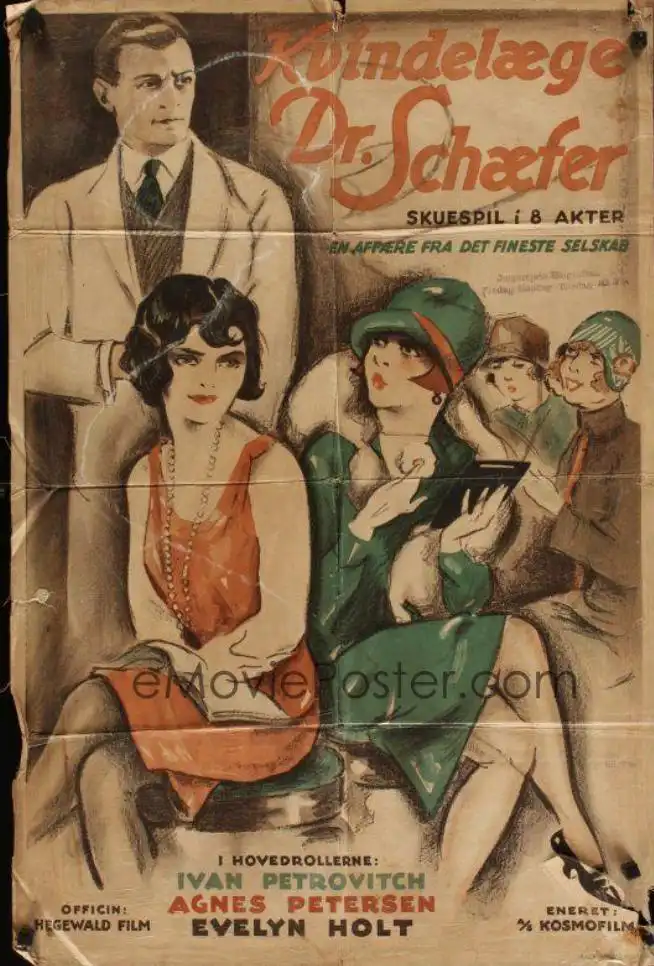
It is a silent film from 1928 called
Frauenarzt Dr. Schäfer, and it deals with things that feel way too modern for a movie that is almost a hundred years old.
If you like those old German movies that look like they were filmed in a basement with a single lightbulb, you will probably dig this.
But if you need things to move fast or you hate reading intertitles every ten seconds, you’re going to be bored out of your mind.
It is worth watching if you want to see how people were already arguing about these huge moral issues way before our time.
The movie starts out feeling like a very stuffy medical lecture.
Professor Hausen is this very tall, very serious man who basically thinks he is the moral compass of the whole city.
He has these huge,
bushy eyebrows that seem to do most of the acting in the first twenty minutes.
He is totally against doing abortions, even when the women coming to him are clearly desperate.
Then you have Dr. Schäfer, who is much younger and seems to actually look at the patients like they are real people.
There is this one scene where a woman is sitting in the waiting room, just clutching her purse so tight her knuckles are white.
The camera stays on her hands for a long time.
It is one of those small things that makes you realize the director actually cared about the
stress of the situation, not just the medical debate.
It reminded me a bit of the vibe in
Shadows of Conscience, where everything feels a bit heavy and dark.
Dr. Schäfer has this very soft way of moving, which contrasts with the Professor who walks like he is made of wood.
I noticed that the lighting in the Professor's office is always really harsh.
It makes him look like a statue.
But then the movie switches gears when the Professor’s own family gets involved in a scandal.
Suddenly, all those big rules he has don't seem so easy to follow when it is his own daughter on the line.
It’s a bit of a cliché, I guess, but the way they film his realization is pretty brutal.
He is sitting at his desk and the shadows just seem to get longer and longer until he is almost invisible.
Hans Albers shows up and he is great, even though he isn't the lead here.
He has this energy that makes everyone else in the room look like they are standing still.
I did find myself getting a bit distracted by the wallpaper in some of the scenes.
It is very 1920s—lots of weird patterns that probably looked great back then but just look busy now. 🏠
The movie doesn't have a lot of "action," obviously.
It is mostly people staring at letters or looking out windows with
intense longing.
There is a moment where a character drops a glass and it shatters, and the movie treats it like a bomb went off.
It is a bit dramatic, but it works because the tension is so high by that point.
I think the middle part of the film drags a little too much.
They spend a lot of time showing the Professor walking through hallways.
We get it, he is a busy and important man.
You don't need to show us three different hallways to prove it.
I found the ending to be a bit rushed, like they realized they only had five minutes of film left and had to wrap everything up.
It doesn't feel as clean as something like
Das Fräulein vom Amt, which feels more balanced.
Still, there is something really raw about the performances.
Especially the women in the clinic scenes—they don't have many lines, but their eyes tell the whole story.
It’s a very quiet kind of sadness.
One thing that stuck with me was a shot of a doctor's bag sitting on a chair.
It just sits there for a few seconds too long, and it feels weirdly ominous.
I don't know if that was intentional or if they just liked the bag.
Anyway, if you can find a decent copy of this, it is a cool piece of history.
It’s not exactly a fun Friday night watch, but it makes you think.
Just don't expect a happy ending where everyone goes out for ice cream.
It is much more of a "stare at the wall and think about life" kind of movie. 🎞️
I’m glad I watched it, even if some of the medical talk felt a bit dated and clunky.
It is messy, but it feels like it was made by people who actually had something to say.