DbcultAccessing Vault...
6.6/10
Senior Film Conservator

A definitive 6.6/10 rating for a film that redefined the boundaries of cult cinema. Fresh Fish remains a cornerstone of transgressive art.
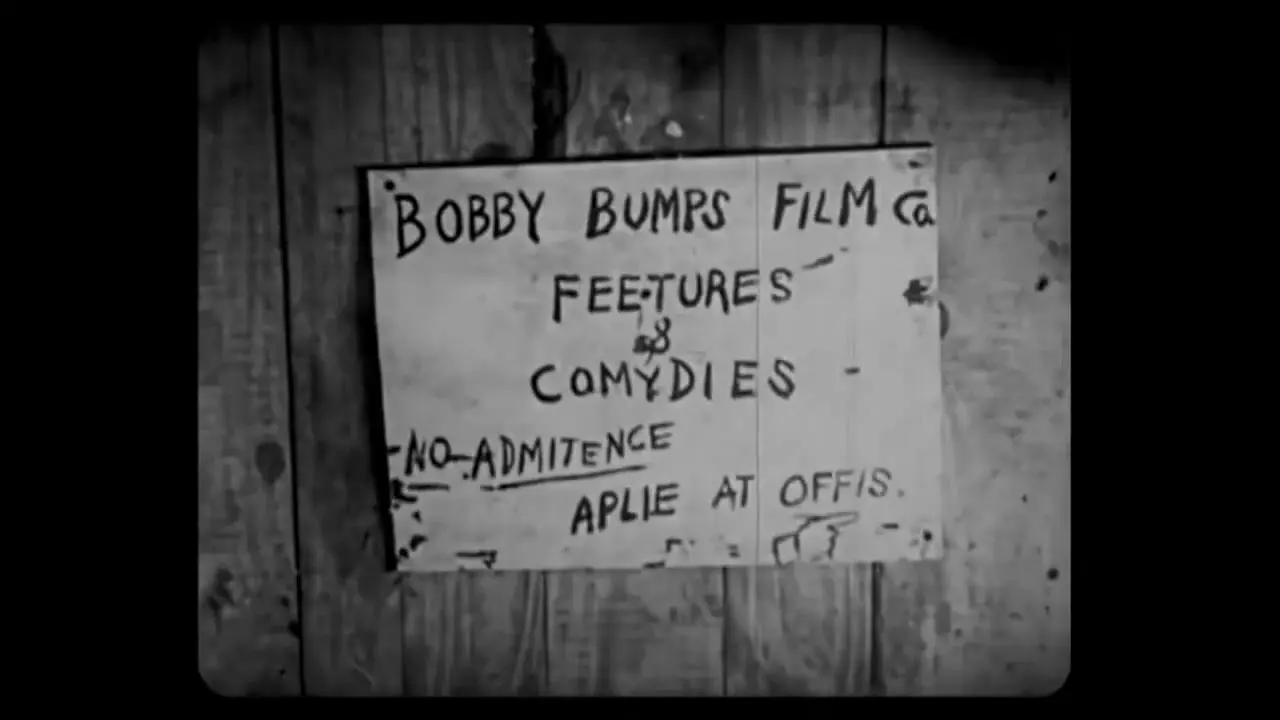
The first time I saw Fresh Fish I yelped—audibly, like a stepped-on squeak toy—because the screen appeared to be devouring itself. Earl Hurd, better known for industrial-era Bobby Bumps shorts, detonates the partition between animator and subject with a nonchalance that feels criminal in its casual brilliance. Released in the same annus mirabilis that gave us The Terror’s gothic hysteria and Divorce and the Daughter’s tear-stained melodrama, this one-reeler refuses to behave like its contemporaries. It is the trickster trout in the cinematic barrel, slippery, iridescent, impossible to taxonomize.
Picture the setup: a live-action cameraman—also christened Bobby—wants to shoot “a fishing picture.” His cartoon progeny, Bobby Jr., and that rubber-limbed mutt Fido, demand screen time. Instead of cutting between dimensions, Hurd staples them together. The cartoon duo slip off their paper moorings, saunter across a wooden dock that exists in negative space, and begin casting lines into a watercolor ocean. Meanwhile the human crew—lighting rigs, clapperboards, sweat-stained fedoras—pokes into the drawn world like rude tourists. Reality retaliates: a flesh-and-blood gull dive-bombs the cel stack, scattering graphite like dandruff. The dog’s tail, previously nine ink strokes, suddenly sprouts hairs—actual hairs—glistening with seawater. You half expect the projectionist to sprint down the aisle screaming that the print is alive.
Hurd’s meta-magic predates by a full decade the self-reflexive japery of His Royal Highness and by nearly a century the pixelated solipsism of The Lego Movie. Yet historical precedence isn’t the hook here; it’s the texture. The film’s surface—scuffed, fingerprinted, baked under arc lamps—breathes. We spot where the acetate shrank, where the ink cracked, where a stray hair got caught under the camera gate and looks, for one fleeting frame, like a sea serpent. Archivists label these artifacts “damage.” I call them ghosts, poltergeists of process, and Hurd invites them to the cookout.
Midway, the narrative—if we dare call it that—mutinies. Bobby-the-boy reels in a boot, then a traffic sign, then a live-action clapperboard labeled “Scene 4 Take 99.” The editing bench glitches: shots run backward, forward, sideways. The dog wags in stroboscopic stutters. A producer’s cigar smoke curls into on-screen intertitles: “WE’RE LOST IN THE MARGIN!” The gag lands harder now, in an age when digital compositing has sanded away the happy accidents. Hurd reminds us that every frame once had a smell: sour chemicals, nicotine, the operator’s sandwich. Imperfection was the price of admission.
Compare this to The Lure of Crooning Water, another 1922 bauble that treats nature as postcard. That film’s river never threatens to drown the camera; it poses prettily, corseted by pictorialism. Hurd’s water, by contrast, sloshes onto the sprockets. It is an agent of anarchy, slapping both cartoon and carbon-based life forms. When a sketched trout rockets from the surf and slaps the director’s cheek, the impact leaves a wet imprint—on the man, on the celluloid, on our optic nerves. Cinema becomes tactile, a medium you towel off with a kerchief.
The sound of Fresh Fish—yes, sound—emanates from your own anxious chuckle. Hurd engineers a pantomime so precise you swear you hear the reel clatter, the gulls shriek, the graphite scrape. Contemporary exhibitors sometimes accompanied it with a jaunty organ riff; I prefer the hum of the projector, the metallic hiccup every time the shutter misses a beat. Silence becomes an instrument, and the absence of synchronized noise makes the dimensional rupture feel sacramental, like witnessing a miracle in a language you cannot speak.
Gender politics? Barely there, yet tellingly. The only female presence is a mermaid doodled on a chalk slate—hourglass figure, seashell bra, grin like she knows she’s bait. Live-action women linger on the periphery, clapping the slate, fetching coffee. Hurd isn’t progressive; he’s a carnival barker hawking visual whiplash. Still, the mermaid eventually erases her own tail, crawls onto the pier, and boots a male extra into the drink. A three-second coup, but it stings like iodine on a paper cut. Even in 1922, the margins mutinied.
Color design—monochrome yet chromatically sneaky—relies on tinting: amber for day, cyan for dusk, rose for the moment when cartoon and human lips sync in a horrifying smile. Those flashes anticipate the expressionist jolts of Satana, where color becomes moral commentary. Here it’s emotional sonar, pinging between dimensions. When the amber drains to sickly tea-brown, you feel the medium itself gag on its own artifice.
Scholars love to cite Leap Year Leaps for slapstick surrealism, but that film keeps its universe hermetically sealed. Fresh Fish leaks. It is the first cinematic fugue state I can name: a picture that forgets it is a picture, remembers, panics, and laughs at its own panic. The closest modern echo might be Who Framed Roger Rabbit, yet Zemeckis treats toonery as immigrant subculture. Hurd treats it as skin disease: once you’ve got it, you can’t scrub it off.
Restorationists at EYE Filmmuseum recently scanned a 35 mm nitrate at 4K. The file now glimmers on my OLED like molten pewter. You can map every vertical scratch, each dupey splice. Paradoxically the hi-def clarity makes the illusion more, not less, persuasive: the sharper the image, the deeper the abyss between planes. I looped the moment when Fido’s ink nose twitches against a live-action ankle—eight frames, maybe nine—until my partner threatened to call a neurologist. Obsession? Perhaps. But obsession is the only sane response to a film that eats its own tail and asks for tartar sauce.
Earl Hurd never again reached such delirious heights. He patented cel animation, collected royalties, and drifted into the beige purgatory of industrial shorts. Maybe meta-narrative didn’t pay the rent. Maybe the industry, hungry for repeatable formulas, spurned a film that waves its own contingency like bunting. Whatever the case, Fresh Fish remains a rogue wave in the archive, a reminder that every medium, at birth, is a monster gnawing its umbilical cord.
Watch it at 3 a.m. when the city outside your window is nothing but sodium blur. Crank the volume on the projector’s rattle. Let the screen’s rectangle become a pier, and feel the spray—some of it ink, some of it salt, some of it your own startled tears—mist across your cheeks. Then try to explain to anyone what you witnessed. You will fail, gloriously, like a fisherman who lands the moon and finds it too luminous to carry home.
IMDb 4.7
1931
Community
Log in to comment.