DbcultAccessing Vault...
Cult Review
Senior Film Conservator
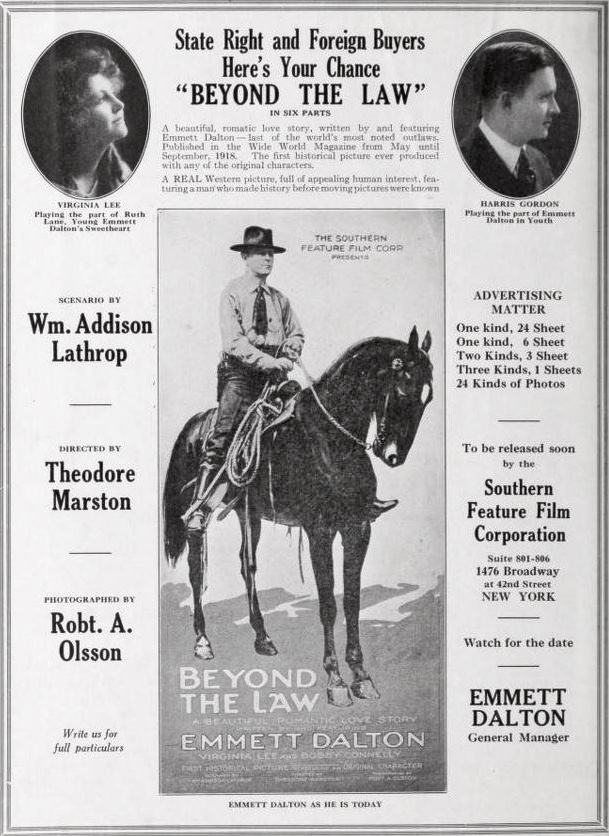
The celluloid of Beyond the Law is cracked like drought-earth, yet those fissures exhale a sulfurous modernity: the suspicion that institutions exist less to protect than to farm their constituents. Directors who later fetishized anti-heroes—from Arthur Penn to Quentin Tarantino—will find their seed here, germinating in 1918’s loam of nickelodeons and war-fatigue.
Cinematographer William R. Dunn shoots candlelit interiors so that faces hover like disembodied consciences; chiaroscuro slashes across cheekbones, implying a moral battlefield beneath the skin. Exterior sequences invert the grammar of the pastoral Western: skyscapes dominate two-thirds of the frame, dwarfing riders who scurry along the bottom sliver—man as afterthought, not anchor. Compare this to the open-air optimism of When the Mountains Call; the difference is spiritual claustrophobia.
As Grat Dalton, Bobby Connelly toggles between Puritan rectitude and wounded vengeance without leaning on histrionic pantomime—no small feat in an era that equated acting with semaphore. His jailhouse monologue, delivered to a mouse he later frees, is a masterclass in micro-gesture: a jaw muscle flickers, knuckles blanch, and suddenly the whole cell feels pressurized. Mabel Bardine, playing a widowed schoolteacher who shelters the fugitives, supplies the film’s moral gyroscope; her silent scrutiny indicts both outlaws and audience for voyeuristic complicity.
Co-writer Emmett Dalton—an actual surviving Dalton brother—imbues the script with lived grime: the way a Colt’s loading gate clicks shut like a coffin lid, the metallic taste of panic after a shoot-out. The dialogue intertitles eschew the purple bombast common in 1918; instead they flick like switchblades: “Justice is a tin star pinned to a dead man’s chest.” Compare that economical venom to the florid moralism of Abraham Lincoln’s Clemency; here, aphorisms bleed.
Archival prints now circulate with a new score: banjo, pump-organ, and a single timpani performed by Jack O’Loughlin. The timpani enters only during scenes of bureaucratic treachery—subtly cueing that the true villain is institutional cowardice, not six-gun slingers. In escheeting heroic brass, the music reframes the Western as courthouse noir, aligning Beyond the Law more with The Red Circle than with open-range hymns of The Three Pals.
Virginia Lee plays newspaper illustrator Lila Trent, a proto-feminist figure who sketches crime scenes with the same clinical detachment medical students reserve for cadavers. Her presence critiques the mythic masculinity peddled by most Westerns, including contemporaries like Madcap Madge. Yet the film denies her savior status; when she brandishes Grat’s own revolver, the recoil knocks her against a whiskey shelf, underscoring that breaking patriarchal cycles demands more than symbolic reversals.
The escape sequence—shot in a decommissioned copper mine—ranks among early cinema’s most harrowing odysseys. Grat crawls through a drainage pipe flooded with runoff; the camera, fixed inside the pipe, tilts downward so water rises toward the lens, as though the earth itself salivates. When he surfaces, moonlight strikes his silhouette, evoking both baptism and predatory resurrection. Few spectacles of 1918, not even the cliffhanger bravado of The Perils of Pauline, married physical ordeal to spiritual limbo this seamlessly.
Amid post-war Red Scare, the film refuses to editorialize: crooked marshals wear both Union vests and Confederate kepis, suggesting corruption as bipartisan fungus. Newspapers, banks, and railroads form an unholy trinity that feels eerily predictive of modern conglomerate rule. The express-company robbery therefore plays not as felonious indulgence but as insurgent audit—an ancestor to contemporary whistle-blowers, albeit with Winchester rifles instead of thumb-drives.
Editor Harris Gordon alternates between tableau longueurs—where characters plan heists amid kerosene gloom—and staccato close-ups of ticking pocket watches, telegraph keys, and hammer cocks. The contrapuntal tempo anticipates Soviet montage, yet remains rooted to narrative rather than ideology. The final standoff cross-cuts between a church bell tolling, a child’s marble rolling under a porch, and the rifled barrels of a posse; the triangulation births a sense of inexorable fate that would make later noir auteurs blush.
Because the film was distributed by a regional outfit that folded during the 1919 recession, Beyond the Law slipped into archival limbo for decades. Yet bootleg 9.5 mm reels circulated in Parisian ciné-clubs of the 1950s, influencing the fatalistic protagonists of Jean-Pierre Melville. The soot-laden palette even haunts New Hollywood—watch The Wild Bunch and you’ll detect visual DNA from Dalton’s last ride. Kino Lorber’s 2023 restoration, scanned at 4K from a nitrate print discovered in a Portuguese monastery, reveals textures of burlap, sweat, and parchment previously smothered by mildew, offering modern viewers a tactile portal into America’s moral wilderness.
To label Beyond the Law a Western is to cage a shape-shifter. It is a procedural about institutional rot, a prison-break thriller, a proto-heist noir, and a meditation on brand loyalty in the marketplace of violence. Its refusal to provide cathartic heroism—brothers vanish into mesquite haze, wanted posters flap like torn prophecies—renders it startlingly modern. In an era when franchises grind moral binaries into CGI sausage, this century-old artifact reminds us that American mythology was always contested terrain. Watch it, and you’ll taste iron in your mouth, dust in your eyes, and the chill suspicion that justice may be nothing more than the narrative that survives.
IMDb —
1929
Community
Log in to comment.