DbcultAccessing Vault...
6.1/10
Senior Film Conservator
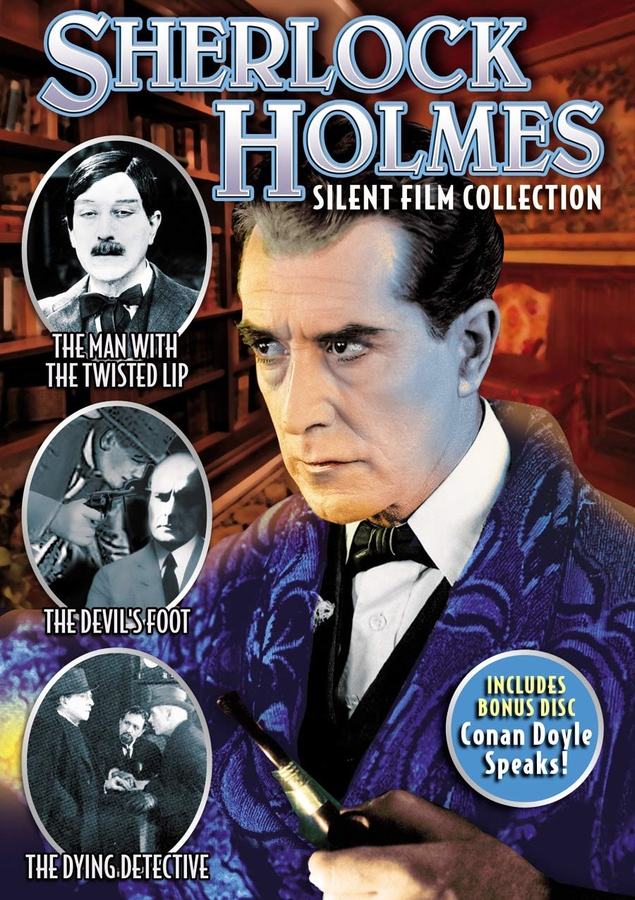
A definitive 6.1/10 rating for a film that redefined the boundaries of cult cinema. The Man with the Twisted Lip remains a cornerstone of transgressive art.
The first time you see Eille Norwood’s silhouette glide across the frame, the camera itself seems to inhale—an intake of breath that has lasted a century. In The Man with the Twisted Lip (1921), director Maurice Elvey distills Conan Doyle’s penny-dreadful parable into pure nitrate nightmare: 25 minutes of celluloid that feels like stumbling upon a lost daguerreotype of the soul.
There is no pipe, no deerstalker, no 221B sitting room stuffed with Persian slippers. Instead, Norwood’s Holmes is a cadaverous poet of deduction, clad in charcoal lounge suit, eyes flickering like shutter blades. He enters the story not through Baker Street’s cozy clutter but through a trapdoor in the Victorian psyche—a trapdoor that opens onto the reeking hold of an opium hulk moored in the Thames. The film’s London is not the fog of romantic lore but a phosphorescent abscess, every cobblestone sweating gin and lamp-oil.
Elvey shoots Swandam Lane as if it were the interior of a malformed heart. The camera tilts, walls lean, shadows lengthen into claws. When St. Clair’s wife (Mme. d’Esterre, luminous even behind a veil of nitrate scratches) receives the ransom letter written in her husband’s hand, the envelope seems to perspire with menace. The audience of 1921 had seen poverty on the newsreels, but here poverty is not an economic statistic—it is a contagion that turns a stockbroker into a grotesque, that dissolves class like acid on enamel.
The beggar Hugh Boone—rendered by Norwood in a dual role of chilling dexterity—first appears as a lump of rags coughing tuberculosis into the night. Yet the moment he lifts his face, the gaslight carves out the same bone structure that once smiled from St. Clair’s wedding photograph. The effect is uncanny not because of trick photography (though the double-exposure work is seamless) but because Norwood modulates micro-gestures: the same nostril flare, the same fractional hesitation before speech. It is as if identity were a garment one might shrug off like an overcoat.
Inside the den, Elvey’s camera becomes narcotic. Frames drift in slow dissolves; opium smoke curls across the lens like ectoplasm. Patrons lie on wooden benches, their faces illuminated by single candle stubs that flicker between copper coins. The proprietor—played by Robert Vallis with the reptilian courtesy of a cathedral verger—collects dreams the way other men collect butterflies. When Holmes inhales the fumes (a liberty that would have appalled Doyle purists), the film cuts to an iris-in on his dilated pupil: a black sun into which the entire narrative collapses.
This is not mere atmospheric indulgence. Elvey aligns the detective’s methodology with the addict’s craving for revelation. Both seek a vanished hour, a hidden quadrant of memory. The difference: the addict wants to forget, Holmes to remember. In a bravura close-up, Norwood’s eyes register the instant when deduction crystallizes—an almost erotic shudder that passes through clenched jaw to fingertips. It is the silent era’s answer to the modern jump-cut epiphany.
What renders Twisted Lip unnerving even now is its diagnosis of affluence as performance. St. Clair’s daily commute—first-class railway carriage to Regent Street office—costs more than the few pence he earns as Boone. Yet the beggar’s income, tax-free and anonymous, paradoxically liberates him from the ledger of respectability. The film stages this inversion in a single devastating match-cut: from St. Clair signing a contract with fountain pen to Boone spitting on a shilling to polish it. Ink becomes spittle; parchment becomes palm.
Compare this to the waterfall imagery in Falling Waters, where social mobility is a gentle cascade; here it is a sewer backflow. Or juxtapose it with The Conqueror’s heroic ascent—Elvey offers no martial trumpets, only the wet slap of mud on silk cuffs.
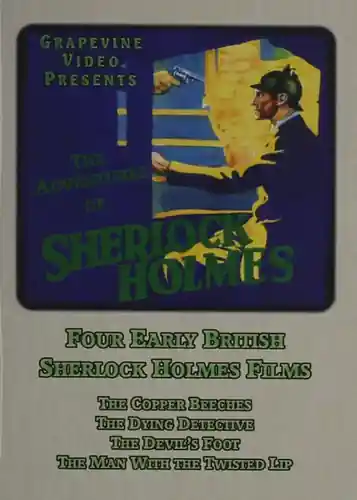
Paulette del Baze, as the street urchin who leads Holmes to the den, functions as the film’s ruptured conscience. Her cap is too large, her boots gaping like clowns’ grins. When she pockets the tuppence fee, the coin dwarfs her palm—an emblem of an economy that metabolizes childhood. In a scene censored in some American prints, she hawks a gob of phlegm onto a missionary tract handed out by do-gooders. The camera lingers on the wet paper sliding down the wall, its biblical text smearing into illegibility—a moment of blasphemy more electric than any gunshot.
Film historians rightly praise Norwood’s 45 on-screen outings as Holmes, yet Twisted Lip distills his art to essences. Watch the micro-muscular shift when Holmes, having unmasked Boone, steps back into the gaslight: shoulders imperceptibly square, chin lifts a millimetre—reasserting the detective’s armature of class. The transition occurs in less than two seconds, but it is the silent equivalent of a Shakespearean soliloquy on the elasticity of self.
Contrast this with the flamboyant disguise sequences in Lifting Shadows, where identity is a masquerade ball; Norwood insists that identity is a scar you cannot exfoliate.
Contemporary reviewers complained the film lacked “incident”—no speeding hansom, no waterfall finale. Yet Elvey orchestrates silence itself as suspense. When Holmes confronts Boone in the garret, the intertitle card reads merely: “You were St. Clair.” For twelve seconds the screen holds a static two-shot: no music, only the crackle of nitrate replicating candle-wick. The absence becomes a roar. Modern thrillers, with their staccato cuts and Hans Zimmer foghorns, could learn the vertiginous power of withheld stimulation.
The final scene rejects Doyle’s neat restoration. St. Clair, scrubbed and re-suited, stands at his drawing-room window while his children practice scales on a rosewood piano. The camera tracks past lace curtains into the street, where the real Boone—now a destitute impostor—limps into darkness. The last intertitle: “The mask returns to its owner.” There is no moral, only the aftertaste of rust on the tongue. Compare the redemptive arc of Life Savers; Elvey offers no buoy, only undertow.
A 2022 4K restoration by the BFI reveals textures previously lost: the herringbone weave of Holmes’s waistcoat, the opium den’s peeling wallpaper patterned with faded chrysanthemums that resemble blood-clots. Under the amber tint of the restoration, the Thames at dawn looks like liquid pewter—beauty that bruises.
Trace the lineage: the chiaroscuro of The Third Man, the bifurcated identity in Vertigo, the urban abyss of Taxi Driver—all sip from Elvey’s gutter. Even the Joker’s laugh in 2019’s Joker echoes Boone’s rictus: the smile that is never joy, only scar tissue.
To watch The Man with the Twisted Lip today is to step through a mirror coated in coal-dust and come face-to-face with your own uneasy reflection. The film lasts 25 minutes; its questions linger for a lifetime. Who among us has not, at some traffic light, locked eyes with a cardboard sign and felt the floor of certainty sag? Elvey’s flickering phantasmagoria reminds us that the only thing more terrifying than the monster is the mask we mistake for a face.
Seek it out on Blu-ray, project it on a white wall at midnight, let the candle gutter. When the screen goes black, listen: you will hear the soft thud of your own coin dropping into the abyss.
IMDb —
1917
Community
Log in to comment.