DbcultAccessing Vault...
5.3/10
Senior Film Conservator
A definitive 5.3/10 rating for a film that redefined the boundaries of cult cinema. Friday, the 13th remains a cornerstone of transgressive art.
Friday, the 13th (1921) arrives as a curious artifact of the silent film era, a relic that straddles the chasm between burlesque and existential horror with a gait both unsteady and deliberate. Directed by Leo S. McNutt, this film’s narrative hinges on the quotidian tribulations of Harry McCoy and Sidney Smith, two everymen whose day spirals into a surreal odyssey of mishaps. What begins as a series of minor inconveniences—a misplaced train ticket, a recalcitrant horse—culminates in their arrival at a chiropractor’s office, a setting that quickly metastasizes into a gothic tableau of bodily and existential disquiet. The film’s genius lies in its ability to transform a mundane medical consultation into a parable of modern alienation.
McNutt’s direction is a masterclass in visual economy. The chiropractor’s office, rendered in stark contrasts of light and shadow, becomes a character in its own right. The skeletal tools of the trade—adjustable tables, leather straps, and enigmatic machines—loom with the menace of a Boschian nightmare. This is a film that understands the silent medium’s capacity for metaphor: the protagonists’ physical discomfort mirrors the viewer’s increasing unease as the narrative veers into the uncanny. The intertitles, sparse yet densely poetic, suggest a Freudian undercurrent, framing each twist and turn as both a bodily correction and a psychological reckoning.
Friday, the 13th’s power is in its restraint. The film avoids overt horror tropes, instead cultivating an atmosphere of quiet dread through composition and performance. Harry McCoy’s portrayal of the lead protagonist is a study in subtlety; his twitching eyelids and clenched jaw betray a man on the brink of collapse, not from physical malady, but from the weight of unseen pressures. Sidney Smith’s comedic timing, reminiscent of Harold Lloyd’s early work, injects levity, yet even his broad grins feel strained, as though the joy is a veneer over deeper anxieties. This duality—the interplay of humor and horror—is the film’s most compelling feature.
Consider the chiropractor, played by an anonymous yet magnetic presence whose every movement is imbued with the authority of a cult leader. His dialogue, though minimal, is punctuated by glances that linger just a beat too long, and gestures that suggest a man in thrall to his own methods. The office itself, with its sterile whiteness and angular furniture, becomes a cathedral of modernity, where science masquerades as salvation. This is a world where the body is a machine, and the chiropractor, its grim mechanic.
"The chiropractor’s instruments, gleaming with clinical promise, become harbingers of the grotesque, their purpose obscured by the shadows of doubt."
The performances in Friday, the 13th are a testament to the silent film era’s reliance on physical expressivity. Harry McCoy’s protagonist, for instance, communicates volumes through micro-expressions—a furrowed brow here, a hesitant step there. His interactions with Sidney Smith are choreographed with a precision that echoes the slapstick duos of Keaton and Lloyd, yet the tone is more somber, the stakes higher. Smith’s character, though ostensibly the comic relief, often serves as the audience’s surrogate, his bewilderment mirroring our own as we navigate the film’s increasingly absurd turns.
The chiropractor’s assistant, a silent figure whose presence is felt more than seen, adds another layer of intrigue. Her wide-eyed stares and hurried movements suggest a complicity in the proceedings, a silent knowingness that amplifies the tension. In one particularly haunting sequence, she arranges the office’s instruments into ritualistic formations, a visual cue that the protagonist’s treatment is less about healing and more about transformation—perhaps even transcendence.
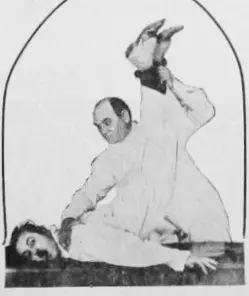
Leo S. McNutt’s visual language is both minimalist and maximalist. The film’s use of chiaroscuro is not merely aesthetic but thematic; the stark lighting divisions between light and shadow mirror the protagonists’ internal struggles between reason and fear, order and chaos. In one sequence, the chiropractor’s office is bathed in an otherworldly glow as the sun filters through stained glass, casting kaleidoscopic patterns on the floor. This is not a space of healing but of revelation, where the mundane is rendered mystical through cinematic alchemy.
The film’s narrative economy is equally impressive. With a runtime that would today qualify as a short, Friday, the 13th tells a complete story of descent into madness and tentative return to clarity. Each mishap the protagonists endure—be it a lost hat or a phantom limb—builds upon the last, creating a cumulative effect of disorientation. The script, penned by McNutt himself, is a labyrinth of allusions, drawing parallels between the physical body and the body politic. It is a film that asks, with silent urgency, whether modernity’s progress is a form of violence against the human form.
"In the silent film’s lexicon, the chiropractor’s adjustments are both a literal and metaphorical dismantling of the self."
Friday, the 13th’s place in early cinema is best understood in dialogue with its contemporaries. Like The Haunted House (1921), it employs domestic spaces as sites of psychological unease, though it diverges by grounding the horror in the body rather than the supernatural. The film’s absurdist undertones recall An Alien Enemy, where the foreign is rendered as both comic and sinister. Yet, where those films rely on external threats, Friday, the 13th turns its gaze inward, finding menace in the mundane.
Its influence can also be traced in the stark minimalism of Umanità, though McNutt’s film is more overtly satirical. The juxtaposition of humor and horror is a technique later refined in The Catspaw, yet here it feels more organic, as if the two genres are inextricably linked. The chiropractor’s office, with its sterile menace, prefigures the dystopian settings of The Eternal Strife, albeit with a lighter touch.
Though often overshadowed by its more famous peers, Friday, the 13th (1921) is a cornerstone of early cinema’s exploration of the human psyche. Its themes of bodily autonomy and societal pressure resonate with the same urgency today, particularly in an age where technology continues to redefine our relationship with the self. The film’s legacy is evident in the works of later directors who would take its subtextual cues—Brewster’s Millions’s satirical edge, Arshin Mal-Alan’s operatic despair—all woven from the same tapestry of existential inquiry.
For modern viewers, the film offers a dual experience: a window into the silent era’s stylistic experimentation and a mirror reflecting our own anxieties about control and vulnerability. The chiropractor’s final act—adjusting the protagonist with a look of serene menace—is less a cure than a covenant, a reminder that in seeking to master our bodies, we may unwittingly surrender them to forces beyond our comprehension. In this, Friday, the 13th is not merely a film of its time but a prescient meditation on the human condition, rendered in the stark poetry of the silent screen.
"A century later, the film’s closing shot of the office door closing behind the protagonist lingers like a question, unanswered yet unanswerable—a testament to cinema’s power to unsettle as it enchants."
IMDb —
1925
Community
Log in to comment.