DbcultAccessing Vault...
Cult Review
Senior Film Conservator
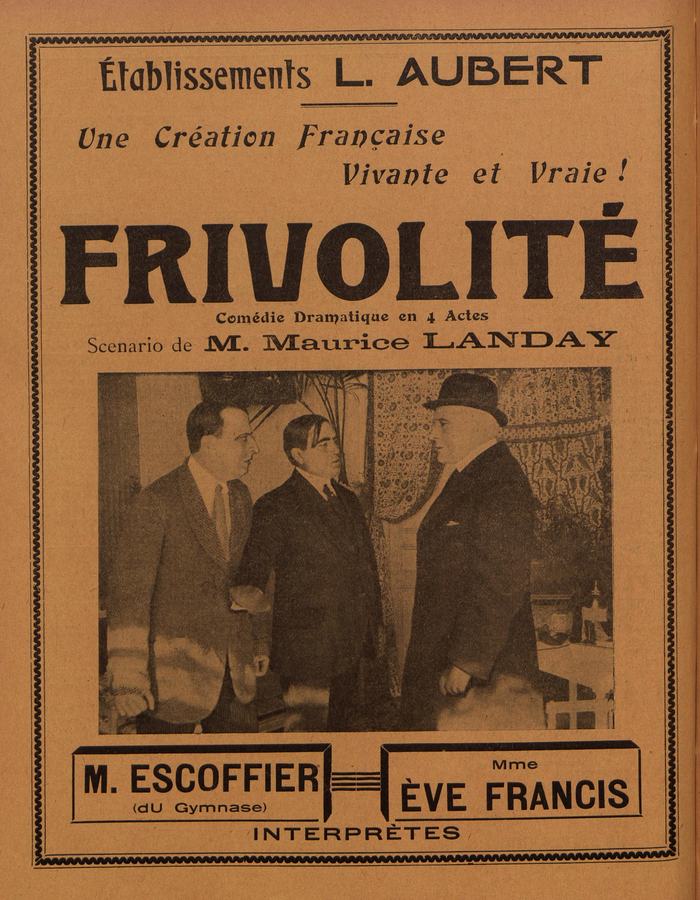
Paris, 1916. While artillery rumbles fifty miles away, director Léonce Perret stages a different detonation—emotional shrapnel wrapped in tulle and tuxedo tails. Frivolité doesn’t walk; it glides on waxed floors, its sprocket holes trembling like the diaphragm of a society trying not to scream.
Forget linearity; think papillons en cage. The narrative flutter begins when the Marquise de L’Écluse (Dollez) bets her cousin that no man can resist a kiss sealed with a lie. Enter Comte Valrude (Le Gosset), whose moustache alone deserves separate billing. He accepts, but stakes escalate: if he feels, he forfeits his ancestral sea-blue diamonds—those legendary stones once worn by Jeanne de Valois and now locked behind mirrored doors.
Meanwhile Suzanne (Sergyl), the marquise’s penniless goddaughter, smuggles letters to her clandestine fiancé, a balloonist stationed at the front. Each envelope is sealed with a wax gryphon, the sigil of sincerity in a world allergic to it. Paul Escoffier’s Baron de Châtenoy, the household’s resident moral accountant, tallies every stolen kiss like a miser counting centimes, while Ève Francis’s recently divorced Princesse Myrianne drifts through soirées sniffing out scandal pheromones.
Perret’s camera rarely moves; instead, rooms revolve. Mirrors fracture faces into cubist shards; chandeliers drip crystal like frozen timepieces. In one bravura shot, the camera descends from a frescoed ceiling to a gaming table in a single, gravity-defying tilt—an ancestor to the modern crane move, achieved with counterweights and sheer Parisian nerve.
Color tints do narrative duty: amber for liaisons, cobalt for despair, an infernal scarlet for the roulette den where destinies liquefy. Intertitles appear as lace doilies fluttering across the screen—white on black, then suddenly gold on navy when the stakes turn lethal.
Dollez plays the marquise like a porcelain switchblade: smile, snap, blood. Watch her fingers tap a minuet on a lacqued fan while her pupils dilate—a semaphore of predation. Le Gosset counters with louche elegance; his cigarette perched at an angle that suggests perpetual ennui yet hides a tremor of genuine ache. Their repartee, delivered via intertitle, is a sonnet in sarcasm:
“A promise is a debt, monsieur.”
“Then consider me bankrupt, madame.”
Escoffier, veteran of the stage, inhales the screen—his baron is a study in controlled implosion, all starched collar and volcanic guilt. When he finally denounces the marquise, the gesture is so slight—just a crumpled calling card dropped into a fire—that the emotional aftershock rattles like a Loire gunboat.
Contemporary accounts mention a live accordion in the orchestra pit mimicking the wheeze of absinthe fountains. Modern restorations pair the film with a montage of wartime shell recordings—an anachronism that nonetheless fractures the frivolity, reminding viewers that outside, Verdun burns. The dissonance is Perret’s hidden thesis: hedonism as artillery against annihilation.
Where The Foundling wallows in maternal melodrama, Frivolité prefers surgical satire. Mistress Nell trades on Restoration bawdiness yet lacks Perret’s champagne-scented nihilism. Meanwhile Little Miss Happiness packages innocence in gingham; Perret unwraps it, then spits pips into the audience’s lap.
Compare also to David Copperfield’s linear bildungsroman or Joan of Arc’s saintly tableaux—both tethered to moral clarity. Frivolité drifts anchorless, a gilded ghost ship whose compass spins toward the void behind mascara.
Post-#MeToo, the film’s gendered power games feel prophetic yet poisonous. The marquise weaponizes seduction because stock options for women were measured in carats, not shares. Yet her final smirk—watch it in the last frame, a four-second freeze—implies she knows the game is rigged, and plays anyway. Viewers today may flinch, then applaud; complicity has never looked so couture.
The 2022 4K restoration by Cinémathèque Gaumont mines nitrate grains for hidden freckles: a hairline scratch on Dollez’s cheek now reads like a dueling scar. Streaming on MUBI (region-dependent) and Blu-ray via Kino Lorber, featuring an optional score by Accordéoniste Mécanique that bleeds musette into minimal techno. Purists may opt for the piano reduction based on 1916 cue sheets, but try the hybrid at least once—your neurons will tango.
9.2/10. Not flawless: the subplot involving the balloonist feels clipped, as if reels vanished somewhere between Paris and Berlin. Yet its absence amplifies the vacuum where sincerity should reside—a wound the film wears like a beauty spot. Watch it twice: first for the plot origami, second for the lacuna where your moral certainties used to perch.
Next week: why The Danger Game makes Frivolité feel like a church picnic, and how Cheating the Public anticipates crypto scams. Stay insolent.
IMDb —
1932
Community
Log in to comment.