DbcultAccessing Vault...
Cult Review
Senior Film Conservator
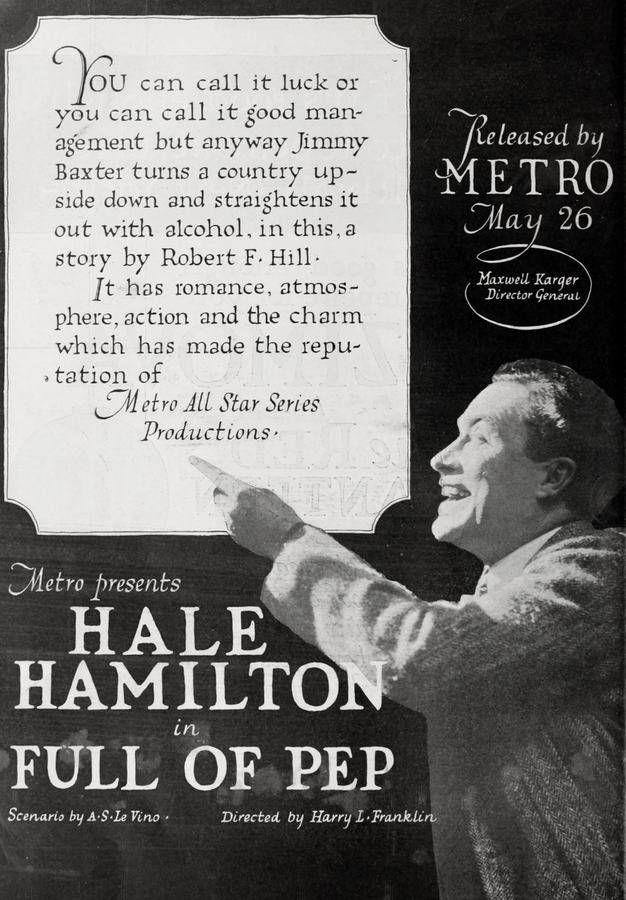
The year 1919 was a period of profound transition for the American psyche, a moment caught between the industrial carnage of the Great War and the burgeoning decadence of the Roaring Twenties. In this context, Full of Pep serves as a fascinating, if somewhat manic, artifact of its time. Directed by Robert F. Hill and written by the prolific Albert S. Le Vino, the film is an exercise in narrative velocity that mirrors its protagonist’s own restless energy. It is a story that manages to weave together the disparate threads of arms dealing, patent medicine fraud, and tropical revolution into a tapestry of comedic adventure that feels remarkably modern in its cynicism toward corporate ethics.
At the center of this whirlwind is Hale Hamilton, an actor whose screen presence was defined by a sort of perpetual motion. As Jimmy Baxter, Hamilton embodies the 'live-wire' archetype that was so prevalent in early 20th-century fiction—the man who succeeds not through intellectual depth, but through sheer, unadulterated speed. Unlike the more somber industrial figures we see in films like Business Is Business, Baxter is a salesman of the soul, a man who views the world as a series of closing opportunities. His performance here is a masterclass in silent-era physical comedy, utilizing his entire frame to convey the urgency of a man who cannot afford to stand still lest his conscience catch up with him.
Hamilton’s chemistry with Alice Lake, who plays the luminous Felicia Bocaz, provides the necessary emotional anchor for the film’s more absurd plot points. Lake, who would later find fame in more dramatic roles, brings a grounded grace to Felicia. She isn't merely a trophy to be won; she represents the civilization that Baxter’s munitions ostensibly protect, yet her father’s precarious position as the President of Santo Dinero highlights the fragility of that very civilization. Their meet-cute at the train station is a delightful piece of visual storytelling, relying on the subtle interplay of luggage tags and fleeting glances—a far cry from the more heavy-handed romanticism found in The Light That Failed.
One cannot discuss Full of Pep without addressing its central, somewhat scandalous conceit: the sale of 'Pep,' a patent medicine that is actually whiskey. In 1919, as the shadow of Prohibition loomed large over the United States, the idea of a hero selling booze under the guise of medicine was both a topical gag and a pointed critique of the burgeoning 'wellness' industry of the era. The film treats the distribution of 'Pep' not as a moral failing, but as a stroke of genius. It is the ultimate lubricant for social and political friction.
When Jimmy arrives in Santo Dinero, he finds a nation on the brink of collapse. The munitions he carries are intended to suppress a revolution, but it is the 'Pep' that truly manages to subvert the uprising. There is a profound irony here: the 'fastest salesman' of death (munitions) finds that life (or at least, the liquid illusion of it) is a far more effective tool for control. This thematic duality elevates the film beyond a simple comedy. It suggests that the American export to the developing world is not just hardware, but a specific brand of intoxicating optimism—one that can be bottled and sold to the highest bidder.
The depiction of Santo Dinero is, admittedly, steeped in the 'Banana Republic' tropes of the early 20th century. However, Hill’s direction manages to avoid some of the more egregious caricatures by focusing on the absurdity of the political machinations. Fred Malatesta portrays General Lopanzo with a deliciously oily villainy. Lopanzo is the perfect foil for Baxter; where Baxter is transparent in his hustle, Lopanzo is shrouded in layers of domestic and political betrayal. The General’s pursuit of Felicia is framed not just as a romantic desire, but as a territorial acquisition, mirroring the way the munitions company views the entire region.
In many ways, Full of Pep serves as a lighter, more frantic cousin to Mr. Grex of Monte Carlo, which also dealt with international intrigue and the intersection of personal desire and geopolitical stability. But where Mr. Grex leans into the shadows of diplomacy, Full of Pep stays firmly in the sunlight, using its vibrant (albeit black and white) setting to emphasize the slapstick nature of power struggles. The scene where Jimmy first sells, then gives away the 'Pep' to the locals is particularly telling. It’s a moment of populist manipulation that feels uncomfortably relevant to modern media cycles.
Technically, the film is a testament to the efficiency of the Metro Pictures Corporation. Robert F. Hill, who would go on to direct numerous serials, understands how to maintain a rhythm. The editing is sharp, particularly during the transition from the bustling American train station to the more languid, yet tension-filled, docks of Santo Dinero. The cinematography captures the scale of the munitions operation with an eye for industrial grandeur that recalls Britain's Bulwarks, No. 1: Women Munitioners of England, though here the context is far more cynical.
The use of intertitles in Full of Pep is also noteworthy. Le Vino’s writing is punchy, filled with the vernacular of the 'go-getter' era. The dialogue doesn't just convey plot; it conveys a worldview. When Jimmy’s father discusses the secret delivery of arms, the language is that of a board meeting, not a war room. This juxtaposition of corporate banality and revolutionary violence is where the film’s sharpest teeth are found. It shares a certain DNA with The Outsider in its exploration of a man entering a closed society and disrupting its internal logic—though Jimmy does so with a smile and a bottle rather than through social friction.
The climax of the film, involving a drunken revolutionary force being led back to order by a salesman, is as hilarious as it is deeply weird. Jimmy Baxter doesn't win the day through superior firepower (despite literally bringing the guns) or through a stirring speech about democracy. He wins because he is the best distributor of a desirable commodity. In the world of Full of Pep, the salesman is the ultimate kingmaker. This conclusion is far more subversive than the typical 'hero saves the day' trope found in films like The Ragged Earl.
As Felicia’s father is restored to power, one has to wonder about the long-term stability of a government held together by 'Pep.' But the film doesn't ask us to look that far ahead. It is a product of the 'now,' a celebratory shout of American ingenuity and the belief that any problem—be it a revolution or a broken heart—can be solved with the right pitch and a stiff drink. It lacks the moral weight of The Mortal Sin, but it replaces that weight with a buoyant, almost infectious joy.
To watch Full of Pep today is to glimpse the DNA of the modern action-comedy. It possesses a relentless drive that many contemporary films struggle to replicate. While it may occasionally stumble into the simplistic tropes of its era, its core remains a sharp, witty, and visually engaging critique of the American spirit. It is a film that understands that sometimes, to save the world, you have to be a little bit of a huckster.
Whether you are drawn to it for Victor Potel’s character work or the sheer spectacle of the 'Pep' distribution, there is no denying that the film lives up to its title. It is an artifact of a time when the world was expanding, and men like Jimmy Baxter were the ones charting the course—one sale at a time. It stands alongside other eccentric gems of the period like A Roadside Impresario as a testament to the creative risks early filmmakers were willing to take. In the end, Full of Pep is more than just a silent comedy; it is a cinematic shot of adrenaline that still packs a punch over a century later.
Critic's Rating: 8.4/10
A dazzling display of silent era energy that balances corporate satire with high-stakes adventure. Hale Hamilton is a revelation, and the film’s cynical take on the 'medicine' industry remains surprisingly sharp.
IMDb 7.6
1926
Community
Log in to comment.