DbcultAccessing Vault...
Cult Review
Senior Film Conservator
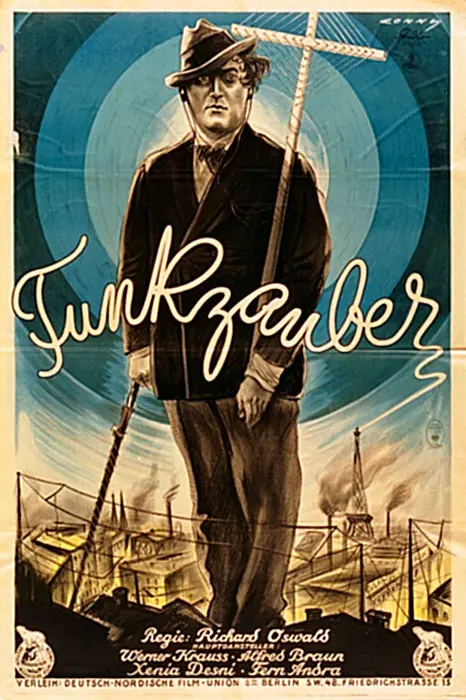
Is Funkzauber worth your time in the digital age? Short answer: Yes, but primarily for those who view cinema as a window into the evolution of human connectivity. It is a film that demands a specific type of patience, one rewarded by the sight of a society collectively losing its mind over a box that makes noise.
This film is for the media historian, the silent cinema enthusiast, and anyone fascinated by how 'new tech' was perceived before it became mundane. It is absolutely not for those seeking a fast-paced modern comedy or a traditional narrative arc with high-stakes tension. It is a series of observations wrapped in the crackle of early radio static.
1) This film works because it treats the radio not just as a gadget, but as a supernatural force that fundamentally altered social etiquette and domestic space.
2) This film fails because its comedic timing is occasionally archaic, relying on physical gags that feel clunky compared to the sophisticated social satire it attempts elsewhere.
3) You should watch it if you want to see a rare, lighter side of German silent cinema that moves away from the shadows of expressionism into the light of the 'New Objectivity'.
In 1927, the world was vibrating with the energy of the wireless. Funkzauber (literally 'Radio Magic') attempts to bottle that lightning. While many films of the era, such as Bismarck, were preoccupied with heavy historical legacies or nationalistic fervor, Funkzauber is refreshingly modern. It looks forward, not backward. It captures the frantic, almost neurotic energy of Berlin during the mid-twenties.
The film excels in its depiction of the 'radio bug.' We see scenes of domesticity completely derailed by the introduction of the receiver. There is a specific, wonderful moment where a family sits in a semi-circle, tethered to a single device by tangled wires, looking like a group of high priests performing a ritual. It’s a striking visual metaphor for how technology began to dictate the geometry of the home. This isn't just movie magic; it's a documentary-adjacent look at a cultural shift.
Unlike the gritty urban underworlds seen in Söhne der Nacht, 1. Teil: Die Verbrecher-GmbH, Funkzauber is bright and airy. The cinematography focuses on the sleek lines of the broadcasting equipment and the polished surfaces of the studios. It reflects a world that believed technology would solve human isolation. It’s optimistic, perhaps naively so, and that’s exactly where its charm lies.
Seeing Werner Krauss in a comedy is a bit like seeing a lion play with a ball of yarn. Known for his towering, often terrifying roles in expressionist masterpieces, Krauss brings a surprising lightness here. He doesn't lean into the grotesque; instead, he uses his precision to highlight the absurdity of the situations. His presence anchors the film, preventing it from floating away into total slapstick irrelevance.
The supporting cast, including Alfred Braun (a real-life radio pioneer), adds a layer of meta-textual depth. Braun isn't just acting; he's performing the medium he helped build. This gives the studio scenes a sense of lived-in reality. When the characters fumble with the massive microphones and the primitive mixing boards, there is a tactile quality to the performance that CGI-heavy modern films can never replicate. You can almost smell the ozone and the dust in the studio.
However, not every performance hits the mark. Some of the broader comedic roles, played by actors like Fritz Kampers, feel a bit too much like leftovers from the 1910s. The 'funny fat man' tropes and the exaggerated double-takes are the film's weakest points. They feel like they belong in a film like Hands Up rather than a forward-looking 1927 production. It’s a jarring contrast between the sophisticated theme and the primitive humor.
Richard Oswald was a director who understood the pulse of the public. In Funkzauber, he uses a rhythmic editing style that mimics the pulse of a radio signal. The way he cuts between the broadcast studio and the listeners in their homes creates a sense of a shared, invisible community. It was a radical concept at the time—the idea that thousands of people could experience the same moment simultaneously while being miles apart.
There is a specific sequence involving a musical broadcast where Oswald uses double exposures to show the music 'traveling' over the city rooftops. It’s a simple effect, but it’s remarkably effective. It visualizes the invisible. This kind of creative problem-solving is what makes silent cinema so engaging. Without the ability to actually play the sound for the audience, the director had to make the audience *feel* the sound through visuals alone.
The pacing, however, is where Oswald struggles. The film occasionally gets bogged down in its own subplots. There is a romantic thread that feels particularly thin, serving only to bridge the gap between the more interesting technical sequences. It lacks the raw emotional power of something like For the Freedom of the World, but then again, it isn't trying to be an epic. It’s a slice-of-life comedy that sometimes forgets to keep the slice thin enough to swallow easily.
Funkzauber is a 1927 German silent film that explores the societal impact and comedic chaos surrounding the early days of radio broadcasting. It portrays how the 'magic' of the airwaves connected people across social and geographic divides.
If you are looking for a masterpiece of narrative structure, look elsewhere. But if you want to see the exact moment that modern media culture was born, Funkzauber is essential. It is a film that documents the transition from a world of physical presence to a world of virtual presence. It’s a fascinating, albeit flawed, time capsule.
The film is also a must-watch for those interested in the 'Neue Sachlichkeit' movement. It eschews the distorted sets of Caligari for a clean, functional aesthetic. This is the cinema of the machine age. It is cool, calculated, and deeply curious about the hardware of the modern world. It is a film about the beauty of a vacuum tube.
Pros:
- Exceptional historical value regarding the birth of mass media.
- Werner Krauss proves his range in a rare comedic role.
- Innovative visual metaphors for sound and connectivity.
- A fascinating glimpse into 1920s Berlin interior design and social norms.
Cons:
- The romantic subplot is entirely forgettable.
- Some physical comedy bits go on for far too long.
- The lack of a central, driving conflict makes it feel episodic.
The cinematography by the likes of Reimar Kuntze is crisp and functional. It doesn't have the poetic dreaminess of Northern Lights, but it has a different kind of beauty—the beauty of the object. The camera lingers on the knobs, the dials, and the glowing filaments of the radio sets. It treats these objects with the same reverence that a director might treat a lead actress's face.
This focus on the 'thingness' of the world is what makes the film so grounded. Even when the plot veers into the absurd, the physical environment remains steadfastly real. It’s a stark contrast to the more fantastical elements of films like Jungle Woman. In Funkzauber, the magic isn't in a monster or a distant land; it’s in the wires in your living room.
The editing is also worth noting. There is a sequence where the film cuts rapidly between different listeners—a lonely old man, a group of workers, a wealthy socialite—all reacting to the same broadcast. This montage technique was relatively fresh at the time and effectively communicates the democratic power of the radio. It levels the social playing field, if only for the duration of a song.
There is a profound irony in a silent film about the radio. It forces the audience to use their imagination to 'hear' the broadcast. In many ways, this makes the film more effective than a sound film might have been. By visualizing the *effect* of the sound rather than the sound itself, Oswald captures the psychological impact of the medium.
I would argue that Funkzauber is actually a more honest depiction of the radio than many later sound films. It treats the broadcast as a mysterious, almost holy event. Once sound came to cinema in 1929, the novelty of the 'voice from the box' disappeared. Funkzauber captures that final moment of mystery. It is a celebration of the unseen.
However, let’s be brutally honest. The film is occasionally boring. If you aren't already invested in the history of the era, the long stretches of characters just looking at their radio sets will test your resolve. It’s a film that requires you to meet it halfway. It doesn't entertain you; it invites you to observe.
Funkzauber is a fascinating relic. It is a film that captures the fever dream of the 1920s—a belief that technology would bring us all together in a harmonious 'magic' circle. While the plot is thin and the humor is hit-or-miss, the visual documentation of the era and the performance of Werner Krauss make it a journey worth taking for the dedicated cinephile.
It isn't a masterpiece. It’s better than that. It’s a piece of evidence. It’s proof of a time when we were still capable of being surprised by the world. In our age of constant, overwhelming connectivity, there is something deeply moving about watching people discover the simple joy of a voice coming through the air. It’s clunky. It’s archaic. But it has a soul that many modern blockbusters lack.
IMDb 6.1
1923
Community
Log in to comment.