DbcultAccessing Vault...
7.4/10
Senior Film Conservator
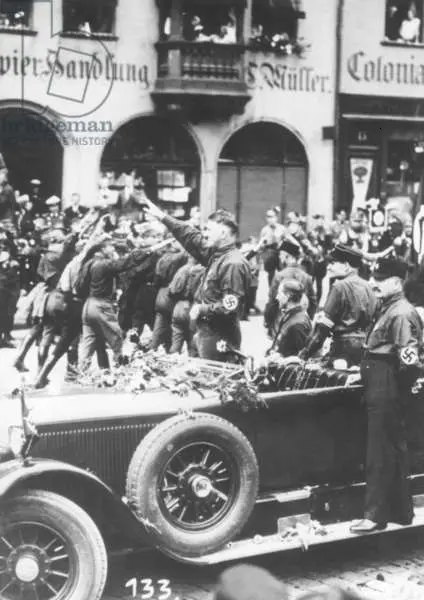
A definitive 7.4/10 rating for a film that redefined the boundaries of cult cinema. NSDAP Parteitag August 20-21, 1927 remains a cornerstone of transgressive art.
Is 'NSDAP Parteitag August 20-21, 1927' worth watching today? The short answer is a resounding 'yes,' but with significant caveats and a clear understanding of its deeply disturbing context. This isn't entertainment; it's a primary historical document, a window into the chilling genesis of one of history's most destructive ideologies.
It is a film absolutely essential for historians, political scientists, and anyone seeking to understand the visual language of nascent totalitarian movements. Conversely, it is decidedly not for the casual viewer looking for a traditional cinematic experience, nor for those unprepared to confront raw, unvarnished early propaganda.
To view 'NSDAP Parteitag August 20-21, 1927' is to embark on a journey not of discovery, but of confrontation. It’s a silent film that speaks volumes, not through dialogue, but through the deliberate arrangement of bodies, flags, and faces. This primitive documentary, the first cinematic record of a Nuremberg Rally, offers a stark, unfiltered look at the early days of the Nazi Party’s public presence.
It’s a film that demands active engagement, critical distance, and a robust historical framework. Without these, it risks being misunderstood, or worse, inadvertently amplifying the very message it sought to propagate a century ago. It works. But it’s flawed.
The direction, rudimentary as it may seem by today’s standards, is undeniably purposeful. The anonymous filmmakers were not aiming for artistic merit in the conventional sense, but rather for documentation as legitimation. Every frame, every pan across the assembled masses, every close-up of Adolf Hitler, is designed to imbue the event with a sense of order, power, and inevitability.
There's an almost anthropological quality to the way the camera observes the rituals: the marching columns, the salutes, the banners unfurling. It’s less about telling a story and more about presenting a fact – the fact of the party's growing presence and the supposed devotion of its adherents. This early directorial impulse is a chilling precursor to the highly stylized, emotionally manipulative propaganda films that would emerge a decade later, most notably from Leni Riefenstahl.
One striking example of this deliberate framing is the recurring shot of the assembled party members, often from a slightly elevated perspective. This isn't just a practical choice; it's a visual metaphor for the unified, overwhelming force the party sought to project. The individual is subsumed by the collective, a recurring motif in totalitarian iconography.
While the film doesn't feature 'actors' in the traditional sense, it is undeniably a performance. Adolf Hitler, the sole credited 'cast' member, is central to this performance. What we see here is Hitler in his relatively early days as a public figure, before the full theatricality of his later rallies had been perfected. His gestures are less refined, his movements perhaps a touch more awkward, yet the nascent power of his presence is palpable.
The film captures him addressing the crowds, his hand gestures already becoming iconic, his gaze fixed and intense. It's a fascinating study in the construction of charisma. The 'performance' also extends to the crowd itself – their synchronized movements, their rapt attention, their enthusiastic responses – all contributing to the meticulously crafted image of a unified, devoted movement.
Consider the moments where Hitler is shown arriving or departing. The camera lingers, emphasizing his central role, even amidst the throngs. This isn't accidental; it’s a deliberate attempt to elevate him, to establish his authority visually, long before the full cult of personality truly took hold. It’s a raw, unpolished form of celebrity manufacturing, chilling in its effectiveness.
The cinematography of 'NSDAP Parteitag August 20-21, 1927' is rudimentary, yet profoundly effective in its simplicity. Shot on black-and-white film, likely with limited equipment, it relies heavily on wide shots to capture the scale of the rallies and medium shots to focus on key figures. There are few complex camera movements, no elaborate tracking shots, just a steady, observational gaze that occasionally zooms in for emphasis.
The tone is one of earnest, almost solemn, self-aggrandizement. There’s a palpable sense of occasion, of historical import, that the filmmakers are trying to convey. The lack of an overt narrative or dramatic arc means the film's 'tone' is derived almost entirely from its subject matter: the disciplined, almost militaristic display of nascent political power.
The use of natural light, the grainy texture of the film, and the occasional imperfections in exposure all contribute to a sense of stark realism. This isn't glossy; it's gritty. And that grit, ironically, lends it a veneer of authenticity that makes its underlying propaganda all the more insidious. It looks like 'truth,' even as it constructs a carefully curated version of it.
One might compare its raw, unfiltered feel to early actualités, those unedited snippets of daily life that fascinated audiences in the early days of cinema. But unlike those, this film has a clear, manipulative agenda from its very inception. It's a document, yes, but a weaponized one.
The pacing of 'NSDAP Parteitag August 20-21, 1927' is dictated entirely by the events it chronicles. There's no dramatic build-up or narrative climax. Instead, it unfolds with a deliberate, almost processional rhythm, mirroring the highly ritualized nature of the rally itself. Sequences of marching formations transition into shots of speeches, then back to the assembled masses.
This repetitive structure, while potentially monotonous for a modern audience, serves a specific propagandistic function: it reinforces the idea of order, discipline, and ceaseless forward momentum. The rally is presented not as a singular event, but as a continuous, unstoppable force. There’s a relentless quality to its progression, a visual echo of the party’s own self-perception.
The film's structure is, in essence, a chronological record of the two-day event, emphasizing continuity and the sheer scale of the gathering. It’s a simple, chronological narrative, devoid of complex editing or non-linear storytelling. This straightforwardness, again, contributes to its perceived authenticity, making its underlying message all the more potent.
Yes, 'NSDAP Parteitag August 20-21, 1927' is unequivocally worth watching, but only if approached with a critical, informed perspective. It is not entertainment. It is a vital historical artifact. It provides an unfiltered, albeit self-serving, look at the nascent stages of Nazi propaganda and the early public persona of Adolf Hitler. For anyone studying political history, media manipulation, or the rise of totalitarianism, this film offers invaluable primary source material. It allows for a direct confrontation with the visual rhetoric that would eventually escalate into horrific state-sponsored terror. It is a challenging watch, but an essential one for understanding the past.
Perhaps the most unconventional observation one can make about 'NSDAP Parteitag August 20-21, 1927' is its almost amateurish quality. Compared to the slick, monumental productions that would follow, particularly Riefenstahl’s Triumph of the Will, this film feels almost like a home movie. Yet, it is precisely this raw, unpolished nature that makes it so terrifyingly effective as a historical document.
It’s a foundational text, a rough draft of evil. It lacks the sophisticated myth-making and aesthetic grandeur of later propaganda, but in its very simplicity, it reveals the raw, unadorned mechanisms of early mass persuasion. It’s not a grand narrative; it’s a direct, almost crude assertion of power, which in its own way, is far more chilling than any elaborate spectacle.
'NSDAP Parteitag August 20-21, 1927' is not a film one enjoys; it is a film one studies. It’s a chilling, essential document of a nascent evil, captured on celluloid almost a century ago. Its value lies not in its artistic merit, which is minimal, but in its historical weight and its stark illustration of how a political movement began to craft its public image through visual spectacle.
For those equipped with the necessary historical knowledge and critical perspective, it offers an invaluable, albeit uncomfortable, journey into the past. It serves as a potent reminder of the insidious power of propaganda and the importance of vigilance against ideologies that seek to dehumanize and control. This is not a recommendation for casual viewing, but a strong imperative for serious study. It is a film that must be seen, but never without a critical lens firmly in place.

IMDb 6.6
1936
Community
Log in to comment.