DbcultAccessing Vault...
Cult Review
Senior Film Conservator
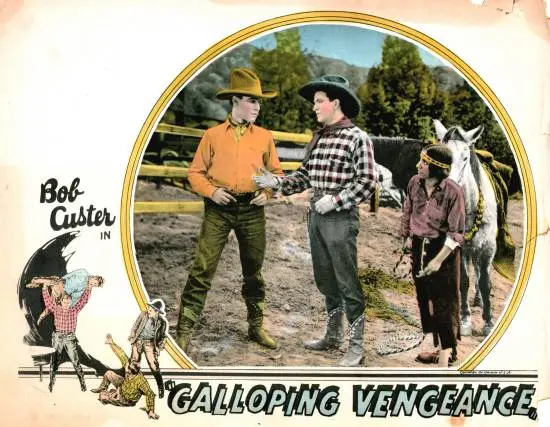
If you are looking for a reason to dive into the dusty archives of 1920s Westerns, Galloping Vengeance offers a compelling, if occasionally clunky, argument for the genre's enduring power. To answer the immediate question: yes, this film is worth watching today, but primarily for those who appreciate the raw, unpolished evolution of the American action hero. It is a mandatory viewing for enthusiasts of early cinema technical feats—specifically the flood sequence—but it will likely frustrate those looking for nuanced character arcs or progressive cultural depictions. This is a film for the person who wants to see the bridge between the theatricality of The Broken Coin and the formulaic B-Westerns that would dominate the 1930s. It is decidedly not for viewers who cannot stomach the broad-strokes melodrama typical of the silent era.
Bob Custer, playing Tom Hardy, is not an actor of great range, and in Galloping Vengeance, his stillness is his greatest asset. Unlike the more expressive stars found in international exports like En ung mans väg, Custer treats the camera like a nuisance he has to tolerate. There is a specific scene early on where he discovers Little Wolf is wounded; Custer’s reaction is almost robotic, yet it conveys a certain frontier pragmatism. He doesn't weep; he calculates. This lack of emotive flair might seem like a weakness, but I would argue it establishes the 'strong, silent' archetype more effectively than many of his contemporaries. He isn't trying to win your sympathy; he’s trying to clear the frame of outlaws.
However, this stoicism creates a vacuum that the supporting cast must fill. Mary Beth Milford, as Marion Reeves, does most of the heavy lifting. In the moments where she has to choose between the lawman she loves and the brother she protects, her face is a map of genuine agony. Compare this to the often-stilted performances in The Heart of a Child, and you see a precursor to modern naturalism. Milford’s decision to hold Tom Hardy at gunpoint is the film's strongest moment of tension. It’s a subversion of the 'damsel' trope that feels earned, even if the script eventually forces her back into a rescue scenario.
Here is my first debatable opinion: Little Wolf is the actual hero of this movie, and Tom Hardy is merely the muscle following his lead. While the film is titled around the 'Galloping Vengeance' of the Ranger, it is the young Little Wolf who does the actual detective work. He is the one who tracks Jack to Granby’s hideout. He is the one who survives a wound that would have sidelined a lesser character. There is a glaring disparity between the Ranger’s supposed expertise and the boy’s actual results. In one specific sequence, Hardy is practically wandering aimlessly until the boy points him in the right direction. This suggests a narrative clumsiness where the writers, George H. Plympton and William Berke, wanted the Ranger to be the lead but couldn't figure out how to make him smart enough to solve the plot without help.
This leads to an unconventional observation: the film’s treatment of its Native American characters is surprisingly utilitarian. Usually, in 1925, these roles were either pure villainy or 'noble' caricatures. Here, Big Wolf and Little Wolf are treated as essential political and tactical assets. They aren't just background dressing; they are the catalyst for the entire plot. While the film doesn't escape the era’s inherent biases, the fact that the Ranger’s success is entirely dependent on Little Wolf’s competence is a fascinating subversion, whether intentional or not.
The saloon fight that leads to Jack Reeves being framed is a masterclass in 1920s stunt coordination. It lacks the surrealism of The Phantom Carriage, opting instead for a gritty, bone-crunching realism. When the man is killed and the blame is shifted to Jack, the pacing of the film accelerates significantly. The cinematography here is frantic. The camera stays low, capturing the dust and the boots of the brawlers, making the viewer feel trapped in the room with the Granby gang. It’s a claustrophobic choice that pays off when the scene finally breaks into the wide-open chase.
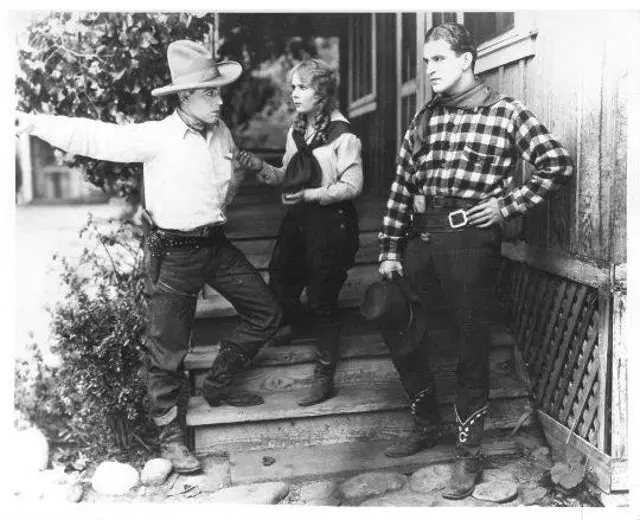
Ralph McCullough’s portrayal of Jack Reeves is another high point. He plays the 'weak link' brother with a desperate, sweaty energy. You can see the regret on his face long before the dam breaks. His involvement with the Granby gang feels less like malice and more like the inevitable result of a young man with no prospects on a dying frontier. This adds a layer of tragedy to the chase; we aren't just watching a lawman catch a criminal; we are watching a family disintegrate in real-time.
The film’s climax involves the blowing of a dam and a subsequent flood. For 1925, the scale of this sequence is staggering. It rivals the ambition of something like The Adventures of Robinson Crusoe in its attempt to pit man against the elements. The rush of water is visceral, and the way the set is literally consumed by the deluge provides a visual spectacle that silent audiences must have found terrifying.
However, here is my second debatable opinion: The flood actually weakens the ending. By introducing a natural disaster, the film lets its characters off the hook. Instead of a final, moral confrontation where Tom Hardy has to decide whether to arrest his future brother-in-law or let him go, the water decides for everyone. Duke Granby’s deathbed confession feels like a convenient script-writing trick to ensure a happy ending without any of the messy legal consequences that would have made the film a true masterpiece of the genre. It’s a 'deus ex machina' via a dam explosion. It’s exciting to watch, but it feels like a retreat from the difficult themes of loyalty and law established in the first two acts.
William Berke’s influence on the script and the overall tone cannot be overstated. There is a relentless forward momentum here that is missing from other contemporary films like Help Wanted - Male. Berke understands that in a Western, if the horses aren't moving, the audience is bored. The transitions between the Reeves ranch and Granby’s den are handled with a sharp editing style that keeps the stakes high. Even the romantic interludes feel hurried, as if the film itself is anxious to get back to the kidnapping plot.
The use of light in the 'den' scenes is particularly noteworthy. The shadows are deep and unforgiving, casting the outlaws in a skeletal light that emphasizes their moral decay. It’s a stark contrast to the bright, overexposed scenes at the ranch, creating a visual shorthand for 'good' and 'evil' that allows the film to move quickly without needing excessive title cards. This efficiency is what makes Galloping Vengeance feel more modern than many of its peers from the mid-20s.
Galloping Vengeance is a sturdy piece of frontier entertainment that manages to rise above its predictable plot through sheer technical ambition. While it lacks the psychological depth of a film like Whitechapel, it makes up for it with a visceral final act that reminds us why the Western became the dominant American myth. It is a film of contradictions: a stoic hero who needs a child to find his way, and a complex family drama that is solved by a wall of water. If you can look past the 1920s tropes, you will find a movie that is surprisingly alive, pulsing with the same energy that would eventually lead to the golden age of the genre. It’s a rough ride, but one that is well worth the time for anyone interested in the roots of cinematic action.
"A fascinating relic where the roar of the water drowns out the nuance of the law, leaving only the raw bones of a family tragedy."
IMDb 6.8
1933
Community
Log in to comment.