DbcultAccessing Vault...
Cult Review
Senior Film Conservator
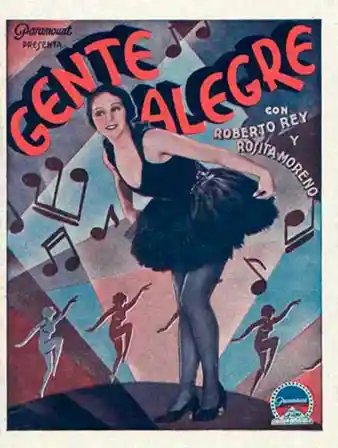
Honestly, you should only watch this if you have a thing for early sound-era chaos or if you’re a total nerd for film history.
If you like movies where people are constantly smiling even when nothing is happening, you'll dig it.
If you hate thin plots and scratchy audio that sounds like it was recorded inside a tin can, stay far away. 🏃♂️
I found myself staring at the background extras more than the main actors sometimes.
They all look so stiff, like they were told if they moved an inch the whole set would fall over.
The movie is called Gente alegre, which means 'Cheerful People,' and boy, do they lean into that.
Everyone is just... so happy all the time for no reason.
It reminds me a little bit of the energy in Everybody's Acting, where the theater vibe is just everywhere.
But here, it’s even more dialed up because of the musical numbers.
The plot is basically about some performers and their messy love lives.
I think there was a love triangle, but I got distracted by a guy's absurdly large bowtie in the second act.
"We are here to sing, we are here to live!" (Or something like that, my Spanish is a bit rusty).
Roberto Rey has this way of looking at the camera that feels like he’s trying to see if the lens is actually clean.
He’s got a good voice, though, even if the recording technology back then didn't do him any favors.
There’s a scene in a cafe where the lighting is so flat it looks like they filmed it in a grocery store basement.
But then Rosita Moreno comes on screen and she just has this natural spark that makes you forget the sets look like they’re made of cardboard.
I noticed that the dialogue gets really fast and then suddenly there’s a five-second pause where nobody says anything.
It’s like they were waiting for the sound guy to give them a thumbs up.
It’s not as polished as something like The Gold Rush, which feels like a masterpiece compared to this clunky thing.
But clunky can be fun if you’re in the right mood.
The whole thing was made by Paramount at their Joinville studios in France, which is a weird bit of trivia.
They were just churning these out for different languages back then.
You can almost feel the factory-line energy behind the camera.
It’s like they had 48 hours to finish the movie or they wouldn't get fed.
I found myself wondering if the actors actually liked each other.
There’s this one reaction shot of María Calvo where she looks like she’s completely over it.
It’s the most relatable moment in the whole film.
Is it a 'good' movie? Probably not by any normal standard.
But it has this weird, bouncy spirit that you don't see anymore.
Modern movies are so worried about being 'gritty' or 'important.'
This movie just wants to show you people in nice clothes singing about their feelings.
I think my favorite part was a sequence near the middle where everyone starts talking at once.
The sound mixing is so bad you can't hear a single word, but their faces are doing so much work.
It’s like watching a silent movie that accidentally has a loud buzzing noise attached to it.
If you've seen Rose-Marie, you know how these early musicals can be a bit of a slog.
Gente alegre is shorter, at least, so it doesn't overstay its welcome too much.
It’s a bit like eating a whole bag of cotton candy—sweet for a second, then you just feel a bit dizzy.
I’ll probably forget most of the plot by tomorrow morning.
But I’ll definitely remember that one guy’s mustache.
It was perfectly groomed. Almost too perfect.
Anyway, it’s a weird little piece of the past. 🎞️
IMDb —
1919
Community
Log in to comment.