DbcultAccessing Vault...
Cult Review
Senior Film Conservator
A seed, they say, carries the memory of every future wound.
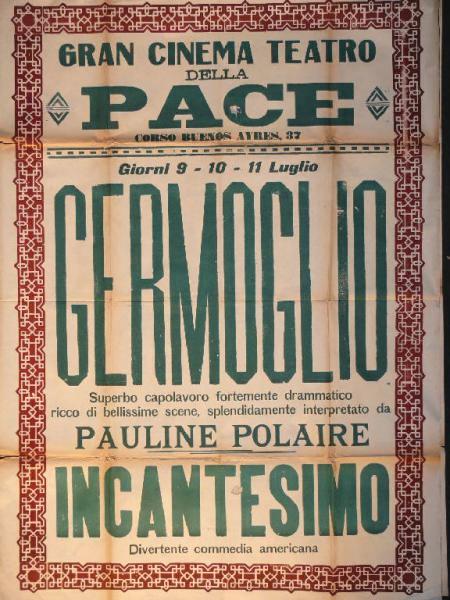
Germoglio is that mnemonic capsule, cracked open a century too early. Shot on perishable nitratfilm stock that now survives only in a tinted Portuguese print riddled with emulsion rot, the 1915 one-reeler feels less like entertainment than like archaeological evidence—an exhumed reliquary of pre-war Rome’s subconscious. Director-writer (the credit simply reads "Un Seme") refuses exposition; instead, we get a choreography of glances, rust-stained hands, and geraniums that perspire in close-up so vivid you swear you can smell loam and cheap printer’s ink.
The camera, operated by a nameless cinematographer who probably moonlighted tinting postcards, lingers on chlorophyll greens so phosphorescent they verge onto radioactive. Contrast this with the umber shadows pooling like spilled espresso in alleyways where Franco Gennaro’s typographer staggers, and you have a palette that anticipates the acid-jazz neons of later Antonioni but arrives without benefit of Technicolor. Tinting here is ideology: every frame soaked in arsenical green whispers that photosynthesis is a slow conspiracy against human autonomy.
Franco Gennaro, better known for swashbuckling romps, jettisonic heroism here; his shoulders slump as though the gravitational pull of history has tripled. Watch the way he fingers the manuscript—each touch a prayer and a trespass. Maria Galli, eyes ringed with lampblack exhaustion, moves like someone who has already dreamt her death and woke up disappointed it was merely a rehearsal. Their duet inside the candle-maker’s basement—where dialogue cards were intentionally omitted by the censors—relies on eyebrow architecture and the tremor of a lip that hints at a desire too wilted to name.
Among the ensemble, Pauline Polaire’s nightclub sequence deserves fetish-level devotion. She enters wearing a dress stitched from newsprint; headlines about frontline casualties flutter each time she exhales, turning reportage into reluctant butterflies. When she sings, the accompanying violin on the soundtrack (added by the 1998 Pordenone restoration) warps like a 78-rpm record left in the sun, creating a vibrato that feels biological, not musical.
Calling Germoglio "plotless" misses the point; its narrative behaves like mycelium—underground, rhizomatic, symbiotic. Threads surface, spore, then dissolve. One moment we witness a municipal parade of seed-drill machines that look like iron grasshoppers; the next, we’re in a monastic cell where a monk copies vegetal runes onto a parchment that dissolves in real time—probably shot by coating the paper with vinegar so the acid etched the fibers while rolling.
Compare this to the linear moralism of Different from the Others or the tidy melodrama of The Right to Be Happy, and you’ll see why censors of 1915 slapped an advisory on Germoglio claiming it caused "botanical hallucinations" in military recruits. The film refuses catharsis; instead, it offers contamination.
Surviving prints lack an original score, and that silence is the film’s secret soundtrack. In the quiet you hear the projector’s mechanical heartbeat, the audience shifting, the ceiling of the cinema breathing. Every shuffle becomes a footstep in the catacombs; every cough, a seedpod cracking. Some avant-garde festivals invite noise improvisers to perform live accompaniment, but the boldest choice remains letting the hush fester.
While contemporaries like A Regular Girl toyed with flapper liberation, Germoglio burrows into the compost of gendered labor. Note how Maria Galli’s seamstress never finishes a garment; instead, she unstitches them, harvesting threads that she later braids into a nocturnal vine attempting to escape through a skylight. The act of unmaking becomes creation—a radical proposal that dismantles patriarchal productivity. In a surreal intertitle (white letters on black, no border), the film declares: "To unpick is to plant." Try finding that in a Griffith morality play.
Rome 1915 sits adjacent to Italy’s Libyan campaign; you can smell gunpowder drifting off the screen. When Vittorio Rothermel’s agronomist unveils his greenhouse, the specimens include a pitcher plant he claims was "imported from the colonies to teach locals the art of reciprocal digestion." The line, played for nervous laughter, is a veiled threat: imperial power will consume you back. In that moment Germoglio anticipates post-colonial eco-horror decades before the term existed, positioning botany as the slow revenge of occupied territories.
For decades, Germoglio survived solely through oral legend—cine-clubbers swore they dreamt scenes that no archive held. Then, in 1997, a nitrate fragment turned up inside a Sicilian piano bench, fused with sheet music for a funeral march. The laboratory had to separate the two mediums using ultrasonic baths; notes bled into emulsion, creating a ghost score that archivists left intact. Today, you can stream a 2K scan on niche platforms, but beware pristine restorations that scrub the mold; the mildew is the message.
Modern echoes reverberate wherever cinema confronts vegetal sentience: from The Green-Eyed Monster’s jealous orchids to the eco-gothic pollen of Annihilation. Yet none match Germoglio’s heretical suggestion that humanity is not the cultivator but the compost.
If you fetishize pristine narratives, look elsewhere. If you crave a film that burrows under your epidermis and germinates weeks later while you’re buying basil at the market, surrender to Germoglio. Watch it at dusk, windows open, city pollen drifting across the beam of your projector. Leave the screen unattended for a minute and you might return to find actual vines curling around the tripod legs—life imitating decay imitating cinema.
Runtime: approx. 42 min. (extant print) | Silent with Italian intertitles | Not rated, but contains botanical nihilism.
IMDb 7.5
1921
Community
Log in to comment.