DbcultAccessing Vault...
Cult Review
Senior Film Conservator
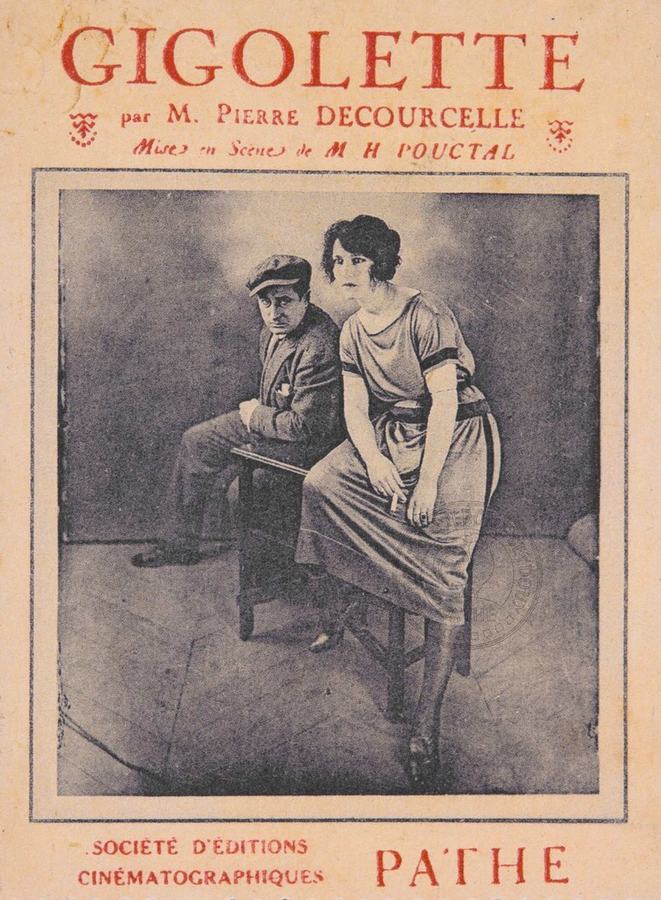
The first image of Gigolette arrives like a slap: Zelie’s lacquered boots striding across a mirror-wet alley, each footfall splashing a neon reflection of the Moulin Rouge sign overhead. Director Charles de Rochefort—also essaying the morally amphibious doctor who both exploits and shields her—frames Jeanne Brindeau’s silhouette against a poster screaming “PARIS FOLIES!” in carnival yellow. The shot is a manifesto: sell illusion, buy survival.
Brindeau, a silent-era chameleon last spied in The City of Masks, wields a gaze so brittle you fear it might shatter the lens. She glides through the film’s episodic gauntlet—cabaret turns, back-alley assignations, police round-ups—with the weary elegance of a fallen angel who has memorised every crack in the pavement. Her body is currency, yet the performance never objectifies; instead it interrogates, asking how flesh becomes negotiable tender when hospitals demand payment in advance.
“Regarde-moi, monsieur. I am the ledger of your sins, and the ink is my skin.”
That line, whispered to a portly banker who smells of Havana and remorse, crystallises the film’s moral algebra: desire is debt, and every caress writes a promissory note fate will collect. Decourcelle’s script—adapted from his own boulevard potboiler—leans into melodrama yet keeps peeling toward something rawer, akin to The Dawn of a Tomorrow stripped of religious balm.
Production designer Paul Ollivier renders Montmartre as a multi-storey panopticon: spiral staircases ascend toward skylights that never quite deliver daylight; basement opium dives exhale blue smoke that curls like opalescent snakes. The camera—courtesy of cinematographer Georges Colin—peeks through bannisters, keyholes, and the cracked opulence of faded wallpaper, stitching a patchwork of surveillance. You feel the city watching Zelie, cataloguing her every transaction, reminding her that solitude is a luxury she can’t afford.
Compare that claustrophobia to the open-air fatalism of On the Banks of Allan Water, where landscapes dwarf human grief. Here, stone corridors compress emotion until it ricochets. When Zelie’s half-sister Delphine (a fever-bright Christiane Delval) coughs blood onto white linen, the crimson bloom feels like graffiti on the prison wall of their rented room.
Charles de Rochefort’s Dr. Sarlat is neither saint nor predator but a man suspended between oaths and appetites. He diagnoses Delphie with tubercular meningitis, prescribes costly serum, then pockets Zelie’s earnings as “consultation fees.” Rochefort’s darting eyes telegraph the war between Hippocrates and Mammon. When he finally slumps at his desk, clutching a framed photo of a child lost in the Great War, the film hints that exploitation is often grief wearing a surgical mask.
Opposite him, Paul Guidé’s Inspector Meroux embodies the state’s janitorial morality: raid the brothels, shuffle the girls, publish the statistics. Watch him interrogate Zelie under a dangling bulb: his questions are carnivorous, yet his fingers tremble as he lights each cigarette. The movie refuses to grant him easy villainy; instead, he is another bureaucrat shackled to ledgers, terrified of the human chaos they represent.
The heart of Gigolette is not the transaction of bodies but the transubstantiation of sisterly love. Zelie’s nightly descent into the streets is framed like a Stations of the Cross: thirteen tableaux, each ending with her washing venial grime from her hands while Delphie’s chest rises in the next room. Editor Berthe Jalabert cuts on match-action between Zelie buttoning her coat and Delphie’s tiny fingers clutching a rosary, suggesting that sacrifice and grace share the same circulatory system.
Listen to the lullaby Zelie hums off-camera—a reedy, off-key wisp of “À la claire fontaine”—and note how composer Philippe Garnier orchestrates it into the film’s climactic cue, swelling beneath strings when the prodigal father finally appears. The motif binds the personal to the mythic, much as The Wishing Ring: An Idyll of Old England uses a child’s charm to refract adult redemption.
Enter Pierre Labry as Gustave, a broken-down wine merchant who arrives at the hospital bearing not gifts but a battered pocket-album of faded photographs. He claims to be Zelie’s estranged father, though the script teases ambiguity: could be a conman, could be a lonely soul manufacturing kinship. Labry’s performance is a masterclass in hesitant affection—his voice cracks on the word “daughter,” as though testing its weight on his tongue.
The film’s most wrenching scene unfolds in a derelict courtyard where Gustave teaches Zelie to skip stones across a frozen pond. Each failed skip is a confession: paternal absence, economic impotence, the unbearable lightness of trying to rewind time. Cinematographer Colin shoots them in long shot, breath fogging like dragon smoke, city lights blinking like distant aircraft. You realise reconciliation is less a moment than an atmosphere—something you inhale until it hurts.
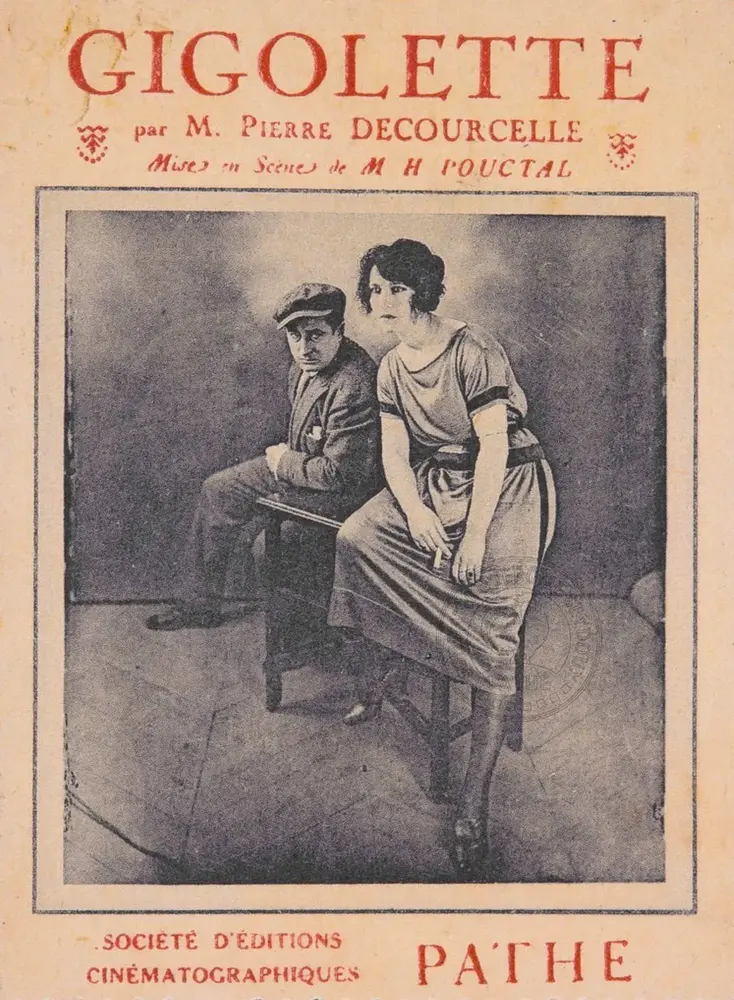
Elaine Vernon’s Apolline, a veteran courtesan turned wardrobe mistress, operates as Zelie’s cynical fairy godmother. She lends silk stockings, then tallies the cost on a hidden slate. Their chemistry is vinegar and honey: Apolline lectures that love is “a fur coat with fleas,” yet quietly sells her cameo brooch to buy Delphie’s medicine. The subplot dovetails into the main narrative when Apolline’s former client—now a magistrate—offers to waive Zelie’s prison sentence if Apolline returns as his mistress. She refuses, whispering, “I’d rather be a ghost in my own life than furniture in yours.” The line detonates like a small revolution, reminding viewers that agency can bloom even in compost.
Compare this to the flapper insouciance of Miss Robinson Crusoe, where female rebellion is played for yacht-party laughs. Here, resistance is crusted with calluses and unpaid rent.
Shot during the waning days of French silent production, Gigolette employs sparse synchronised segments—footsteps on staircases, a tram bell, Delphie’s final wheeze—while relying on intertitles that read like bruised poetry. Note the intertitle that precedes Zelie’s first nocturnal stroll: “Night draped the city in velvet, but the lining was sackcloth.” Decourcelle, a former journalist, understood that words could be percussion, not mere exposition.
Garnier’s score, restored in 4K by Cinémathèque Française, melds accordion lament with snare drum tension; it gallops when police boots drum the pavement, then recedes to solo piano when Zelie counts coins in the dark. The dynamic range is startling for 1937, predating the Italian memoria sonora experiments later seen in Memoria dell’altro.
Catholic iconography haunts every reel: a chipped Madonna statue in Zelie’s flat, Delphie clutching a holy card of Saint Thérèse, Apolline’s rosary entwined around a gin bottle. Yet the film resists proselytising; grace arrives obliquely, like light through cracked stained glass. When Zelie finally kneels beside her recovered sister, the camera frames her against a cracked plaster wall where previous tenants have pencilled growth marks of children long gone. The implication: holiness is graffiti we leave on each other’s ruin.
Film historians often trace the poetic underbelly of Les Enfants du Paradis back to Carné’s 1945 masterpiece, yet the DNA is already here—the carnivalesque melancholy, the courtesan with a heart soldered by hardship, the city as omnipresent chorus. One could splice scenes of Zelie traversing the Boulevard de Clichy into Carné’s Boulevard du Crime without jarring visual grammar.
Equally, the film’s interrogation of transactional intimacy prefigures the chillier geometries of Solid Concrete, where bodies become data points in post-industrial alienation. Both works ask: when does proximity become a form of exile?
Viewed today, Gigolette reverberates amid debates on universal healthcare, gig-economy precarity, and the criminalisation of sex work. Replace Zelie’s francs with today’s cryptocurrency wallets and the plot still clicks into place like a well-oiled lock. Social media would call her a “provider”; GoFundMe would monetise her story; hashtags would trend and vanish. Decourcelle’s film knows that survival under capitalism is a perpetual audition for humanity.
For all its aching humanity, the picture occasionally slips into boulevard melodrama: a mustache-twirling landlord who demands back rent at knife-point, a deus-ex-magistrate who commutes sentences with quill-pen flourish. These contrivances, typical of pre-Code narrative shortcuts, momentarily puncture the vérité. Yet even the clichés carry a camp frisson—proof that the film is dated but never dead.
The 2022 4K restoration, overseen by the CNC, resurrects tonal nuances lost for decades: the sickly green of absinthe fluoresces against nicotine-brown walls; the crimson of Zelie’s dress bleeds into shadows like spilled communion wine. Streaming platforms have yet to secure global rights, but boutique Blu-ray label Éclipse Obscura plans a region-free release with essays by critic Séphora Mossé and historian Andrée Lionel. Seek it out; your retina will thank you.
Great art doesn’t preach; it wounds and then secretly stitches. Gigolette ends not with triumph but with a tentative truce: father and daughters sharing bread that tastes of rain, their silhouettes framed by a doorway opening onto a street that still hums with predatory neon. The camera lingers for three heartbeats, then fades. You exit into your own night, suddenly aware of the cost of every kindness you’ve ever withheld, and of the fragile francs—call them dollars, euros, likes, retweets—jangling in your own pocket.
Watch it, not to feel better about the world, but to feel more honest about the price of breath.

IMDb 6.3
1928
Community
Log in to comment.