DbcultAccessing Vault...
Cult Review
Senior Film Conservator
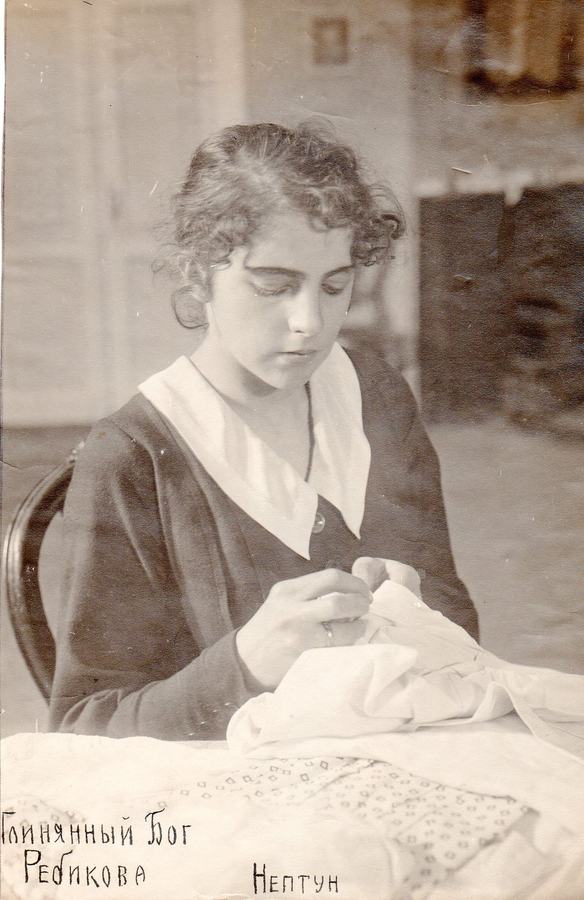
There is a specific, haunting quality to the Russian cinema of 1918—a period caught between the twilight of an empire and the violent birth of a new world. Glinyanyy bog, directed with a palpable sense of dread, stands as a testament to the psychological complexity that characterized this era’s output. Unlike the more overt propaganda that would soon follow, this film is an intimate, almost claustrophobic study of the rot that begins within the home. It is a criminal-psychological drama that avoids the easy tropes of the genre, opting instead for a slow-burn immersion into the mechanics of guilt and the crushing weight of martyrdom.
The film’s title, translating to 'The Clay God,' serves as a masterstroke of metaphorical foreshadowing. It suggests a figure of worship that is fundamentally flawed, a deity that crumbles at the first touch of moisture or pressure. In this case, the idol is the husband, played with a jittery, nervous energy by the formidable Oleg Frelikh. Frelikh does not play the gambler as a suave risk-taker; instead, he portrays a man undergoing a cellular transformation. Every loss at the table is a chip away at his humanity, leaving behind a brittle shell that his wife desperately tries to hold together.
The gambling sequences in Glinyanyy bog are not about the thrill of the win, but the agony of the compulsion. The cinematography utilizes heavy shadows and tight framing to create a sense of entrapment. We see the husband not as a protagonist, but as a victim of his own fractured psyche. This thematic exploration of financial and moral ruin draws interesting parallels to other works of the period. For instance, while The Spendthrift deals with the dissipation of wealth through a more traditional narrative lens, Glinyanyy bog pushes the stakes into the realm of the existential. Here, the money is secondary to the loss of self.
The script, penned by Olga Blazhevich, is remarkably progressive for its time in its treatment of the female lead. A. Ostrovskaya delivers a performance of quiet, devastating intensity. Her character’s journey is not one of passive victimhood but of active, albeit tragic, agency. When her husband finally crosses the line into criminality—a desperate act born of a cornered mind—she does not simply weep. She calculates the cost of his salvation and decides to pay it herself. It is a sacrifice that feels less like a romantic gesture and more like a grim necessity, a theme we also see explored with varying degrees of nuance in Loyalty.
To understand the gravity of Glinyanyy bog, one must look at how it diverges from its contemporaries. Where a film like The Lure of the Circus might lean into the spectacle of its setting, Blazhevich’s story remains resolutely focused on the internal. Even when compared to the high-stakes intrigue of Jim the Penman, this film feels more grounded in a recognizable, albeit heightened, reality. The crime committed is not a grand heist but a pathetic, fumbled attempt to stave off the inevitable, making the subsequent fallout all the more painful to witness.
The supporting cast, including Aleksandr Chabrov and Aleksandra Rebikova, provide a necessary social context to the central couple's isolation. They represent the world that watches, judges, and ultimately moves on, oblivious to the private Gethsemane being endured in the parlor next door. There is a sense of social inertia here that reminds me of the atmospheric tension in Gefangene Seele, where the soul is truly a prisoner of its circumstances.
The visual palette of the film—even through the grain of surviving prints—is striking. The use of light to bisect the frame often mirrors the husband’s split personality: the respectable man he pretends to be and the desperate criminal he has become. There is a particular scene where he returns home after a night at the tables, his face half-obscured by the grey light of dawn, that perfectly encapsulates his moral ambiguity. It’s a visual shorthand for the 'clay' nature of his soul—pliable, damp, and losing its form.
In contrast, the wife is often bathed in a more consistent, albeit softer, light. She is the anchor, but as the film progresses, we see that anchor being dragged into the depths. This cinematic language of light and dark is far more sophisticated than the melodramas of the early 1910s, such as Poor Little Peppina, which relied more on stagey gesticulation. Here, the emotion is in the eyes, the slumped shoulders, and the agonizingly slow movements of a woman who knows she is walking toward her own destruction.
What makes Glinyanyy bog particularly resonant is its refusal to offer easy catharsis. The wife’s sacrifice is not portrayed as a glorious triumph of the spirit. It is presented as a tragedy of errors. By saving her husband from the legal consequences of his crime, does she actually save him? Or does she merely preserve a hollow idol that will inevitably crumble again? This ambiguity is what elevates the film from a simple morality tale to a profound psychological inquiry.
This thematic complexity is something we see mirrored in The Valley of Decision, where characters are forced to choose between personal happiness and a perceived higher duty. In Glinyanyy bog, the 'duty' is to a man who has forfeited his right to it, making the woman's choice all the more controversial and compelling. It challenges the audience to define the limits of loyalty. At what point does self-sacrifice become self-destruction?
Olga Blazhevich’s contribution to the screenplay cannot be overstated. In an era where female voices were often relegated to the background, her script for Glinyanyy bog is a sharp, incisive look at the domestic sphere as a site of intense psychological warfare. She captures the specific anxieties of the Russian middle class during a time of extreme volatility. The film functions as a microcosm of a society where the old structures (the 'gods') were proving to be made of clay, unable to withstand the pressures of a changing world.
Comparing this to The End of the Road, one can see a shared preoccupation with the finality of certain choices. Once the husband commits his crime, there is no turning back; the trajectory is set. The film’s pacing reflects this, accelerating as the gambling debts pile up, then slowing down to a funereal crawl as the wife realizes what she must do. It is a masterclass in narrative tension that feels surprisingly modern.
"Glinyanyy bog is not merely a film about gambling; it is a clinical autopsy of a marriage performed under the harsh glare of moral failure. It remains a staggering achievement of silent cinema, demanding to be seen by anyone interested in the evolution of the psychological thriller."
The film also shares a certain DNA with Playing Dead, particularly in its fascination with deception and the masks we wear to maintain social standing. However, Glinyanyy bog is far bleaker. There is no dark comedy here, only the cold realization that some idols are not worth saving. The performances of Frelikh and Ostrovskaya create a central vacuum that pulls the viewer in, making the inevitable collapse feel deeply personal.
As we look back at this 1918 relic, we see a bridge between the theatricality of early cinema and the psychological realism of the mid-20th century. It lacks the whimsical charm of Emmy of Stork's Nest or the adventurous spirit of The Circus of Life, but it offers something far more substantial: a mirror held up to the darkest corners of the human heart. It is a film that asks uncomfortable questions about the nature of love and the price of integrity, questions that remain just as pressing today as they were over a century ago.
In the final analysis, Glinyanyy bog is a harrowing experience, but a necessary one. It reminds us that our 'gods'—be they people, institutions, or ideologies—are often far more fragile than we dare to admit. When they break, it is often the innocent who are left to pick up the pieces, even if it means cutting their own hands in the process. It is a somber, beautifully crafted piece of art that deserves a prominent place in the pantheon of early European cinema.
IMDb —
1936
Community
Log in to comment.