DbcultAccessing Vault...
Cult Review
Senior Film Conservator
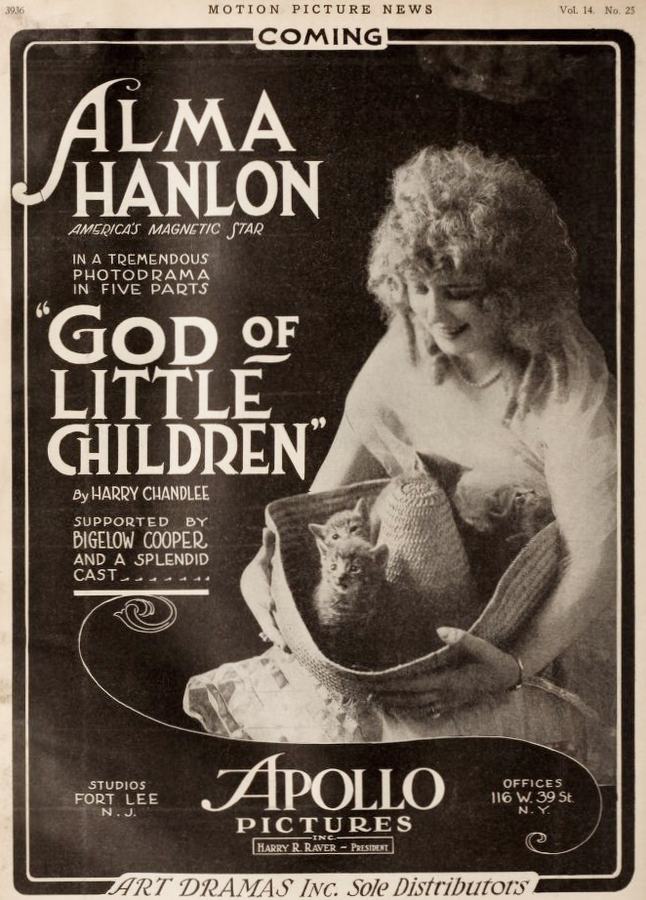
In the expansive tapestry of early cinematic drama, God of Little Children (1920) emerges not merely as a quaint artifact of the silent era, but as a profoundly resonant narrative woven with threads of moral compromise, burgeoning affection, and the desperate fight for self-determination. This is a film that, despite its century-old vintage, pulsates with a timeless human struggle, inviting us to peer into the heart of a woman caught between the oppressive weight of her past and the luminous promise of an unlooked-for future. It’s a compelling testament to the power of love to dismantle the most meticulously constructed schemes of villainy, reminding us that even in the deepest shadows, a flicker of redemption can ignite a revolution of the spirit within the human soul.
At the very core of this compelling narrative lies Mary Keene, a character brought to life with a captivating blend of vulnerability and nascent strength by Alma Hanlon. Mary is introduced to us not as an inherently malevolent figure, but rather as a victim of circumstance, her life inextricably entangled with the nefarious Robert Moran and his shadowy coterie of blackmailers. Her past transgressions, whether born of desperate necessity or naive misjudgment, have rendered her an unwilling pawn in Moran’s insidious game, a perpetual state of coercion hanging over her head like a sharpened blade. The film masterfully establishes this suffocating predicament, illustrating with chilling clarity how the fear of exposure and the specter of imprisonment can compel an individual to participate in acts diametrically opposed to their true nature. This initial setup immediately draws parallels to other silent-era melodramas where female protagonists grapple with the harsh realities of societal judgment and profound moral quandaries, much like the titular character in The Seventh Sin, who, like Mary, finds herself ensnared in a web of difficult, often heartbreaking, choices.
Moran’s latest machination is a particularly cruel and calculating one: to defraud the seemingly simple, yet profoundly benevolent, John Ingalls. Ingalls, a man whose heart beats with an almost childlike purity and an uncommon fondness for children, lives a secluded existence, making him an ideal, unsuspecting target for exploitation. Moran, a master manipulator of human weakness, discerns Ingalls's Achilles' heel – his profound loneliness and his deep-seated paternal affections – and crafts a plan designed to exploit these very virtues. Mary's role is pivotal: she is to infiltrate Ingalls's life, not directly, but through the surrogate innocence of a fabricated "little sister," a child meticulously trained to weave her way into Ingalls's affections and, ultimately, into his substantial fortune. This elaborate setup, designed to weaponize trust and affection, is a chilling demonstration of Moran's depravity, reflecting a dark undercurrent of human vice often explored in films like Das Laster, where characters are driven by their own moral failings to manipulate and ruin others.
What Moran, in his cold calculations, utterly fails to account for, however, is the unpredictable, often inconvenient, emergence of genuine human connection. As Mary spends an increasing amount of time in Ingalls’s orbit, assisting him in his daily affairs, she witnesses firsthand his innate goodness, his unassuming generosity, and his deep-seated compassion. The facade she is compelled to maintain begins to crack under the burgeoning weight of her conscience. Charles Hutchison, as John Ingalls, imbues his character with an endearing sincerity, making him a compelling counterpoint to Moran's pervasive darkness. It’s this authentic portrayal of a man undeserving of such treachery that catalyzes Mary's profound internal transformation. Her initial complicity, born purely of fear and desperation, slowly gives way to a profound sense of guilt and, more powerfully, an authentic, blossoming love. This is not a sudden, melodramatic epiphany, but a gradual, believable shift, subtly conveyed through Hanlon’s expressive eyes and restrained gestures – a hallmark of truly effective silent film acting, where every movement and glance carries immense emotional weight.
The narrative meticulously charts the blossoming romance between Mary and John. His affection for her is genuine, untainted by any knowledge of her coerced past, a purity that stands in stark contrast to Moran's manipulative and predatory desires. When Ingalls, still blissfully oblivious to the intricate web of deceit surrounding them, offers Mary his hand in marriage, it represents not just a simple proposal, but a profound offer of redemption and a chance at a life free from shadows. The wedding ceremony, depicted as simple yet brimming with an understated beauty and sincere emotion, marks a fleeting moment of unadulterated happiness for Mary, a taste of the peaceful, loving life she never dared to dream of. This emotional resonance, where happiness is hard-won and fragile, echoes the poignant struggles often seen in films like Sally in Our Alley, where ordinary people strive for joy amidst overwhelming adversity.
However, such tranquility, such nascent happiness, cannot last in the face of relentless malevolence. Robert Moran, a character whose villainy is as relentless as it is calculating, views Mary not as a person with agency and feelings, but as property, a mere tool to be used, and ultimately, a coveted prize to be possessed. His initial scheme, meticulously planned, has been unexpectedly thwarted by an inconvenient romance, a variable he simply could not foresee. Undeterred, he pivots, formulating an even more sinister and personal plan. Moran’s avarice is now inextricably intertwined with a chilling personal obsession; he desires Mary for himself, planning to force her to abscond with a significant portion of Ingalls’s wealth and flee with him to foreign shores. This escalation of his villainy, moving from mere financial exploitation to deep-seated emotional and physical coercion, elevates the stakes considerably, pushing the narrative into darker, more desperate territory. It’s a stark reminder of the predatory figures that populate early cinema, often seen in films like Der Geheimsekretär, where powerful individuals ruthlessly exploit the vulnerable for their own gain.
Mary's newfound happiness is amplified beyond measure by the joyous, miraculous realization that she is to become a mother. This discovery, a profound symbol of pure, unadulterated hope and a future untainted by her past, makes Moran’s subsequent threats all the more devastating and heartbreaking. The news sends Ingalls, too, into a reverie, feeling the vitality of young manhood coursing through his veins once more, a poignant detail that underscores the profound and transformative impact Mary has had on his solitary life. This idyllic interlude, however, is brutally shattered when Moran confronts Mary, his threats of exposure and public disgrace – for both her and Ingalls – leaving her with a horrifying ultimatum: comply with his demands or face utter, irreversible ruin. The crushing weight of this decision, the impossible choice between her husband’s reputation and her own life, is etched across Hanlon’s face in a truly affecting and memorable performance, conveying a silent scream of anguish.
Overwhelmed by her impossible predicament, Mary retreats to the solitude of her home, gazing out at the placid, unmoving lake. In a moment of profound despair, and with a silent, desperate prayer to the "God of Little Children" – a powerful invocation that resonates deeply with her burgeoning maternity and Ingalls's own benevolent spirit – she contemplates the ultimate, tragic escape: suicide. This pivotal scene is a masterclass in silent film emotional conveyance, where the serene stillness of the lake contrasts sharply and painfully with the raging turmoil in Mary’s soul. It is a desperate act born not of weakness, but of a profound desire to protect those she loves from the disgrace and ruin Moran threatens, an echo of the self-sacrificial impulses often explored in melodramas like Amalia, where heroines face profound personal sacrifices for the sake of others.
Unbeknownst to Mary, Moran’s malevolence has reached its absolute apex. He conspires with his brutish accomplice, a figure named "Hard Tack," to murder John Ingalls, meticulously staging it as a suicide prompted by Mary's supposed desertion. The meticulously crafted suicide note, intended to be found beside Ingalls’s body, is designed to seal Mary’s fate as a disgraced widow, leaving her entirely at Moran’s mercy and, more importantly, cementing his claim to Ingalls's substantial fortune. This cold, calculated plot reveals the full, terrifying extent of Moran’s depravity, transforming him from a mere blackmailer into a cold-blooded murderer. The tension here is almost unbearable, a classic silent thriller trope where the audience is privy to the villain's sinister scheme while the protagonists remain perilously unaware, similar to the agonizing suspense found in films like The Buzzard's Shadow, where danger lurks unseen.
The narrative accelerates towards its explosive and inevitable climax. Ingalls, utterly oblivious to the imminent danger that stalks him, sits peacefully in his library, a picture of domestic tranquility about to be shattered. Mary, standing by the lake and on the precipice of ending her own life, casts one last, silent prayer towards Ingalls’s brightly lit window. It is in this precise, agonizing moment of profound despair and desperate hope that fate intervenes with a dramatic flourish. She spots a crouching figure, Hard Tack, silhouetted against the blind, a pistol clutched menacingly in his hand, aiming directly at her beloved husband. The terrifying sight galvanizes her, transforming her despair into a surge of protective adrenaline and fierce determination. Her prayer to the "God of Little Children" is answered not by divine intervention, but by the awakening of her own indomitable spirit.
What follows is a rapid succession of events, a ballet of violence and heroism that plays out with breathtaking speed. Mary rushes into the house, her speed and desperation palpable even in the silent medium, conveyed through quick cuts and frantic camera movements. She reaches Ingalls just in the nick of time, diverting Hard Tack’s bullet, a moment of breathtaking courage and split-second timing. Ingalls, now fully aware of the deadly threat, confronts the assassin. The ensuing struggle is raw and visceral, a desperate fight for survival, culminating in Hard Tack being hurled through a window to his death – a swift, decisive, and brutal end to one of Moran's insidious tools. This sequence is a masterclass in silent film action, relying on dynamic camera work, frantic editing, and the expressive physicality of the actors to convey the sheer intensity of the confrontation, leaving the audience breathless.
Meanwhile, Moran, waiting impatiently outside for Mary to fulfill her forced rendezvous, hears the pistol shot. Alarmed by Hard Tack’s prolonged absence and the unexpected noise, he boldly enters the library, revolver still in hand, his predatory confidence undiminished. He steps into a scene of chaos and consequence, finding Ingalls alive and Hard Tack dead. Mary, witnessing Moran’s sudden entrance and believing Ingalls's life to be once again in mortal peril, seizes a fallen weapon from the floor. In a moment of ultimate defiance and protective fury, fueled by the primal instinct of a mother-to-be, she takes aim and fires. Moran falls dead, the bullet piercing his heart, bringing an abrupt and definitive end to his reign of terror and insidious schemes. This double climax – the defeat of Hard Tack, followed immediately by the decisive demise of Moran – ensures a complete purging of the antagonistic forces, leaving no lingering threat. It is a conclusion that, while perhaps melodramatic by modern standards, delivers a deeply satisfying sense of justice and catharsis, a common and beloved thread in films where good ultimately triumphs over evil, much like The Great Ruby.
The story concludes, as promised by the synopsis, on a note of profound happiness and resolution. The forces of darkness have been vanquished, and Mary and John are left to embrace their future, their love forged and solidified in the crucible of adversity. The "God of Little Children" has, indeed, answered her prayer, not by allowing her to escape through death, but by empowering her to fight fiercely for life, for love, and for the family she is now destined to build. This resolution, while undeniably tidy, feels deeply earned, a culmination of Mary's profound internal struggle and her eventual triumph over both external threats and her own past demons, a true testament to her resilience and newfound strength.
God of Little Children is far more than a simple melodrama; it is a compelling exploration of moral transformation, the redemptive power of love, and the enduring human spirit in the face of overwhelming odds. Alma Hanlon’s portrayal of Mary Keene is particularly noteworthy, capturing the character’s complex evolution from coerced accomplice to heroic protector with nuanced emotional depth, a performance that holds its own against other strong female leads of the era, such as those in Pauline or My Lady's Slipper. Charles Hutchison’s John Ingalls provides the necessary anchor of goodness and unwavering integrity, making his vulnerability and eventual strength deeply sympathetic and relatable.
Director Harry Chandlee, working in close collaboration with his talented cast, crafts a narrative that, despite the inherent constraints of silent film technology, manages to convey complex emotional states and high-stakes drama with remarkable clarity and profound impact. The film’s pacing, its judicious use of dramatic irony, and its powerful visual storytelling elements combine seamlessly to create a truly engaging and memorable cinematic experience. It stands as a vibrant example of how early cinema, often unfairly dismissed as simplistic, could tackle profound human themes and deliver thrilling, emotionally resonant stories that captivated audiences. For those interested in the rich, often overlooked, history of silent films and the fascinating evolution of cinematic storytelling, God of Little Children offers a captivating glimpse into the dramatic sensibilities of its time, proving unequivocally that genuine human drama, regardless of the technological era, remains eternally captivating and universally understood. It's a powerful reminder that even in the profound absence of spoken dialogue, the language of the human heart speaks volumes, transcending time and medium.
IMDb 7
1928
Community
Log in to comment.