DbcultAccessing Vault...
Cult Review
Senior Film Conservator
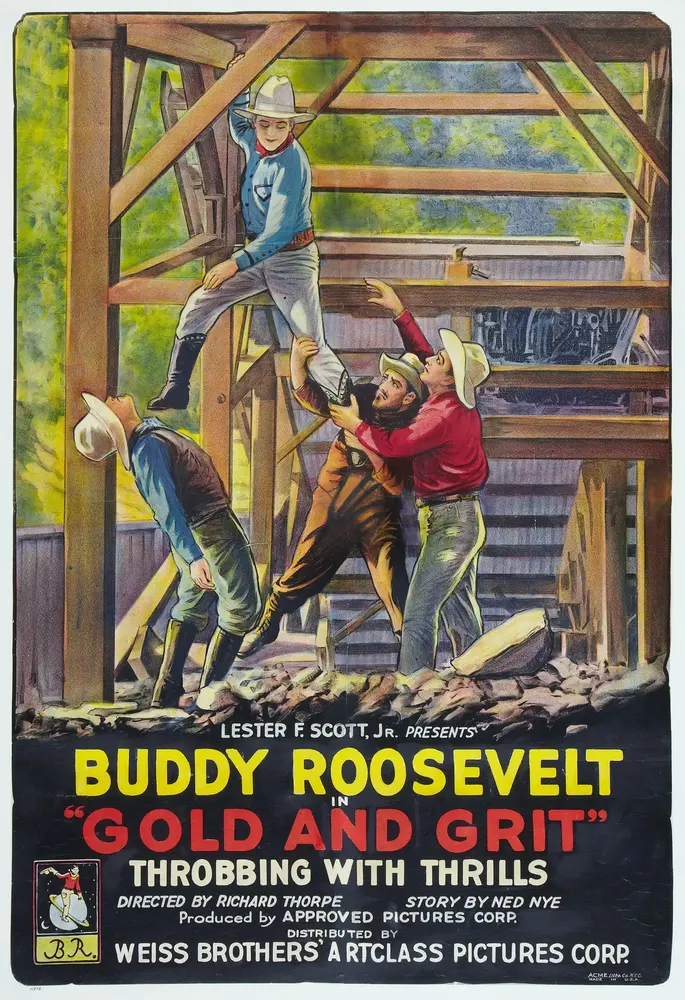
Short answer: Yes, Gold and Grit is worth watching today, but primarily as a historical curiosity for those who value stunt work over sophisticated plotting. This film is for silent-era enthusiasts and Western completists who enjoy the raw, unpolished energy of 1920s B-movies; it is not for viewers who demand modern pacing or logical character motivations.
The 1920s were a transformative decade for the Western genre, moving away from the Victorian moralizing of the previous era and toward the stunt-heavy spectacle that would define the B-Western for decades to much. Gold and Grit, directed by Richard Thorpe (though often associated with the prolific output of the era's independent studios), serves as a fascinating specimen of this transition. It stars Buddy Roosevelt, an actor whose physical prowess often outshone his dramatic range, and here, that trade-off is on full display. The film works because Roosevelt carries the physical weight of the stunts with a sincerity that masks the script's thinner moments. However, the film fails because the antagonist’s death by lightning feels like the writer, Ned Nye, simply ran out of time to draft a proper confrontation. You should watch it if you enjoy the raw, unpolished energy of 1920s B-Westerns that prioritize action over psychological nuance.
Buddy Roosevelt was never the most expressive actor of the silent screen, but in Gold and Grit, his stoicism serves the character well. Playing a man wrongly accused of robbery, Roosevelt uses his frame to convey a sense of suppressed energy. In the opening sequence, where he stops the runaway stagecoach, his movements are fluid and genuinely dangerous. Unlike the more polished action of modern cinema, there is a palpable sense of risk in these early stunts. You can see the dust clogging the air and the genuine strain on the horses. This isn't just movie magic; it's a testament to the physical demands placed on silent stars.
The scene where Buddy is recognized by Blaabs, the Shakespearean actor played by Nelson McDowell, offers a rare moment of tension that doesn't rely on gunfire. McDowell brings a theatricality that contrasts sharply with Roosevelt's minimalism. While Buddy is trying to disappear into the landscape, Blaabs is a man who carries his own stage with him. This dynamic creates a secondary layer of conflict: the man who wants to be forgotten versus the man who lives to be seen. It’s a more sophisticated character beat than one usually finds in films like Sky-Eye or other contemporary adventures.
One of the most effective segments of the film occurs during the storm. When Helen Mason and Jack Crawford take refuge in Buddy's cabin, the film shifts from a sprawling outdoor adventure to a tense chamber drama. The use of low-key lighting—or as close as 1925 technology allowed—creates a sense of impending doom. Jack Crawford, played with oily precision by Wilbur Mack, represents the corrupting influence of wealth. The card game scene, where Jack cheats to force Helen into marriage, is a masterclass in silent-era villainy. Mack’s subtle smirks and the way he handles the deck of cards tell the audience everything they need to know about his character without a single title card.
This sequence also highlights the film's cynical view of the upper class. Crawford isn't just a villain; he's a cheat who uses the law and social contracts to bind people to his will. In contrast, Buddy, the supposed criminal, is the only person in the room with a shred of honor. This inversion of social status was a common theme in films like In the Bishop's Carriage, where the line between the law-abiding and the law-breaking is blurred by personal character.
I have a strong, perhaps debatable opinion about the film's climax: the lightning strike that kills Jack Crawford is one of the most audacious and hilarious examples of deus ex machina in early cinema. Some critics might argue this is a failure of screenwriting, a lazy way to dispose of a villain without the hero having to soil his hands. I disagree. In the context of the 1920s Western, this bolt from the blue serves as a cosmic moral judgment. In a land where the legal system is corrupt (represented by the elder Crawford), only the heavens can provide true justice.
However, from a modern perspective, it is undeniably jarring. One moment Jack is lunging with a knife, and the next, he is a charred heap on the floor. It lacks the catharsis of a hard-fought duel. If you compare this to the more grounded resolutions in Hitchin' Posts, Gold and Grit feels almost mythological in its absurdity. It is an unexpected choice that pulls the film out of the realm of realism and into something more surreal.
The final act of the film moves back into high-gear action. The elder Crawford’s attempt to blow up the Golden Eagle Mine provides a pyrotechnic finale that must have been a major selling point for 1925 audiences. The cinematography here is surprisingly dynamic. The camera captures the frantic efforts of the men to remove the gold, and the subsequent explosion is handled with a scale that feels impressive even today. The mine itself becomes a character—a dark, cavernous space that swallows the greedy and protects the righteous.
Buddy’s capture of the men and the return of the stolen ore is a standard heroic beat, but it’s executed with a crispness that keeps the momentum from sagging. The film understands its own limitations; it doesn't try to be a deep psychological study. Instead, it leans into the "grit" of its title. The physical toll of the mine work and the subsequent chase are rendered with a tactile quality that modern CGI-heavy Westerns often lack. You can almost feel the weight of the gold bars and the heat of the fuse.
If you are looking for a masterpiece of silent cinema on par with the works of Murnau or Lang, you will be disappointed. Gold and Grit is a "bread and butter" film—the kind of movie that kept cinemas running between prestige releases. However, it is worth watching for anyone interested in the evolution of the Western hero. Buddy Roosevelt represents a specific type of rugged individualism that would later be refined by John Wayne and Gary Cooper. The film’s blend of melodrama, Shakespearean asides, and explosive action provides a unique window into the tastes of the mid-20s public.
Furthermore, the performance of Nelson McDowell as Blaabs is a hidden gem. His character feels like he wandered in from a completely different film, perhaps something like Wanted - A Film Actress, and his presence adds a layer of meta-commentary on the art of performance itself. When he watches Buddy, he is both a participant in the plot and an audience member, reflecting our own gaze back at us.
Gold and Grit is a solid, three-star Western that survives on the strength of its lead's athleticism and a few inspired moments of weirdness. While it lacks the emotional depth of Freckles or the epic scale of Adventures of Tarzan, it possesses a charm that is uniquely its own. It is a film of its time, unapologetically loud (in spirit) and physically demanding. If you can forgive the divine lightning and the somewhat abrupt resolution of the mine plot, you'll find a rewarding experience that captures the dust, sweat, and moral clarity of the 1920s frontier. It’s not a classic, but it’s a hell of a ride.
"A fascinating relic of an era where justice was served by the elements as often as by the gun, Gold and Grit proves that Buddy Roosevelt was the unsung workhorse of the silent Western."
IMDb —
1917
Community
Log in to comment.