DbcultAccessing Vault...
4.6/10
Senior Film Conservator
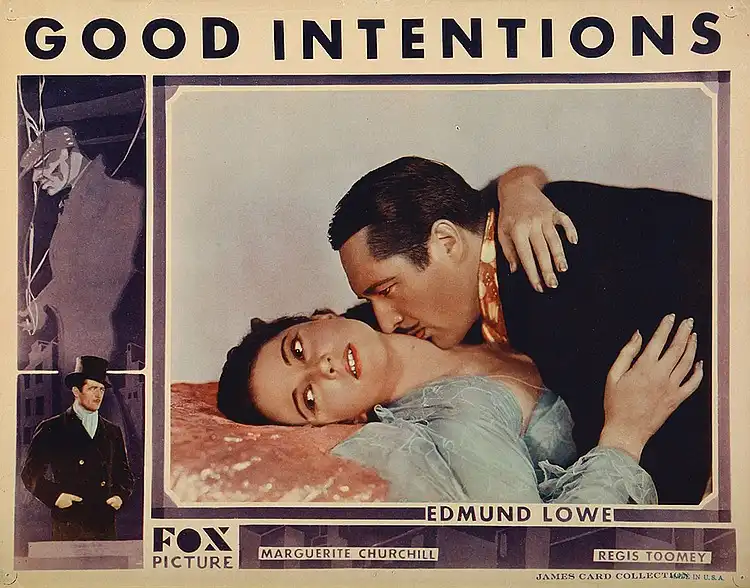
A definitive 4.6/10 rating for a film that redefined the boundaries of cult cinema. Good Intentions remains a cornerstone of transgressive art.
You should probably watch Good Intentions if you have a soft spot for those dusty, early 1930s crime flicks where everyone talks like they have a mouthful of marbles. It’s a good pick for people who enjoy watching a tough guy try to act like a gentleman and failing just enough to make it interesting.
If you hate slow-moving plots or movies where the sound quality makes it seem like the actors are whispering from across a canyon, you’ll likely want to skip this one. It’s definitely a product of its time.
Edmund Lowe plays David Cresson, and he’s got this very specific way of holding his shoulders that screams 'I might punch you' even when he’s wearing a tuxedo. He falls for Helen (Marguerite Churchill), and suddenly the racketeering life doesn't seem so glamorous anymore.
The movie really gets going when his old gang members show up. They look genuinely distressed that their leader is going soft over a girl.
There is a scene in a dimly lit room where the smoke from the cigars is so thick you can barely see the actors' faces. I love those moments in these old movies because it feels like they didn't care about 'perfect lighting' as much as they cared about the mood.
J. Carrol Naish has this one look in his eyes that is way more intimidating than any of the actual dialogue. He doesn't even have to say much to make you feel like Cresson is making a huge mistake.
The dialogue is written by William K. Howard and George Manker Watters, and you can tell they were trying to bridge the gap between silent acting and the new 'talkie' style. Sometimes a character will stand perfectly still for five seconds before answering a question.
It’s a bit like the stiff energy you see in The Woman Beneath, though the crime element here keeps it from being too boring. It's not nearly as frantic as something like The Little Pest, which is probably a relief for some.
I noticed a small detail in the background of the club scene. One of the extras is clearly just eating a piece of bread and looking at the camera like he's confused about why he's there.
Those little mistakes make these films feel more human to me. It’s not a polished machine; it’s just a bunch of people on a set trying to figure out how sound movies work.
The romance between Cresson and Helen is... fine. It’s very 1930s, meaning they mostly just stare intensely at each other and talk about honor and destiny.
I found myself much more interested in the gang dynamics. The way the associates start to whisper behind Cresson's back feels very real and dangerous.
There’s a tension there that isn't always present in these older films. You can almost feel the movie trying to decide if it wants to be a tragedy or a standard romance.
It reminded me slightly of the class struggle vibes in The Climbers, though with more guns and less fancy hats. Actually, there are still a lot of fancy hats.
One specific moment toward the end has a character walking down a hallway, and the shadows are stretched out so long they look like monsters. It’s a very noir touch before noir was even a real thing.
The pacing isn't great, to be honest. It drags in the middle when Cresson is trying to prove he’s a 'straight-and-narrow' guy.
We get it, David, you’re good now. Let’s get back to the gangsters being hostile.
Is it a masterpiece? No way. But it’s got a certain charm that you don't find in modern stuff.
It’s better than watching a generic modern remake of the same story. At least here, the grit feels like actual dirt on the lens and not a digital filter.
If you've got an hour and a half and want to see Edmund Lowe look conflicted, give it a go. Just don't expect it to change your life or anything.
I guess if I had to compare it to other stuff from that era, it’s not quite as punchy as some, but it’s far from the worst. It’s certainly more watchable than Sweet Daddy if you're looking for actual drama.
The ending comes on pretty fast. It’s like they realized they were running out of time and needed to wrap everything up in two minutes flat.
But hey, that’s just how they did it back then. No need for a twenty-minute epilogue where everyone explains their feelings.
IMDb —
1917
Community
Log in to comment.