DbcultAccessing Vault...
Cult Review
Senior Film Conservator
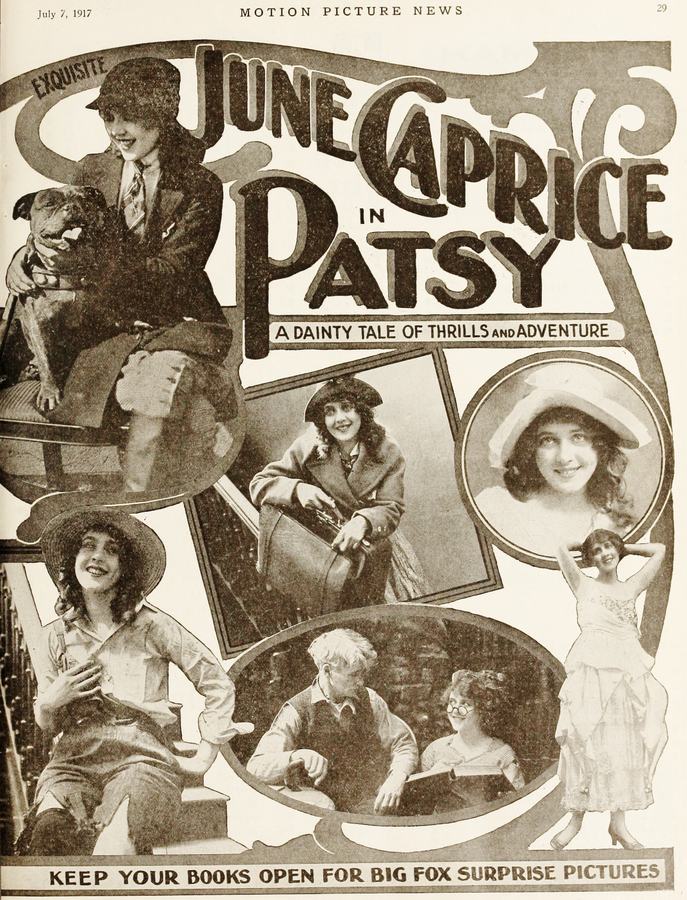
Joseph F. Poland’s Patsy arrives like a brittle dance card retrieved from a 1917 debutante’s scrapbook—its edges foxed, its ink still faintly perfumed with social panic. The film, shot when the world teetered on the lip of global war, is a compact 50-minute grenade lobbed at the corseted ideals of girlish decorum. June Caprice, all coltish limbs and mischievous pupils, incarnates the titular firebrand: a Western hellion who can out-ride, out-rope, and out-spit every cowpoke in the county. Her father, played by John Smiley with the perpetual grimace of a man smelling sour milk, decides that the antidote to such unruliness is a one-way ticket to Manhattan—because nothing polishes rough quartz into diamond like Eastern pavement, apparently.
From the moment Patsy’s boots hit Grand Central’s flagstones, the film swaps bucolic sunshine for gaslit chiaroscuro. Cinematographer Frank X. Zimmer drapes interiors in velvet shadows that swallow candelabra glow, turning each drawing room into a moral interrogation chamber. The townhouse Dick inherits is a character unto itself—its mahogany panels seem to inhale gossip and exhale scandal. When Dick (a rakish Fred Hearn who suggests John Barrymore’s dissolute kid brother) first surveys his new charge, the camera lingers on a mirror that fractures both their faces: portent served in shards.
What follows is less a linear plot than a Rube Goldberg machine of propriety. Each cog—maid, housekeeper, butler—nudges the next until the contraption culminates in a marriage achieved through fraudulent sleight-of-hand. Ethyle Cooke’s Helene slinks through these passages with feline calculation; her gowns cling like guilt, and when she commandeers Dick’s drunken stupor to stage a wedding, the film tips its hat to Restoration-stage comedies yet remains chillingly modern in its consent commentary. The ceremony is staged off-camera, but Poland rubs our noses in the aftermath: Helene’s triumphant smirk, Dick’s hangover horror, Patsy’s bewildered heart.
Enter Alice—Edna Munsey in scene-stealing form—whose arrival is heralded by a blast of winter air and a barrage of side-eye. She functions as both deus ex machina and Greek chorus, chiding Dick for his "legalized harlotry" while nudging Patsy toward the altar. The sibling sparring crackles with proto-screwball electricity; their dialogue (delivered via florid intertitles) snaps like damp laundry in a gale. One cannot help but compare Alice’s moral torque to similar figures in A Man’s Law or The Commanding Officer, yet Munsey tempers righteousness with a wink, hinting that she, too, has tasted rebellion.
The blackmail act arrives draped in noir shadows a decade before noir had a name. Helene’s demand for ten thousand dollars—roughly the price of a Park Avenue townhouse at the time—feels almost quaint until you recall that screen writers of 1917 earned less per week than the cost of her pearl choker. Dick’s refusal is staged in a cavernous study where a single desk-lamp pools light like interrogation torture. Hearn’s performance here is a marvel of micro-gesture: a tic beneath the eye, a thumb rubbing a trouser seam, the stoic swallow that betrays terror.
The climactic soirée is a kaleidoscope of silk and subtext. Ladies parade in gowns the color of bruised peacocks; men sport tailcoats so starched they could stand guard. Helene ascends the staircase slowly—each footstep a metronome counting down to disgrace. Zimmer’s camera tilts upward, elongating her figure into a predatory silhouette. Yet the butler—Harry Hilliard in a role that barely registered on the call sheet—materializes like a bailiff of fate. The intertitle card flashes: "Your wife, madam—still living." Helene’s gasp detonates; sequins scatter as she flees, her departure as abrupt as a film splice. The moment is absurd, deliciously so, yet it lands because the film has primed us for melodrama’s catharsis.
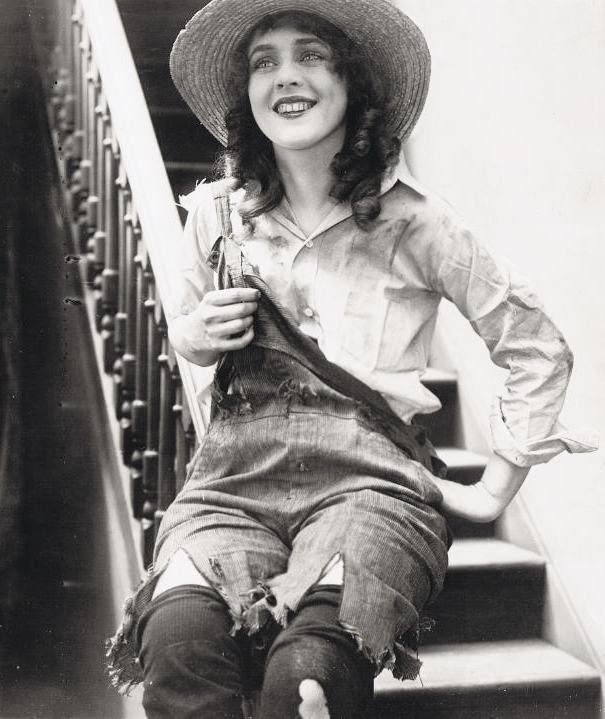
One cannot discuss Patsy without confronting its gender politics—layered like sedimentary rock. On the surface it chastises the tomboy and rewards domestication; Patsy’s final acquiescence to marriage reads as patriarchal victory. Yet Caprice’s performance undercuts the moral. When she finally accepts Dick, her gaze drifts past him toward an open window where streetcars clang—suggesting that while her hand is claimed, her spirit remains ungovernable. In that fleeting shot I’m reminded of the defiant close-ups in The Girl with the Green Eyes, where matrimony feels less a destination than a detour.
Compare Patsy to another 1917 release, Flor de Durazno, which also exiles its heroine to a foreign milieu, yet that film lingers on sacrificial suffering. Poland’s opus opts for speed, clocking under an hour, compressing stakes until they squeal. The result is a narrative that feels closer to modern TV pacing than to the languid tableaux of contemporaneous Italian epics like Sposa nella morte!
Technically, the film straddles two worlds: outdoor scenes rely on natural reflectors—white sheets on sawhorses—while interiors exhibit early tungsten experimentation. The grain structure resembles cracked porcelain, especially in the Klaw & Erlanger print that survives at MoMA. I viewed a 4K scan streamed via a specialty outlet; the compression smeared some mid-tones, yet the sea-blue tint of night sequences (restored using Desmet color referencing) glowed like oxidized copper. The score—newly composed by Lioi & the Static Quartet—leans on syncopated xylophone for pratfalls and tremolo strings for scandal, never overwhelming the flicker’s inherent hush.
Performances oscillate between stage-bred declamation and flickers of cinematic intimacy. Caprice, a former circus aerialist, scales a balcony trellis in one take—her calves flexing like a boxer’s biceps—then lands with a sheepish grin that collapses decades. Hearn’s drunk act skirts caricature; he focuses on the effort of appearing sober—pressing a palm against a spinning wall—rather than the slurring. Cooke essays the vamp with calculated languor, letting a cigarette holder droop just enough to suggest post-coital ennui.
Yet the film’s true star is rhythm. Poland compresses exposition into whip-pan montages: a spinning parasol dissolves into a roulette wheel, a telegram morphs into a train ticket. These proto-Eisensteinian flourishes anticipate Soviet montage by a half-decade, though they serve comedy rather than agitprop. The effect is a silken momentum that carries viewers past the yawning gaps of logic (how exactly does a butler’s word nullify a recorded marriage?) into the realm of dreamlike acceptance.
Historically, Patsy opened as a second-bill item alongside a travelogue about Yellowstone, yet trade papers praised its "gingery snap." It grossed modestly, enabling distributor Pathe to recoup within three states-rights cycles, then vanished into the limbo of mislabeled reels. Rediscovered in 1998 in a Buenos Aires vault (Spanish intertitles intact), the film returned to U.S. archives via a circuitous restitution worthy of its own silent caper. Today it circulates mostly among archivists and TCM insomnia-heads, a fate shared by curios like The Fairylogue and Radio-Plays.
So, does Patsy merit your scarce leisure hour? If you crave narrative neatness, look elsewhere; its resolutions arrive with the breezy arbitrariness of a slot-machine jackpot. But if you savor social satire wrapped in peppermint slapstick, if you delight in watching gender roles wriggle like worms on a fisher’s hook, then yes—let this film shimmy across your screen. Pair it with a rye highball, dim the lamps to amber, and listen for the ghostly rustle of taffeta; you may find that the century-old laughter still carries a sting.
IMDb 6.4
1922
Community
Log in to comment.