DbcultAccessing Vault...
Cult Review
Senior Film Conservator
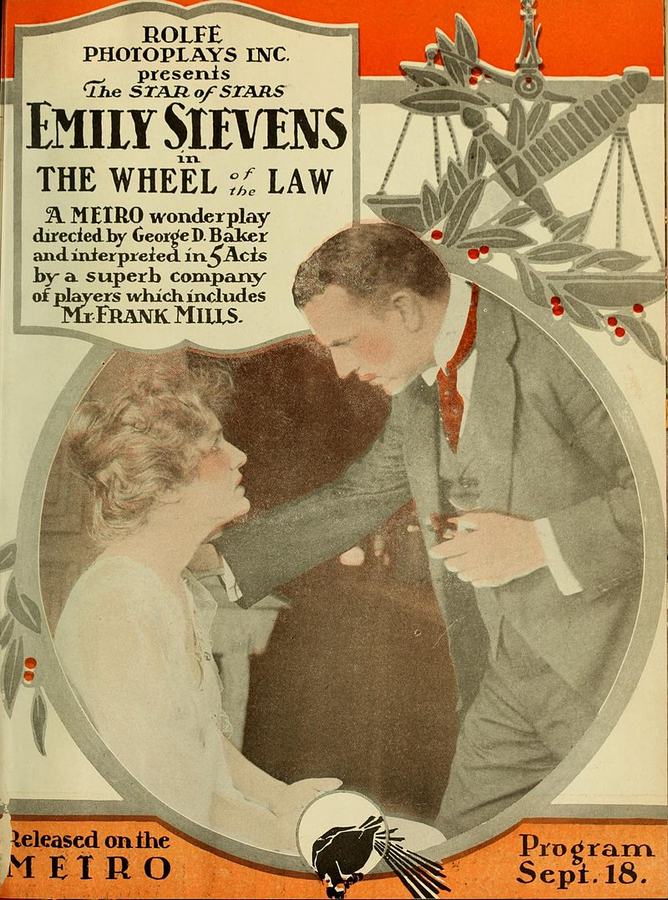
The 1916 cinematic landscape was often characterized by moralizing tales and simplistic dichotomies, yet The Wheel of the Law, directed by Howard M. Mitchell, dares to dissect the very sinews of American justice with a surgical precision that feels uncomfortably modern. At its core, the film is a scathing indictment of the 'conviction at any cost' mentality that permeated the era's legal frameworks. John Norton, portrayed with a chillingly focused intensity by Frank Mills, is not a villain in the traditional sense; rather, he is a man seduced by the mathematical elegance of circumstantial evidence. To him, the courtroom is not a sanctuary of truth, but a laboratory where human lives are the variables in a formula for professional advancement.
Emily Stevens, as Mona Mainard, provides the emotional and ethical fulcrum of the narrative. Her transition from the footlights of Broadway to the shadowed domesticity of a prosecutor's wife is played with a nuanced melancholy. Stevens avoids the hyperbolic gesticulation often associated with the silent era, opting instead for a performance grounded in internal conflict. Unlike the protagonists in The Silent Woman, Mona is not a victim of circumstance but a master of it. She understands the performative nature of the law because she has lived the performative nature of the stage. This meta-textual layer—the actress using her craft to expose the theater of the courtroom—is where the film achieves its most profound resonance.
The chemistry between Stevens and Mills is a study in diverging ideologies. Norton views his wife’s empathy as a sentimental weakness, a vestige of her theatrical background that has no place in the cold, hard world of jurisprudence. Meanwhile, Mona recognizes that Norton’s 'logic' is merely a sophisticated form of confirmation bias. The film brilliantly illustrates this through the tragic vignette of the old man who dies on the witness stand—a victim of Norton’s relentless prosecution. This moment serves as the catalyst for Mona’s transformation from a passive observer into a clandestine radical, writing scathing newspaper editorials under a pseudonym to challenge her husband’s reign.
The setting of the Arcadia Hotel provides a stark contrast to the sterile, wood-paneled halls of justice. It is a space of vice, jealousy, and political machinations, presided over by Boss Ryan. The film’s portrayal of the relationship between Ryan and the adventuress Pearl Le Claire echoes the power dynamics found in Deti veka, where the domestic sphere is inextricably linked to social standing and masculine pride. When Ryan’s jealousy erupts into murder, the narrative gears shift from a domestic drama into a high-stakes thriller. The fact that the evidence points so cleanly to the innocent Tommy—working as a bell-boy—is the film’s ultimate irony. It is the perfect 'circumstantial' case, the kind Norton has built his career upon, now threatening to consume his own family.
The cinematography within the Arcadia is claustrophobic, utilizing the deep shadows of the 1910s aesthetic to emphasize the entrapment of the characters. Raymond McKee’s performance as Tommy/John Smith is poignant; his refusal to reveal his true identity to spare his sister’s reputation adds a layer of chivalric tragedy that complicates the film’s critique of social status. It highlights a recurring theme in early cinema, also seen in His Birthright, where the burden of family honor often necessitates self-sacrifice.
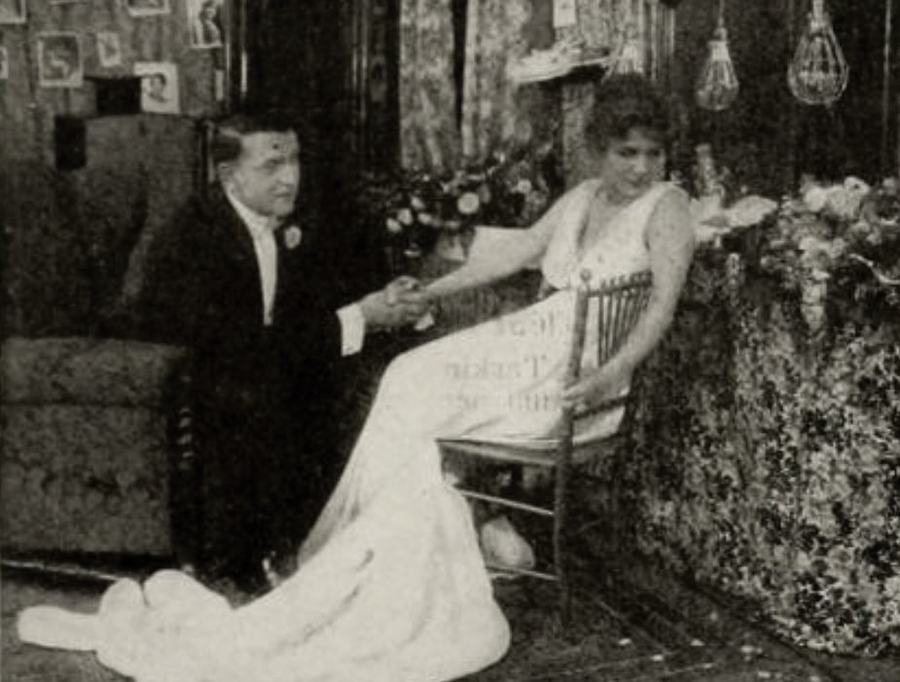
The third act of The Wheel of the Law is a daring departure from standard legal procedurals. The presence of a laboratory adjacent to Norton’s library is a fascinating narrative device. It suggests that for Norton, the law is an empirical science, devoid of human warmth. Mona’s decision to manipulate this space—switching the labels on the sedative and the poison—is a masterstroke of dramatic writing by Katharine Kavanaugh. It forces Norton to experience the sheer terror of being judged by the very 'unassailable' evidence he has used to condemn others.
As Mona feigns agony, the film reaches a fever pitch of tension. The arrival of the police and servants creates a chaotic tableau where Norton, the ultimate authority figure, is suddenly reduced to a stammering defendant. The irony is delicious and devastating. His pleas for forgiveness and his promise to abandon his hard-heartedness are not born of a sudden moral epiphany, but of the visceral fear of the gallows. This cynical view of human nature distinguishes the film from more sentimental works like Home, Sweet Home. In Mitchell’s world, change is often only achieved through the threat of destruction.
The resolution, while ostensibly happy, leaves a lingering sense of unease. While Tommy is exonerated and Boss Ryan is brought to justice, the fundamental flaw in the legal system remains. Norton’s admission that 'circumstantial evidence may be wrong' is a personal victory for Mona, but the film suggests that the 'Wheel of the Law' will continue to turn, likely crushing others in its path. This skepticism toward institutional power is a hallmark of the era's more sophisticated screenwriting, comparable to the themes explored in The Waxen Doll regarding the artificiality of social roles.
The technical merits of the film deserve significant praise. The editing during the poisoning sequence is remarkably fluid for 1916, building a sense of urgency that mirrors Mona’s internal desperation. The use of close-ups to capture Norton’s dawning realization of his predicament is particularly effective, stripping away his professional veneer to reveal the terrified man beneath. Furthermore, the film's refusal to rely on a traditional courtroom climax—choosing instead a domestic 'trial' by poison—is a testament to Kavanaugh’s innovative approach to the genre.
In the broader context of silent cinema, The Wheel of the Law stands as a vital bridge between the moralistic melodramas of the early 1910s and the more complex social dramas of the 1920s. It anticipates the noir sensibilities of the 1940s, particularly in its depiction of the city as a place of corruption and the law as a weapon rather than a shield. While it shares some DNA with contemporary mysteries like A London Flat Mystery, its focus on the psychological and ethical ramifications of prosecution gives it a weight that many of its peers lack.
Ultimately, the film is a celebration of the 'best little actress in the world.' Mona Mainard does not just save her brother; she saves her husband’s soul by forcing him to look into the abyss of his own methodology. It is a powerful reminder that justice is not merely the application of logic to evidence, but an act of imagination and empathy—qualities that Mona possesses in abundance. For anyone interested in the evolution of the legal thriller or the history of social critique in film, this work remains an essential, if often overlooked, milestone. It challenges the viewer to question the certainty of their own judgments and to recognize the inherent theater in every act of governance.
IMDb 6.8
1936
Community
Log in to comment.