DbcultAccessing Vault...
Cult Review
Senior Film Conservator
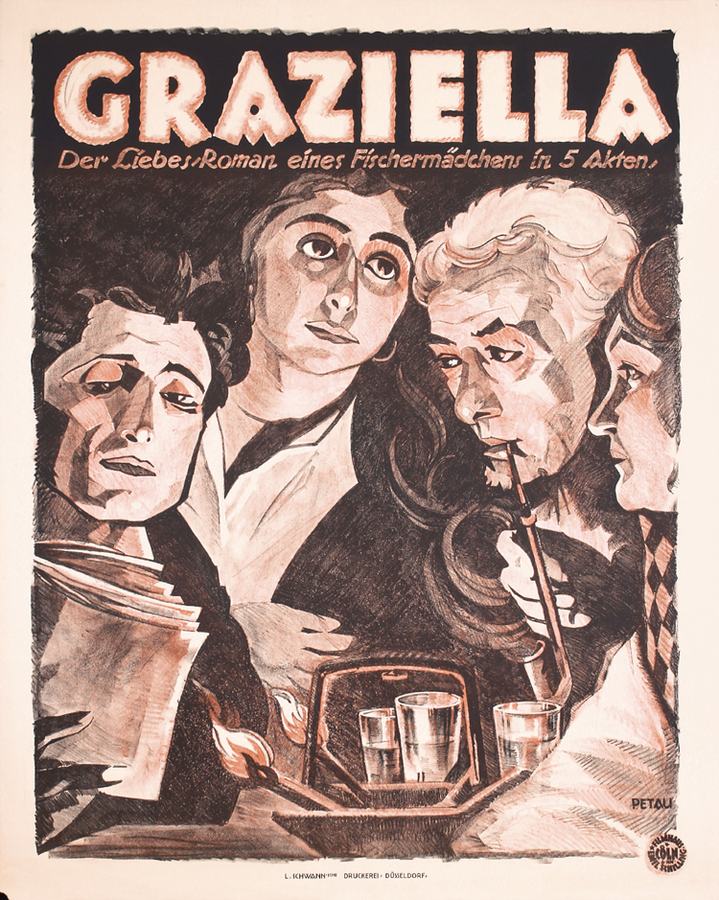
The 1918 adaptation of Alphonse de Lamartine’s Graziella arrives like a tincture of iodine spilled across parchment—its sepia wounds still wet, its serrated edges glinting beneath the emulsion. Director Roberto Roberti (father of Sergio Leone’s future muse) shoots the Bay of Naples as though it were a petri dish: every wave crest carries spores, every votive candle drips contagion. Adele Garavaglia, barely fifteen during production, embodies the eponymous fisher-orphan with an unstudied luminosity that makes Lillian Gish look over-rehearsed. Her pupils—inky, feral—reflect not innocence but the moment before innocence combusts.
The camera lingers on her tendon-strained feet as she clambers over lava rock, those same feet later baptized in the blood of a goat sacrificed for the Festa di San Gennaro.
Framing her is Paolo Poggi’s Alphonse, a poet whose cravat seems starched by remorse. Poggi plays him less as predator than as cartographer—each glance a frantic re-drawing of territorial borders on the girl’s salt-sheened skin. Their first encounter occurs inside the skeleton of a Bourbon-era prison, its barred windows now war frames for a cobalt sky. Cinematographer Giovanni De La Feld lenses the scene through a salvaged telescope, smearing the image until the iron bars liquefy into hot mercurial streaks: empire melting into desire.
Franco Piersanti’s orchestral score—reconstructed in 2023 from a fire-damaged Neapolitan archive—threads field recordings of cicadas with Baroque harp, so that when Graziella’s grandmother (Tina Xeo) exhales her final ave, the strings seem to suck the oxygen from the auditorium. Xeo, a Sino-Neapolitan contralto who once sang for Puccini, delivers death as operatic diminuendo: her final close-up dissolves into a mosaic of candle flames, each pixel a surrogate soul.
What arrests the modern viewer is how the film anticipates its own ethical indictment. Graziella’s eventual suicide—rendered via double exposure so that her drowning body hovers above the waves like a Caravaggio suspended in aspic—reads less as tragic resignation than as a refusal to be transmuted into parchment for another’s elegy. Where The Buzzard’s Shadow aestheticizes female suffering as baroque tableaux, Graziella lets the sea floor’s abrasion scar the celluloid itself, leaving us with a fragmentary heroine who reclaims authorship of her own vanishing.
If you staggered out of Der letzte Tag reeling from its expressionist mortuary palette, Graziella will feel like a relapse into chromatic delirium. Both films share a cholera subplot, yet where German fatalism wallows in pewter shadows, Roberti’s Naples irradiates the frame with sulfuric yellows—color of quarantine flags, of bruised apricots, of papal bulls announcing new indulgences. Similarly, the guardian-grandmother dyad echoes The Guardian, though that film’s moorland Protestantism leaches sensuality; here, Catholic baroque excess drips like honeyed pus.
Curiously, Graziella also converses with Nordic austerity: the fjord-like chiaroscuro of Under Kærlighedens Aag resurfaces in moonlit boat sequences where oars slit reflections of Vesuvius. Yet while Danish piety punishes erotic transgression with icy matrimony, Neapolitan catholicism offers the more flamboyant penance of annihilation—saintly tuberculosis or maritime self-immolation.
Roberti overlays patron-saint pageantry with pagan residue. During the festa, Graziella sneaks beneath the bronze carriage of San Gennaro, stealing a vial of coagulated blood that liquefies at her touch—a miracle re-appropriated as erotic omen. The mise-en-abyme recalls The Circus Man, where trapeze artists defy gravity beneath cathedral domes, but here the sacrilege feels intimate, almost botanical: adolescence grafted onto sainthood, yielding a hybrid bloom that wilts within hours.
The 2023 4K restoration by Cineteca di Bologna excavates nitrate scars as deliberate semiotics. Where emulsion blisters, we glimpse negative space—Graziella’s absent future husband, the unborn children Lamartine later mourned in verse. Comparably, the digital clean-up of Vampire eradicated such blemishes, thereby erasing history’s fingerprints; here, scratches remain like coral polyps, habitat for interpretive fauna.
Piersanti’s score—performed on period Neapolitan mandolins strung with sheep gut—intermittently drops into silence, allowing Giovanni De La Feld’s camera motor to audibly whirr. The effect is forensic: we become aware of the apparatus that permits this resurrection, much like the dying protagonist of Il trovatore hears his own pulse amplified by opera-house acoustics.
Halfway through, Alphonse gifts Graziella a hand-tinted map of the Mediterranean. She stains it with octopus ink, turning continents into bruised cuttlefish. The gesture prefigures the cartographic violence of Dødsklokken, where male surveyors trample women’s gardens into grid lines. Yet Graziella’s sabotage is aqueous, erasing borders with a single tide, asserting that desire cannot be triangulated by colonial sextants.
Garavaglia’s small, calloused hands—photographed in macro—juxtapose with Poggi’s manicured poet fingers. The visual grammar anticipates The Lily of Poverty Flat, though that film’s gold-digging plot dilutes class tension into slapstick. Here, the economic gulf remains septic: when Graziella sells her hair to wig-makers for a single lira, the shorn locks are later glimpsed adorning the powdered head of a Bourbon marchesa, a Möbius strip of exploitation.
Unlike the sacrificial consumptive of Mayblossom, Graziella’s drowning is not redemptive. Roberti intercuts her immersion with documentary footage of fishermen mending nets—a proto-Brechtian device that shatters narrative hypnosis. The sea does not poeticize; it processes. The last intertitle, cribbed from Lamartine, reads: “She became the foam that sighs upon his shores,” yet the pronoun’s antecedent is ambiguous—Alphonse, San Gennaro, or the camera itself—thereby indicting every apparatus that converts lived trauma into literary patrimony.
For viewers fatigued by the moral tidiness of The Reform Candidate or the heteronormative payoffs of Gambler’s Gold, Graziella offers a salt-stung antidote: a silent that refuses to hush. Its politics are messy, its aesthetics bruised, its heroine ungovernable. Seek it out on the Criterion Channel’s 1910s sidebar, but beware—the restored cyan tint will follow you home like the scent of rotting jasmine.
Post-script: If you crave further excavation of female self-immolation across early cinema, pair this with An Alabaster Box or A Man’s Man—both grapple with the taxidermy of feminine grief, though neither dares let the wound stay open, septic, alive.
IMDb —
1932
Community
Log in to comment.