DbcultAccessing Vault...
4.8/10
Senior Film Conservator
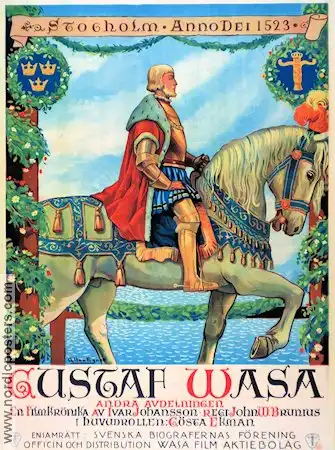
A definitive 4.8/10 rating for a film that redefined the boundaries of cult cinema. Gustaf Wasa del II remains a cornerstone of transgressive art.
Right off the bat, if you're not already someone who actively seeks out silent films, or at least has a strong interest in early 20th-century Swedish history, Gustaf Wasa del II probably isn't going to be your casual Friday night watch. For the dedicated silent film enthusiast, though, or anyone curious about how a national epic played out on screen nearly a century ago, there’s something here. It's a bit of a commitment, full of the grand gestures and often stilted pacing that defined the era, but it certainly has its moments.
As the title suggests, this is the second part of a larger story, and it jumps right into Gustaf Wasa's flight through Dalarna, disguised and hunted by the Danish King Kristian II. The narrative assumes you know the first part, which is fair enough for its original audience, but for us now, it means a few early scenes feel like catching up on a conversation already in progress. You get the gist quickly enough: Wasa is on the run, the Danes are bad, and the Swedish people are suffering.
The acting, as expected for 1928, is largely a study in broad strokes. Nils Lundell as Gustaf Wasa has this particular intensity, a constant furrowing of the brow that, after the third or fourth close-up, starts to feel less like stoic determination and more like he's just forgotten his glasses. You can almost feel the film trying to convince you this man is a legendary figure through sheer force of his pained expressions. It’s effective in short bursts, but a bit much over ninety minutes.
Frida Dahlskog, playing one of the local women who aids Wasa, occasionally breaks through this. There’s a scene where she’s hiding Wasa in a barn, and the fear in her eyes, even through the heavy makeup and silent performance, feels genuinely palpable. It's a quiet moment, just a few glances and a trembling hand, but it cuts through the melodrama of the surrounding scenes. It’s one of those tiny, unexpected flashes where the humanity of the situation actually lands.
Then there are the crowd scenes. When Wasa finally starts to rally the peasants, there’s this oddly empty feeling to some of the gatherings. You see a handful of villagers, maybe twenty or thirty, waving their arms with great enthusiasm, but the wide shots often reveal vast, unpopulated fields just beyond them. It’s hard to shake the feeling that half the extras wandered off for a fika break. The scale the story demands just isn't always met by the film's resources, or perhaps its blocking.
Pacing is, predictably, a mixed bag. Some of the horseback chases through snowy landscapes are genuinely thrilling for the period, with a surprising dynamism in the camera work. But then you get a sequence, maybe fifteen minutes in, where Kristian II (played by Edvin Adolphson, who leans into the villainy with relish) is just... walking through a village. He stops, he stares, he listens to a single, very long intertitle about his cruelty. The scene goes on about 20 seconds too long, and the silence starts to feel awkward rather than emotional, like a director waiting for something to happen that never quite does.
The intertitles themselves are a character. Some are poetic, almost lyrical, while others are incredibly blunt, just stating facts or character names. There’s one particularly clunky exchange where a Danish soldier barks, “WHERE IS WASA?!” and the peasant replies, “I KNOW NOT OF WHOM YOU SPEAK, SIR!” The capital letters and exclamation marks really drive home the lack of subtlety, but it’s hard not to chuckle a little. It’s not bad acting, per se, but it highlights the inherent stiffness of conveying dialogue this way.
Visually, the film has its moments. The snow-covered landscapes of Dalarna are often quite beautiful, lending a stark, almost mythic quality to Wasa's arduous journey. There's a shot of him silhouetted against a setting sun, tiny against the vastness, that’s genuinely striking. But then you have some interior sets that look like they were thrown together in an afternoon, particularly a certain tavern scene with noticeably wobbly walls.
What’s most interesting, perhaps, is the film's almost casual acceptance of its own historical weight. It doesn't try to be a grand, sweeping epic in the way later films would. It feels more like a direct retelling, a visual history lesson, albeit one with dramatic flourishes. There are no huge, complex battle sequences; instead, you get smaller skirmishes and the constant threat of capture. It’s a more intimate kind of epic, if that makes sense.
Ultimately, Gustaf Wasa del II is a fascinating artifact. It's not a masterpiece that transcends its era, but it’s a solid example of what was possible in Swedish cinema almost a century ago. You’ll find yourself laughing at its quirks, admiring its ambition, and occasionally being genuinely moved by a well-placed close-up or a desperate chase. Just don’t go in expecting anything but a journey back in time, complete with all the rough edges.
IMDb —
1919
Community
Log in to comment.