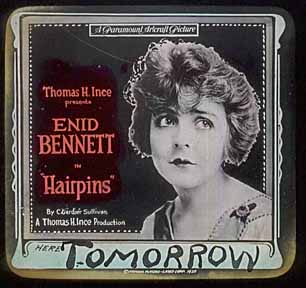
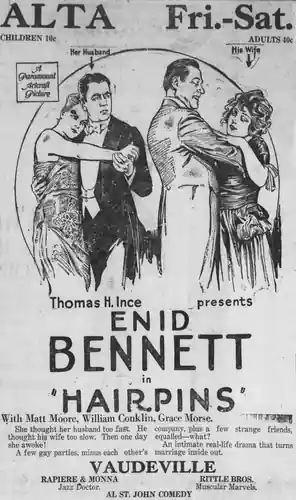
A definitive 6/10 rating for a film that redefined the boundaries of cult cinema. Hairpins remains a cornerstone of transgressive art.
The celluloid of 1920 is brittle, yet Hairpins survives like a pressed flower that still bleeds chlorophyll: a domestic battle fought with hatpins instead of bayonets. Director Robert Ellis—hardly a household sigil outside hardcore cine-archaeologists—marshals a trio of incandescent performers who navigate the treacherous lattice of class aspiration, marital entropy, and the quiet terrorism of mirrors.
The Plot as Palimpsest
What sounds like a dime-novelle adultery curveball is, under the skin, an autopsy of American upward mobility. Our protagonist, Richard Vale (played by Matt Moore with the perpetual half-smile of someone who has already penciled his own congratulatory headlines), believes the world is a ledger: polish the wife, lease the right automobile, secure the country-club invitation, and the future will fatten itself. His wife Miriam (Aggie Herring)—all elbows and unmoored hairpins—refuses the corset of that equation. She leaves stockings drying over the ficus, serves consommé lukewarm, and, most damningly, laughs at the wrong jokes.
So Richard does what any corporation-destined striver of the era would: he weaponizes Evelyn (Enid Bennett), his secretary, whose silhouette alone could secure a bank loan. Their courtship unfurls in negative space—no open-mouthed kisses, just intertitles that sting like alcohol on a cut: She understood that a man may need two calendars—one for engagements, one for secrets. Cue the affair, shot almost entirely in doorframes: the camera peeks through a crack while Evelyn’s hand lingers on Richard’s lapel, a gestural whisper louder than any lip-lock.
The Wife’s Counter-Revolution
Halfway mark, the film flips its own axis. Miriam, previously sketched as comic ballast, commandeers the narrative. She patronizes a Parisian modiste (read: Sears catalog and a daring pair of scissors), learns the foxtrot, and—most subversively—cultivates silence. In a dinner sequence that plays like a chess match staged by Ingram, she arrives late, hair shellacked into a helmet, dress the color of arterial blood. Richard’s promotion prospects hinge on this very soirée; instead of fawning, Miriam greets the brass with a languid nod, sips champagne, and says nothing. The silence detonates louder than any slap.
Visual Lexicon
Cinematographer Friend Baker shoots marital clutter like a crime scene: a half-eaten pear browning on a porcelain plate, a spilt box of hairpins scattered like shrapnel across parquet. Every object is an accusation. When Miriam later tidies up, the pins are gathered into a gleaming bouquet—an image so freighted it could headline a feminist manifesto.
Contrast this with the secretary’s apartment: negative space, venetian blinds slicing sunlight into prison bars. Richard is free to roam, yet looks caged. The film grasps that modernity itself can be a set of velvet handcuffs.
Performances Calibrated to a Dime
Aggie Herring delivers a masterclass in micro-gesture: watch her left eyebrow when Richard praises Evelyn’s shorthand—an imperceptible twitch that contains multitudes of marital contempt. Matt Moore walks the tightrope between charm and smarm without ever caricaturing the era’s masculine entitlement. Enid Bennett, saddled with the other woman trope, refuses pity; her Evelyn enjoys the power of being the hidden gear in the capitalist machine.
Intertitles as Stilettos
He thought a wife was a portfolio—something to be balanced at quarterly intervals.
Scene from Hairpins
Cinematic perspective: Exploring the visual vocabulary of Hairpins (1920) through its definitive frames.
Such intertitles, written by serial scenarist C. Gardner Sullivan, arrive like poisoned darts. They condense the Gilded Age’s transactional view of matrimony into epigrams worthy of Wilde.
Historical Resonance
Released months after the 19th Amendment’s ratification, Hairpins vibrates with the tremors of redefined gender roles. Women could now vote; the film asks whether they may also veto. Miriam’s transformation is less about winning her husband back than about seizing authorship. In that sense, the movie converses with post-war suffrage dramas yet refuses to sermonize. Its feminism is prickly, opportunistic, deliciously human.
Sound That Isn’t There
Because this is 1920, the absence of diegetic audio becomes a character. Listen—metaphorically—to the hush when Richard’s briefcase snaps shut: it is the sound of a contract sealing not only a business deal but also his emotional bankruptcy. The orchestra score, lost to nitrate decay, survives only in cue sheets; contemporary restorations often pair the film with jazzy riffs that feel anachronistic. I prefer silence—pure, caustic, allowing the creak of chairs and the rustle of taffeta to echo across a century.
Comparative Glances
If Silence of the Dead externalizes guilt into spectral visitations, Hairpins internalizes it as décor: a marriage haunted by poorly hung drapes. Likewise, where Molly Entangled traps its heroine in spider-web plot contrivances, Hairpins grants Miriam agency to spin her own web.
Restoration & Availability
Only a 35mm tinted print at La Cinémathèque française and a 16mm reduction at UCLA survive; both bear the scabs of vinegar syndrome. Current digital transfers mute the original stencil hues—amber for interiors, cyan for exteriors—yet even in pallid grayscale, the film crackles. A crowdfunding campaign aims to fund a 4K wet-gate restoration; cinephiles should lob coins faster than a Chaplin boot.
Final Pin-Prick
By the last reel, every character wears a mask polished to perfection. Richard, now poised for partnership, discovers that the cost is a wife more enigmatic than any corporate ledger. Miriam, coiffed and cool, has learned that reinvention is not reconciliation. They exit the frame side by side, not touching, heading toward separate limousines. The camera tilts up to an electric billboard advertising A Future of Limitless Possibilities—a cruel joke, since possibilities have become the very battleground on which their marriage bleeds.
Hairpins is less a moral tale than a sartorial one: how we tailor ourselves to impress strangers, and how a single stray thread—one hairpin—can unravel the whole ensemble. In 1920 or 2023, the film insists, the most damning affairs aren’t conducted in bedrooms but in mirrors.