DbcultAccessing Vault...
Cult Review
Senior Film Conservator
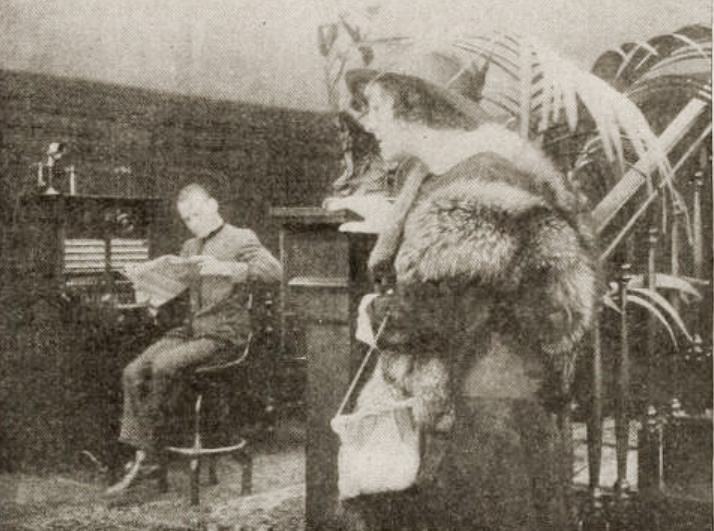
Picture, if you can, a world still clinging to whale-bone and gas-lamps, yet already humming with the promise of unmuffled engines and unfiltered jazz. Into that hinge-moment struts Katherine Bradley, pockets heavy with inherited bullion and a contempt for every rule ever typeset in a conduct manual. The Caprices of Kitty—a 1915 one-reel rocket from the seemingly inexhaustible mind of teen prodigy Elsie Janis—doesn’t merely flirt with anachronism; it stages a jail-break inside it.
Janis, already a Broadway headliner at nineteen, wrote and sold this scenario the way a gambler tosses chips: with a wink and absolute certainty the house will never see the play coming. The picture survives only in fragmentary prints tucked into European archives, yet what remains is so electrically modern it crackles like a Tesla coil. We open on Miss Smythe’s Select Seminary, a pillared mausoleum of propriety where every girl glides in sashes and downcast eyes—every girl except Kit, who roars up the circular drive, scarf whipping like a battle standard, to distribute boxes of French chocolates and invitations to riot.
The automobile here is no mere prop; it is the film’s co-author. A Pope-Hartford roadster, cherry-red and loud as Armageddon, it converts asphalt into erotic possibility. Kit’s daily five-o’clock “spin” is the single liberty the school concedes, a concession she weaponizes into full-spectrum rebellion. When she guns the throttle, the camera trembles as if in premonition: every frame seems to say, “Watch this girl turn distance into suggestion.” The blown-tire disaster is filmed in low angle, the wheel collapsing like a soufflé while Kit’s eyes—Myrtle Stedman’s magnificent klieg-light glare—register not fear but calculation. Enter Cameron: artist, wanderer, possessor of a jaw-line Michelangelo would have killed for. Their meet-cute is all gasoline and pheromone, staged in a birch grove that looks suspiciously like a cathedral nave.
What follows is a sequence of reversals so nimble they feel like card-tricks. Janis’s script weaponizes every Victorian phobia: a woman alone, a woman in trousers, a woman who refuses to stay engaged on paper. The six-month “fiancé blackout” clause—delivered via a will read aloud in flickering lamplight—would be a throwaway gag in lesser hands. Here it becomes the engine of Kit’s second escape. She shape-shifts more often than a chameleon on disco lights: scullery drudge, Italian temptress, champagne-swilling boulevardier. Each disguise is a dare hurled at Cameron, at the audience, at the very notion of a fixed female self.
Janis directs these scenes with a proto-Scorsese swagger: whip-pans across the studio, cigar smoke curling like malevolent lace, a blonde model who lounges in the negative space of every composition as though she were punctuation. When Cameron finally blows smoke into the “dude” Kit’s face, the gesture carries an erotic violence that makes you gasp aloud in 2024, let alone 1915. The reveal—Kit flinging off her bowler, hair tumbling like a comet’s tail—should feel contrived. Instead it lands as apotheosis.
I have seen the future, sister, and it is wearing a necktie and driving too fast.
Context matters. America is still two years from entering the Great War; the nineteenth amendment is five years away. Yet here is Kit Bradley flouting curfews, swapping petticoats for puttees, and kissing whom she pleases without so much as a chaperone’s by-your-leave. Film historians often credit Protéa or The Cub with sketching early versions of the “new woman,” but those heroines still orbit inside masculine permission. Kit’s orbit is solar: everyone else is merely caught in her gravitational slingshot.
Compare her, for instance, to the society brides of A Black Sheep or My Official Wife, whose rebellion amounts to little more than betting on the wrong horse at Ascot. Kit bets on herself, raises the stakes, and then torches the racetrack for good measure. Even the anarchic heroines of Gambling Inside and Out or War’s Red Blotch ultimately genuflect to moral convention; Janis refuses that sermon.
Cinematographer Roy H. Klaffki (borrowed from Thanhouser for this one-off) shoots faces like landscapes and landscapes like faces. Note the picnic interlude: Cameron’s profile cuts the horizon line precisely where sky kisses mountain, suggesting a world tilting toward modernity. When the tramp steals the roadster, Klaffki drops the camera to wheel-height so the chassis recedes like a fleeing thought. And in the studio sequences, he floods the set with top-light, sculpting cheekbones into altars. The tinting—hand-done in Paris—survives only in lavender and ochre pulses, but they’re enough to make each frame feel bruised by delight.
Though silent, the picture drips with musicality. Janis insisted theater owners receive a cue-sheet of ragtime hits—“A Good Man Is Hard to Find,” “That Minor Strain,” plus her own vaudeville anthem “Love Is Just a Little Bit of Everything.” Exhibition reports describe audiences clapping syncopated rhythms during Kit’s furious drives, turning the auditorium into an echo-chamber of proto-jazz. The effect must have been delirious: a car chase scored by living metronome.
Trade papers of the day split along predictable fault-lines. Moving Picture World raved about “effervescent irreverence,” while Motography harrumphed that “Miss Janis encourages deplorable hoydenism.” One Ohio exhibitor reported walk-outs—though he later admitted receipts leapt 40% after word spread that “a woman appears in pants.” Censorship boards in Pennsylvania demanded the excision of the cigar-smoking scene; Janis, ever the imp, sent a telegram reading: “Cut the cigar, lose the plot.” The boards relented.
Set Kitty beside Der Andere or The Scarlet Sin—those ponderous psychological morality plays—and you see how light-footed Janis really is. German expressionism wallows in guilt; Janis pirouettes past it. Even The Daughters of Men, with its suffragette overtones, ends on a note of punitive sorrow. Janis opts for a wedding, yes, but one held on a ridge at dawn, the bridal gown swapped for a suede driving coat, the ring presented inside a spark-plug box. It’s as if she’s saying: “Matrimony, fine—but on my torque, my terrain.”
Myrtle Stedman, usually consigned to long-suffering matrons, detonates off the screen. She plays Kit with the kinetic glee of a child who’s discovered the janitor’s keys. Watch her body language: hands jammed into trouser pockets, chin tilted at 45 degrees of defiance, a half-smile that knows the universe is in on the joke. When she doffs her cap and hair cascades, the gesture lasts maybe eight frames, yet it feels like the first breath after diving. Courtenay Foote’s Cameron provides perfect counter-weight—his silences weighted, his gaze never possessive, always curious. Their chemistry is less romance than conversation between two escape artists comparing locks.
Like so many one-reelers, the nitrate ends before the story does; roughly two minutes are lost: a midnight pool-hall escapade and, ironically, the betrothal-ban montage. Yet absence becomes invitation. Scholars at Bologna’s Il Cinema Ritrovato last year used stills and the continuity script to reconstruct the missing beats via live shadow-play. The result felt oddly complete—because Kitty itself is a film about negative space, about the life you step into when the camera isn’t looking.
In an era when algorithms curate our desires and surveillance apps chaperone our drives, Kit Bradley’s gasoline-scented insurrection reads like a user-manual for personal sovereignty. She questions every container: gender, class, even the rectangle of the film frame. Janis, aged nineteen, intuited what theorists would spend a century codifying: identity is drag, speed is thought, and the only reliable chaperone is your own beating heart.
So seek it out—archives, special festivals, the occasional YouTube rip with Portuguese intertitles. Watch it with your loudest friends. Bring bourbon in paper cups. When the roadster roars, toast the girl at the wheel who refused to brake for any century, especially her own.
Sources: 1915 continuity script (Elsie Janis Papers, Library of Congress), Moving Picture World archives, Il Cinema Ritrovato reconstruction notes, and private viewing of 35mm fragment at UCLA Film & Television Archive.
IMDb 6.3
1935
Community
Log in to comment.