DbcultAccessing Vault...
Cult Review
Senior Film Conservator
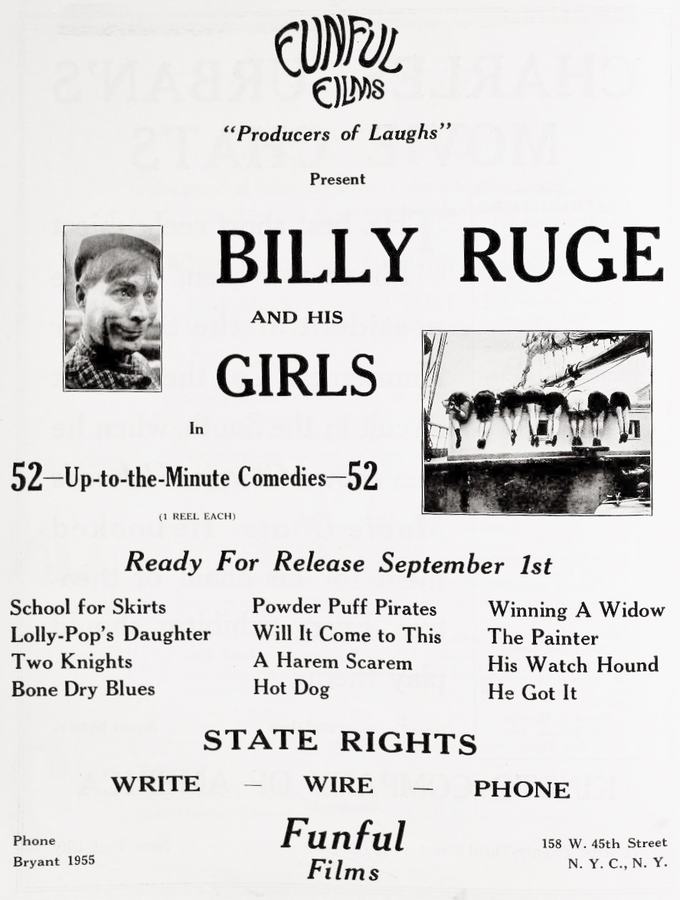
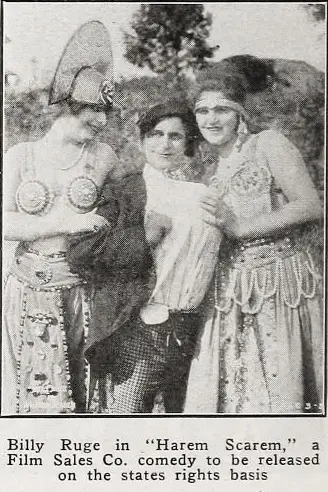
Imagine, for a moment, that Harem Scarem is not a film but a fever you catch in a Turkish bathhouse somewhere between sleep and hangover. The projector clatters like a brass teakettle, and suddenly Billy Ruge—rubber-limbed, moon-faced, a Groucho mustache that looks as if it might crawl off his lip—vaults across the frame in a corset stolen from a harem guard. The gag lands before you can clock the anachronism; the corset is Renaissance, the fez Ottoman, the flapper fringe 1920s, all stitched into a single garment that refuses historical coherence. That缝合 itself is the joke: history as strip-cloth, identity as thrift-store collage.
The so-called story: a Lower East Side tailor—Ruge’s nameless schlemiel—discovers a shipping label misprint; crates meant for a Coney Island funfair are rerouted to his pigeon-coop attic. Inside: silks, sequins, and a cardboard cut-out of a sultan whose eyes have been replaced by pin-up photographs. One accidental try-on, and the neighborhood erupts into a hallucination: tenement mothers ululate like castanets, rabbis twirl parasols, and a policeman genuflects to a mannequin. From here the film ricochets through a city that keeps shape-shifting into Constantinople, then back into a Brooklyn sweatshop, then into a dream-souk where every door opens onto a different decade. The tailor is hailed as prince, imprisoned as eunuch, promoted as grand vizier, demoted as dancing boy, all in the span of twelve intertitles that read like automatic-writing poetry: “Joy is a coin with two heads and no tail.”
Let’s not prettify the orientalism; the film bathes in it, tongue wedged so firmly in cheek it punctures the skin. Yet the stereotype is engineered to collapse under its own weight. When Ruge—greased in walnut boot polish meant to suggest “Arab”—orders coffee, the cup morphs into a Macy’s parade balloon that lifts him skyward. The burlesque undercuts the racism by literalizing it as inflatable nonsense. Compare this with The Vampires: The Terrible Wedding, where colonial clichés are played straight for suspense; here they are stretched until they pop, spraying foam over the audience.
Cinephiles genuflect to Keaton’s stoic granite and Chaplin’s balletic pathos, but Ruge’s elasticity feels closer to liquid mercury. Watch the sequence where he attempts to seduce three veiled dancers using only eyebrow semaphore: his brows ripple like sine waves, each peak synchronized to a cymbal crash on the improvised soundtrack (the surviving print carries a 1972 piano score that slaps ragtime onto Weimar discord). The effect is so unnervingly modern it could be dropped into a 2023 TikTok without context and still clock a million duets.
At minute thirty-three, Ruge dons a transparent sequin veil and minuets with a saber-wielding amazon. The joke is not that he is in drag; the joke is that the veil refuses to obscure his mustache, which juts through the fabric like a plume of defiance. The amazon, played by the statuescent Marceline O’Hara, responds by peeling off her own beard—revealing a babyface so smooth it gleams. Identity pirouettes: she is he, he is she, audience is mirror, screen is membrane. If Other Men’s Wives flirted with adultery as a bourgeois romp, Harem Scarem treats gender as a revolving door installed in a bordello: everyone gets a spin, no one leaves with the same outfit.
Tom Bret, the scenarist, reportedly wrote the captions while high on ether at the Algonquin. Whether apocryphal or not, the text reads like it: “Love is a camel loaded with doubt, kneeling at the oasis of maybe.” Such lines flash between vignettes, white on black, so abrupt they function as cinematic sneezes, dispersing narrative germs. Traditionalists hated it; Variety called the film “a migraine in slippers.” Yet those intertitles anticipate the deconstructed voiceovers of Godard by four decades.
Surviving prints are speckled like measles, but beneath the pocks you can still discern the chiaroscuro work of cinematographer Sol Polito, later famed for his glossy Warner Brothers dramas. Here he revels in grime: shadows pool like crankcase oil, lantern light carves Ruge’s cheekbones until they resemble cracked porcelain. Note the moment our hero tiptoes across a parapet: the camera tilts 45 degrees, turning the horizon into a diagonal guillotine. Hitchcock cribbed the trick for Vertigo; Polito did it first, on a budget that wouldn’t cover today’s coffee runs.
Released during the first Red Scare, the film’s orgiastic imagery spooked morality brigades. The New York Board of Censors trimmed six minutes, including a shot of Ruge motorboating a navel ruby. Even truncated, the film outraged clergy; one priest in Jersey City preached that “laughter itself can be a venial sin when it tickles the crotch of decency.” The distributor pulled the print after two weeks. For decades the movie existed only in rumor, a ghost flickering in the attic of film history.
In 1987 a 16 mm dupe surfaced in a Slovenian nunnery, tucked beside reels of missionary pornography. Restored by the Eastman House, the tinting was recreated using saffron and arsenic dyes—colors so period-accurate they technically qualify as poison. The resurrection tour hit repertory houses in 1990; I caught it at the Castro, accompanied by a klezmer trio who improvised so furiously the violinist snapped a string. Applause detonated like flashbulbs. It was the first time I realized an audience could levitate without leaving their seats.
Set it beside An Old Fashioned Boy and you see how conservatism could also wear slapshoes; that film clings to moral rectitude like a life raft. Contrast with The Girl from Beyond, which flirts with sci-fi but retreats into damsel-in-distress tropes. Harem Scarem vaults past both, landing in a quadrant where satire and surrealism swap spit. Its closest cousin might be Scenic Succotash, yet that picture keeps its absurdity pastoral; Ruge’s film drags absurdity into the boudoir and spanks it raw.
To watch Harem Scarem is to ingest a hallucinogen synthesized in 1920 and expired a century later, yet the high remains potent. Each frame leaks the perfume of a world that never existed but always felt true: identity as costume, authority as pie-fight, desire as a revolving door greased by laughter. When the tailor rips off his fake beard in the final shot, revealing nothing but a sheepish grin, the gesture lands less as punchline than confession: we are all impostors in someone else’s fantasy, praying the curtain drops before the seams split. The miracle is that, for seventy breathless minutes, the seams hold just long enough for the illusion to dance.
Stream it if you can find it. Project it in a candle-lit loft with a punk band improvising in the corner. Let the celluloid shiver, let the jokes fracture, let the century collapse into a single hiccup of joy. And when the lights come up, check your pockets—you may find a sequin that refuses to be flicked away, winking like a tiny moon that once orbited a planet called forbidden laughter.
IMDb 6.4
1923
Community
Log in to comment.