DbcultAccessing Vault...
6.3/10
Senior Film Conservator
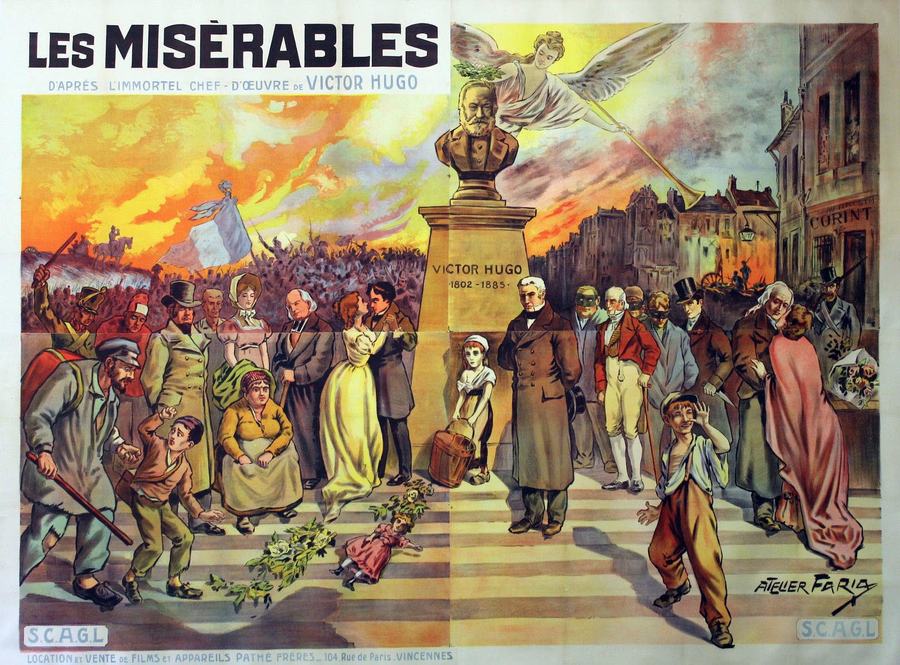
A definitive 6.3/10 rating for a film that redefined the boundaries of cult cinema. Les misérables remains a cornerstone of transgressive art.
The year 1912 stands as a monumental meridian in the history of the moving image, a period where the medium finally shed its swaddling clothes of short, anecdotal 'scènes' to embrace the staggering breadth of the 'long métrage.' At the vanguard of this revolution was Albert Capellani, a director whose sensibilities were steeped in the theatrical tradition but whose vision was undeniably cinematic. His adaptation of Les Misérables is not merely a film; it is a sprawling, multi-part testament to the endurance of the human spirit, a work that sought to capture the entirety of Victor Hugo’s literary leviathan at a time when most films were still struggling to narrate a simple joke. While earlier attempts at long-form storytelling like The Story of the Kelly Gang paved the way, Capellani’s work brought a sophisticated European aesthetic that married social realism with grand melodrama.
Released in four distinct segments, this 1912 iteration functions with the rhythmic pulse of a serial, yet it possesses a thematic unity that remains startlingly modern. The narrative arc of Jean Valjean, portrayed with a hulking, soulful gravitas by Henry Krauss, serves as the spine of this epic. Krauss does not merely act; he inhabits the physical toll of nineteen years in the galleys. His performance avoids the histrionic gesticulation common in the era, opting instead for a simmering intensity that mirrors the internal 'storm under a skull' that Hugo so eloquently described. In comparison to other 1912 landmarks like The Life and Death of King Richard III, Capellani’s direction feels more fluid, more attuned to the psychological nuances of its protagonists.
The film’s structure allows for a slow-burn immersion into the socio-political climate of mid-19th century France. We see the Bishop of Digne not as a mere plot device, but as the catalyst for a spiritual awakening that challenges the very foundations of the Napoleonic Code. The cinematography, though largely static by contemporary standards, utilizes deep focus and elaborate set design to create a sense of place that is almost tactile. The streets of Montreuil-sur-Mer and the labyrinthine alleys of Paris are rendered with a chiaroscuro beauty that evokes the etchings of Gustave Doré. This visual richness puts it on par with the ambitious staging seen in Dante's Inferno, though Capellani trades mythological surrealism for a grit-under-the-fingernails naturalism.
Opposite Krauss is Henri Étiévant as Inspector Javert, the personification of unyielding, mechanistic justice. Étiévant plays Javert with a predatory stillness, a man who has replaced his conscience with a rulebook. The conflict between Valjean and Javert is framed not as a simple game of cat and mouse, but as a philosophical collision between the letter of the law and the spirit of mercy. This duality is central to the film’s power. While contemporary films like Oliver Twist explored the plight of the poor with a Dickensian sentimentality, Capellani’s Les Misérables feels more like a sociological autopsy. It examines how the state, through figures like Javert, creates the very 'monsters' it seeks to imprison.
The chase sequences, particularly those through the Parisian shadows, are edited with a burgeoning sense of tension. Capellani understands the power of the frame; he uses doorways, windows, and the looming architecture of the city to entrap Valjean visually long before Javert’s hand ever touches his shoulder. This mastery of spatial dynamics was a significant leap forward from the more theatrical staging of Life and Passion of Christ, proving that cinema could communicate complex emotional states through composition alone.
The third and fourth parts of the film shift the focus toward the younger generation—Marius, Cosette, and the doomed revolutionaries of the ABC Society. The transition from the personal redemption of Valjean to the collective aspiration of the 1832 June Rebellion is handled with remarkable grace. The barricade sequences are a marvel of early production design. Hundreds of extras, authentic-looking weaponry, and a genuine sense of chaos imbue these scenes with a documentary-like urgency. It is here that the film’s scale truly rivals the historical epics of the time, such as Cleopatra or the Russian spectacle 1812.
The character of Gavroche is portrayed with a plucky, tragic energy that serves as the emotional heartbeat of the rebellion. His death on the barricades remains one of the most poignant moments in silent cinema, a sequence that Capellani captures without the need for excessive intertitles. The visual storytelling is so potent that the audience feels the weight of the failed uprising in every frame. This ability to balance the 'macro' of historical events with the 'micro' of individual suffering is what elevates this film above mere adaptation; it is a cinematic translation of Hugo’s very soul.
Viewing Les Misérables today, one is struck by its sheer audacity. In an era where the film industry was still debating whether audiences had the attention span for anything over twenty minutes, Capellani delivered a multi-hour experience that demanded intellectual and emotional engagement. It set a precedent for the 'prestige' adaptation, a lineage that would eventually lead to the works of Abel Gance and beyond. The film’s influence can even be seen in the way later biblical epics like From the Manger to the Cross utilized location shooting and naturalistic lighting to enhance their moral narratives.
Furthermore, the film’s treatment of Fantine, played with heartbreaking vulnerability by Maria Ventura, remains a searing indictment of social hypocrisy. Her descent from a hopeful mother to a discarded 'miserable' is filmed with a unflinching eye that refuses to look away from the consequences of poverty. This commitment to social truth, even within the confines of a commercial production, marks Capellani as a filmmaker of profound moral conscience. He doesn't just show us the 'what' of the story; he makes us feel the 'why.'
While D.W. Griffith is often credited with 'inventing' the language of cinema, Capellani was concurrently developing a sophisticated visual vocabulary in France. The use of the 'cut-in' to a medium shot for emotional emphasis, the rhythmic pacing of the chase scenes, and the evocative use of landscape—reminiscent of the vistas in Glacier National Park—all point to a director who understood the camera’s power to do more than just record a stage play. The film’s length allowed for a novelistic depth of characterization that was previously thought impossible in movies. It proved that cinema could be a medium of ideas, a vehicle for the same philosophical weight as the great works of literature.
The restoration of this 1912 version is a gift to cinephiles, allowing us to see the vibrant textures and nuanced performances that were nearly lost to time. It is a reminder that the 'silent' era was never truly silent; it was filled with the roar of revolution, the whispers of prayer, and the clanking of chains. Capellani’s Les Misérables is a cornerstone of film history, a bridge between the primitive attractions of the nickelodeon and the sophisticated art form that cinema would become. It is a work of immense beauty, profound sadness, and ultimate hope—a cinematic cathedral built on the bedrock of Victor Hugo's immortal words.
In conclusion, this adaptation remains the definitive silent version of the tale. It captures the essence of the 'miserables'—the wretched of the earth—not as caricatures of suffering, but as complex human beings caught in the gears of a merciless society. Whether you are a scholar of early film or a lover of Hugo’s epic, this 1912 masterpiece is essential viewing. It is a testament to the fact that even in the infancy of the medium, filmmakers were already reaching for the stars, attempting to capture the full spectrum of human experience in a flickering beam of light. Its shadows are deep, its lights are blinding, and its heart is as large as France itself.
IMDb —
1935
Community
Log in to comment.